Physical Fitness Standards for LEOs Need To Be Raised

A quick rant, since this keeps coming up in social media…

If people are really concerned about police use of force (which contrary to uninformed opinion is not a significant problem in the US) I think it is necessary that we raise physical fitness standards for officers.

Force is a continuum. On one end we have light touch which may be used to indicate to someone what we want them to do, on the other end we have lethal force, a level capable of causing injuries severe enough to result in death.

Ideally, when defending yourself or, if you have a duty to act, attempting to apprehend or restrain someone who is using force against you, you should use only only as much force as necessary to protect yourself or subdue them without causing them any more harm than necessary.

The goal is not to hurt or kill the other person. The goal is to prevent them from hurting or killing you (or subduing them if you have a duty to do so).

To do this you have to be able to adjust your level of force to match or exceed theirs. Ideally you want to match it so that you do not harm them any more than necessary, however if you are not able to match it exactly you will need to use the lowest level force option you have that still exceeds theirs which usually means some kind of weapon.

How fast do you run the hundred?

For example, if on a scale of 1 to 100 your ability to use force unarmed maxes out at 20 and your attacker is using 30 you need a tool that increases your ability to use force to over 30. If the only tool you have increases the force to 50 or more you would be justified in using it, and the harm done to them would still be entirely their fault, but it would be better if you were able to stop them with only 30 and cause them less harm.

The better your training and your physical condition the more force you are capable of and the more effectively you will be able to scale that force to the appropriate level.

Defensive tactics training is probably far more important but physical condition can make a huge difference. The stronger and better conditioned you are the more options you have and the LESS you will need to hurt someone to successfully defend yourself or subdue them.

When physical fitness standards are lowered for police, whether to accommodate cops that don’t stay in shape or women who are naturally smaller and weaker than men on average, the average LEO’s ability to effectively use unarmed force goes down making them more reliant on force multipliers. They are still justified in using as much force as necessary to protect themselves or subdue an assailant, but this may result in the level of force being higher and the harm being greater in many situations than if they were in better shape.

Again, the goal is NOT to hurt or kill someone but to stop them from doing whatever it is they’re not supposed be doing and if you have to use more force to do so it is the attackers fault not yours. They do NOT have a right to attack you. You DO have a right to defend yourself. If you are a LEO you DO have a right to defend yourself and a duty to protect others and apprehend them. It is ENTIRELY THEIR FAULT if you have to hurt or kill them because it was their actions that made doing so necessary. However, if there is anything you CAN do to be able to protect yourself or subdue criminals while causing less harm you SHOULD do it.

There is no question in my mind that LEOs should be required to meet high physical standards for their safety and everyone else’s. I suspect this is going to piss off some union members and some female officers, but if you aren’t stronger and better conditioned than the average male you probably shouldn’t be in a job where your life or someone else’s may some day depend on it.
Video: HIT Volume and Frequency Recommendations

In response to my recent article Muscle Building Myths: Workout Frequency and Muscle Atrophy someone asked why I recommend most people do two or three full-body HIT workouts per week instead of training the whole body only once a week or following a split routine working different muscle groups every four to seven days.

I replied there are some people who need to limit their workout volume and frequency to a split routine performed only once or twice a week, but it is not a good starting point for most people.

Most people will get better results training the whole body two or three times a week starting out, when they are still learning how to and getting accustomed to training more intensely. Eventually, as they learn to train harder most will need to cut back to slightly briefer workouts performed only twice a week, and some will need to split their routines and/or reduce their frequency even further, but very few will need to cut back more than that.

Often, people reduce their volume and frequency prematurely because they believe they are overtraining when their real problem is they have unrealistic expectations of how quickly they should be able to continue to gain muscular strength and size beyond their first few years of training. By doing so, they only slow their progress down even more.

I talked about this in more detail in a recent live video on my public Facebook HIT page, and posted it to my YouTube channel:

Recently during one of my live video seminars HIT trainer Andrew Short jokingly suggested I talk about “speed strength.” I say “jokingly” because he and I and probably most of the people watching know there is no such thing, but a lot of people do believe things like moving quickly, lifting heavy weights, and performing endurance activities require different types of strength and different ways of training to improve them. Fortunately, this isn’t the case and you do not need complex workout programming to improve all of these.

Your muscles produce force for the primary purpose of controlling your body’s position and movement. If your muscles get stronger they can produce more force, if they get weaker they can produce less.

The other factors of functional ability support the work done by your muscles. Your bones and connective tissues transmit the force. Your cardiovascular system delivers fuel to and wastes away from yours muscles so they can create the energy required produce force. Your flexibility allows your muscles to move your joints. Skill allows your muscles to produce force in a coordinated and efficient manner.

How much weight you can lift, hold, or lower under control depends on how much force your muscles can produce. How many times you can lift and lower or how long you can hold a particular weight depends on how much force your muscles can produce. How quickly or “explosively” or fast you can move depends on how much force your muscles can produce.

These are not different types of strength, they’re just different ways of using your strength in combination with other factors of functional ability.

Different uses of strength

Your maximum or limit strength isn’t a specific type of strength, it is just the most force you can produce for a short duration to lift or hold something heavy.

Your “strength endurance” or local muscular endurance is not a specific type of strength either. The stronger you are, the lower the percentage of effort required to lift a sub maximal weight so the longer you are able to do it.

There is no such thing as “speed strength” or “explosive strength”, either. If you are stronger you can generate more force thus accelerate more quickly and move faster.

There is no such thing as “agile strength.” Your ability to move and change direction quickly is depends on a combination of your strength and your skill in the type of movements you are performing, and not a different type of strength.

Why is this important? Because it means you don’t need different types of training to improve these things; just getting stronger in general will improve all of them. You don’t need to alternate between focusing on “max strength” one week, “strength endurance” the next, and “explosive” strength the week after that. You just need to focus on getting stronger in general and all of these will improve. If you want to optimize your ability to perform an activity or skill you need to combine general  exercise for strength with specific practice for skill.

Muscle Building Myths: Workout Frequency and Muscle Atrophy

Muscle Building Myths: Workout Frequency and Muscle Atrophy

MYTH: “Your muscles start to atrophy after a few days if you don’t work out. So, you should train each muscle group at least twice a week if you want to increase muscular strength and size. Training once weekly or less frequently is only good for maintenance.”

TRUTH: It would make little evolutionary sense for your body to produce a costly adaptation like muscle hypertrophy only to allow it to be quickly lost.

Unless you are:

  • immobilized
  • bedridden
  • starving yourself
  • or suffering from a disease that causes muscle wasting

your muscles will not start atrophying only a few days after working out. It takes much longer – about three to four weeks. Even then, the loss is very slow.

Once Upon a Time

When I started training people long ago, sometimes my clients would leave on business or vacation.  They would go a few weeks without working out. I would then reduce their weights slightly when they returned.

I quickly learned this was unnecessary and stopped doing it. Nobody was losing strength. In fact, many clients even came back slightly stronger.

I don’t recommend people stop working out entirely when they’re away for a few weeks. Even though you may not lose any progress, you won’t be making any, either. Even if you don’t have access to a gym, you can do bodyweight and isometric workouts anywhere with little or no equipment.

However, you shouldn’t stress over it if you can only fit in a few workouts while you’re gone. You are not going to lose muscle. You can still gain muscle even if you are only able to fit in one brief, hard workout per week.

Which brings me to the next part:

Once weekly training may not be optimal for people who recover and adapt more quickly.  But it is not just for maintenance, either.  Your exercise tolerance and recovery ability may allow you to progress on two or three intense workouts per week. You can still increase muscular strength and size training only once weekly, just not as much.

Training Once a Week: An Anecdote

don’t recommend it as a starting point for most people. But there are many high intensity training studios that have been successful promoting just one intense workout each week. They produce good results for busy people. In fact, one of the most dramatic, drug-free physical transformations I’ve seen was in a person who worked out only once a week.

When I was in college, I worked at the Gold’s Gym in Green Bay, WI (now Titletown Fitness). Every Saturday my brothers would drive up to the gym with a few of their friends. They would train their friends while waiting for me to train them during my breaks between clients.

One of their friends was very tall and skinny when he started out. He was about 6’3″ and weighed 145 lbs (about 1.9 meters and 66 kg). That earned him the nickname “Ethiopia”.

Once a week, he would work out with my brothers. They did very basic HIT workouts usually consisting of:

  • stiff-legged deadlift
  • leg press
  • close underhand-grip pulldown
  • chest press
  • compound row
  • shoulder press

Because they rushed between exercises, these workouts often took less than 20 minutes to complete (not counting the occasional delays when someone had to stumble to the locker room to vomit from exertion). In less than one year “Ethiopia” gained about fifty pounds. He stayed lean, meaning most of the weight he gained was muscle.

Your muscles are not going to atrophy if you don’t train them every couple of days. In fact, you can even build them with very brief, infrequent workouts as long as you are willing to work hard enough.

References:

Ogasawara, Riki et al. “Comparison Of Muscle Hypertrophy Following 6-Month Of Continuous And Periodic Strength Training.” European Journal of Applied Physiology 113.4 (2012): 975-985.

Muscle Building Myths: Compound Versus Simple Exercises

Myth: Compound exercises are for building mass and simple exercises are for “shaping” muscles.

Truth: All exercises – both compound and simple – do the same thing; they stimulate muscles to grow larger and stronger. While it is possible to alter your overall body shape by focusing on building certain muscle groups more than others it is not possible to alter the general shape of a muscle or muscle group, only its size.

It is often claimed that compound exercises are more effective mass builders because they allow you to lift more weight relative to simple exercises targeting the same muscle groups. However, the amount of weight you lift during an exercise is irrelevant, what matters is the resistance each of the involved muscles work against and the tension you are able to create in them. You are able to lift more weight during compound exercises because the work is shared by multiple muscle groups and the leverages are often more favorable, but you are not working those muscle groups harder than you would during simple exercises.

Compound vs Simple Exercises

You can actually work the individual muscle groups harder with simple exercises because it is possible to perform them in a way that maintains more consistent tension on them over the full range of the exercise. Also, some muscle groups like those in the neck and forearms and the calves can only be effectively trained with simple exercises.

Another popular claim is that compound exercises are more effective mass builders because they stimulate greater increases in testosterone and growth hormone. This is not true either, though. Numerous studies show post-exercise increases in anabolic hormones do not have a significant effect on muscular strength and size.

While compound exercises are not more effective than simple exercises for increasing muscle mass the ability to effectively work multiple muscle groups simultaneously does provide several advantages. Workouts built around compound exercises are more time efficient making them a better choice for busy people who want to get in and out of the gym as quickly as possible. Compound exercises are more systemically demanding making them more effective for stimulating improvements in cardiovascular fitness. Most compound exercises are easier to learn and master than most simple exercises, making them better choices for beginners.

While simple exercises can not change the shape of a muscle they also provide several advantages. They are an effective way to target specific muscle groups to balance out your physique. With the right equipment some simple exercises can also be used to work around injuries that prevent you from safely performing compound exercises. Simple exercises.

Whether your goal is to develop an aesthetically well-balanced physique or just become as big and strong as possible you can do it with both compound and simple exercises.

References:

Gentil, P., Soares, S., & Bottaro, M. (2015). Single vs. Multi-Joint Resistance Exercises: Effects on Muscle Strength and Hypertrophy. Asian Journal Of Sports Medicine, 6(1). doi:10.5812/asjsm.24057

Morton, R., Oikawa, S., Wavell, C., Mazara, N., McGlory, C., & Quadrilatero, J. et al. (2016). Neither load nor systemic hormones determine resistance training-mediated hypertrophy or strength gains in resistance-trained young men. Journal Of Applied Physiology, 121(1), 129-138. doi:10.1152/japplphysiol.00154.2016

West, D., Burd, N., Tang, J., Moore, D., Staples, A., & Holwerda, A. et al. (2009). Elevations in ostensibly anabolic hormones with resistance exercise enhance neither training-induced muscle hypertrophy nor strength of the elbow flexors. Journal Of Applied Physiology, 108(1), 60-67. doi:10.1152/japplphysiol.01147.2009

West, D., Kujbida, G., Moore, D., Atherton, P., Burd, N., & Padzik, J. et al. (2009). Resistance exercise-induced increases in putative anabolic hormones do not enhance muscle protein synthesis or intracellular signalling in young men. The Journal Of Physiology, 587(21), 5239-5247. doi:10.1113/jphysiol.2009.177220

Yarasheski, K., Zachweija, J., Angelopoulos, T., & Bier, D. (1993). Short-term growth hormone treatment does not increase muscle protein synthesis in experienced weight lifters. Journal Of Applied Physiology, 74(6), 3073-3076.

Q&A: Muscular Strength And Balance In Seniors

Question: What can be done to improve balance in seniors? Are there any specific exercises you recommend?

Answer: To maintain your balance while stationary or moving requires a coordinated effort of your nervous and muscular systems. Your nervous system constantly senses whether you are in balance and tells each of your muscles how forcefully to contract to regain or maintain it. If there is a problem with either of these systems your balance will be compromised.

Many older people develop problems with balance despite having normal, properly-functioning nervous systems due to sarcopenia, the age-related loss of muscular strength and size. Fortunately this loss of muscle can be significantly reduced or even reversed with proper strength training at any age.

If the problem with your balance is neurological, depending on the type of problem you might also benefit from practicing the specific activities you are having difficulty with. Don’t make the mistake of wasting time learning to balance on gimmicky balance equipment like Bosu balls, balance boards and discs, however. Balances skills are specific and do not transfer between different activities. The skill of maintaining your balance on a wobble board does not transfer to other activities.

If you’ve got too much body fat you can also improve your balance by leaning down. The less you weigh the easier it is for your muscles to move your body or hold it in a position of equilibrium to maintain your balance. While losing fat is primarily a matter of diet, for the best possible results you should also be strength training.

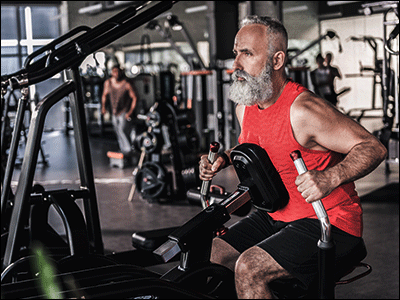
Senior performing compound row exercise

Exercise and balance skills practice are distinct activities that need to be performed separately. Do not make the common mistake of trying to combine the two by either adding balance challenges to your workouts or strength and conditioning challenges to your balance practice sessions.

Exercise is for stimulating improvements in the general factors of functional ability and is made less effective by adding a balance challenge. Choose exercises and equipment that challenge your strength not your balance.

Balance skills are specific and should be practiced the way they are normally performed or the improvements will not transfer. Practice balancing in the positions and during the activities which are difficult for you, but do not add weight to these or alter them to make them more challenging (avoid wobble boards, Bosu balls, and the like).

Choose exercises that do not require you to stand unless they can be performed while holding something for balance or under the close supervision of someone capable of assisting you if necessary. When possible perform exercises on machines which can be used while seated and which can be easily and safely entered and exited (avoid machines which require you to either climb or get down on the ground to use).

To reduce the difficulty of moving between other exercises perform your hip and leg exercises last in your workout. When you finish a leg exercise be cautious. Don’t trust your legs right away, and make sure you are able to stand before you attempt to walk. Don’t attempt to walk if you feel wobbly after any exercise; wait for your legs to recover or get assistance.

For more on strength training for seniors read:

High Intensity Training for Seniors

You Are Never Too Old For Exercise

2017 HIT Holiday Gift Guide

Are you having difficulty finding the right holiday gifts for your favorite HIT’ers or your own holiday wish list? Here are some gift ideas based on my recommendations over the past year to family, friends, and clients.

This is a work in progress, and more items will be added over the next few days. All prices were accurate at the time this guide was posted but may change.

Gifts under $25

I don’t recommend using straps, hooks, or other grip aids unless absolutely necessary, and if they are necessary then strengthening your grip should be a high priority (assuming the problem is muscular weakness and not an injury or neurological problem) However, if you do need straps the IronMind Sew-Easy Lifting Straps ($18.95) are quick and easy to use and do the job well.

An adjustable 2″ Web Belt with a Side Release Buckle ($9.00) is a highly versatile piece of equipment. It can be used for many timed static contraction exercises including neck flexion and extension and shoulder and hip abduction. It can be used to limit weight stack or movement arm travel on some machines to perform TSC. It can also be used in place of a seat belt on some machines that should have them but do not.

The Forearm Forklift moving straps ($19.99 to $24.99) are also great for a wide variety of timed static contraction exercises including TSC belt squats, deadlifts, chest and shoulder presses, rows, pulldowns and more. The multiple, padded loops can be used for gripping, looped around the wrists, arms, or ankles, securing the strap under the feet, or for restraining the movement of free weights and some machines for TSC/SH hybrid protocols.

Gifts under $50

The Ivanko Super Gripper ($32.50) is hands down (pun intended) my favorite gripper. It provides over fifty levels of resistance from about 45 up to 345 pounds and the tension feels more consistent than with torsion spring grippers like the Captains of Crush.

Olympic Fractional Weight Plates ($36.95) are essential for precise resistance progression when training with barbells. Every gym should have these, and if yours doesn’t you should have your own set to bring with you to work out.

Fat  Gripz ($39.00) increase the diameter of regular barbells and dumbbell grips to challenge your grip. They can also be used to reduce hand discomfort on many pushing exercises. I recommend using a thick bar or Fat Gripz for wrist curls and wrist extensions because it reduces the degree of finger flexion required to grip the bar. This prevents active insufficiency of the wrist and finger flexors during curls and passive insufficiency during extensions.

Plate Mates 1-1/4 Pound Magnetic Hex Weights ($34.95 per pair) allow you to increase the weight of uncoated metal dumbbells by 1-1/4 (offset) to 2-1/2  pounds at a time for more precise resistance progression. Buy two pairs so you can use them on two dumbbells at a time.

Gifts under $100

When properly performed weighted chin-ups and dips are two of the best upper body muscle builders, and while it is possible to make these exercises more challenging by manipulating leverage and timing, it is simpler and more straight forward to add weight using a dipping belt. The IronMind Dipping Belt ($76.95) is more comfortable than most with a heavy weight, and the nylon strap doesn’t dig into your thighs like chains do. It is even more efficient when used with a Loading Pin and Carabiner ($61.95) instead of looping the strap through plates.

Gifts under $500

I’ve been using the Bowflex SelectTech 552 Adjustable Dumbbells ($259.00 per pair) and the SelectTech 1090 Adjustable Dumbbells ($269.99 single) for several years now and highly recommend them for home training due to their space efficiency, fast and easy adjustability, and small progression increments.

If you get them I also recommend one of the newly redesigned SelectTech Dumbbell Stands ($169.00) which hold both the 552s and 1090s at a convenient height.

Drew Baye’s High Intensity Training is a participant in the Amazon Services LLC Associates Program, an affiliate advertising program designed to provide a means for us to earn fees by linking to Amazon.com and affiliated sites.

Q&A: Should You Perform Isometrics in Multiple Positions or One?

Question: In the comments on my previous Q&A on training to momentary muscular failure on timed static contractions, someone asked what I thought about performing isometrics in several different points in the range of motion (ROM) of an exercise. His reason for asking is that some studies, including research performed by MedX, have shown strength gains from isometric exercise to be specific to the position trained for most people.

Answer: If your goal is to improve your general muscular strength and size you do not need to perform isometrics in more than one position. While some studies on isometrics suggest strength gains are position specific the effect appears to be due to neural adaptations rather than to changes in the muscle that would affect general strength or appearance, and other studies show strength gains are not specific to the position trained.

If your goal is to lift more weight in a specific exercise for competition there may be benefit to taking advantage of the neural effect and alternating between performing the exercise dynamically and performing it isometrically at the weakest position or “sticking point”. This is not going to transfer to greater improvements in strength in similar joint angles in different movements, however.

Bicep curl in the gym

If general strength gains were specific to the positions trained isometrically during exercise  (as opposed to exercise specific neural adaptations) it would mean a person’s strength curves would change over time to match the resistance curves of the exercises they perform. If this happened the sticking points in those exercises would eventually be eliminated, but this doesn’t happen; no matter how long you perform the barbell squat or bench press in your workouts the bottom of the ROM of those exercises will always be more difficult than the top.

It would also mean someone who only performs an exercise isometrically for a long time may become weaker in other portions of the ROM and have difficulty in them if they attempt the exercise dynamically. However, this does not happen either. I have trained many people using TSC protocol on the RenEx isometric machines which measured and displayed their force input. On occasion I would have people perform some of their exercises dynamically instead of using TSC, increasing their weight for the dynamic exercise proportional to their isometric strength increases. Contrary to what would be expected if the strength gains were specific to the position trained during TSC, their strength curves did not appear to be effected.

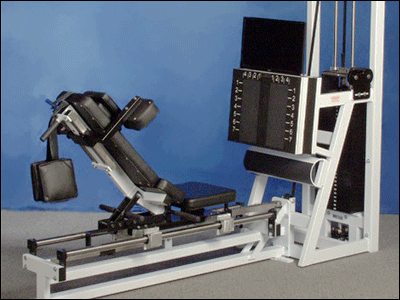
RenEx Leg Press

For most exercises I recommend performing isometrics at or near the mid-range position (in the middle third of your range of motion). Avoid performing any kind of isometrics at or near the end point of compound pushing movements and avoid performing static holds in positions where the targeted muscles are stretched.

References:

  1. Graves, J., Pollock, M., Jones, A., Colvin, A., & Leggett, S. (1989). Specificity of limited range of motion variable resistance training. Medicine And Science In Sports And Exercise, 21(1), 84-89.
  2. Knapik JA. Mawdsley RH. Ramos MU: Angular Specificity and Test Mode Specificity of Isometric and lsokinetic Strength Training. Journal Of Orthopaedic & Sports Physical Therapy 5:58-65.1983
  3. Kitai, T., & Sale, D. (1989). Specificity of joint angle in isometric training. European Journal Of Applied Physiology And Occupational Physiology, 58(7), 744-748. doi:10.1007/bf00637386
  4. Jackson, A. (1985). Strength Development: Using Functional Isometrics in an Isotonic Strength Training Program. Research Quarterly For Exercise And Sport, 56(3), 234-37.

Q&A: Training to Failure on Timed Static Contractions

Question: How do I know if I am training hard enough to reach momentary muscular failure (MMF) when doing a timed static contraction (TSC)?

I often begin to shake when performing TSC. Does that mean I’m at momentary muscle failure?

I bought your book Timed Static Contraction Training: A Guide to Minimalist High Intensity Isometrics and I´ve been training using that as guide.

Answer: MMF occurs when you are unable to continue performing an exercise in the prescribed manner. This is the point when you are unable to continue lifting in strict form when performing dynamic exercises, and the point when you are unable to prevent the weight from lowering during static holds. The main reason working to MMF is recommended during these kinds of exercises is because it guarantees you have worked the target muscles as intensely as possible (as hard as possible relative to their momentary ability).

MMF doesn’t happen when performing TSC because you’re contracting against an immobile or unyielding object for a predetermined amount of time instead of lifting or holding a weight until you can’t. TSC is typically performed in three phases of increasing effort, starting with a moderate or 50 percent effort, then increasing to hard or 75%, and finally maximum effort. When you contract as hard as you can during this last phase you accomplish the same thing you do when working to MMF during dynamic exercises and static holds.

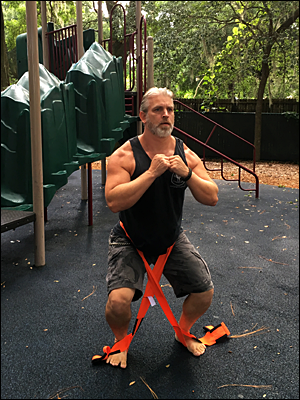
Timed Static Contraction Belt Squat


If your muscles shake during exercise it is because they are becoming deeply fatigued. Normally, your body recruits exactly the number of motor units (groups of muscle fibers sharing a motor neuron) needed to produce the desired amount of force for the movement you are performing. As some become fatigued others are recruited to take their place. Normally this happens pretty smoothly, but the more fatigued you become and the more and larger the motor units dropping out the more the force produced varies from the target and you start to shake.

The degree of shakiness relative to fatigue can vary a lot between individuals and even between muscle groups within individuals though, and is not a reliable indicator of how hard you’re working. I often shake after only one or two reps when performing upper body pushing exercises, but very little during other exercises. I’ve trained some people who shake from the start on certain exercises and others who don’t shake at all.

Don’t worry about either MMF or shaking during TSC. If you want the best possible results from TSC just commit to consistently giving everything you’ve got during the final, maximum-effort phase.