Why Do Slow Repetitions?

Yesterday someone in a Facebook exercise group posted a video of himself performing the leg press and asked for comments. Like most of the people who post exercise videos in that group his form needed work. He was was holding his breath, moving too fast, locking out, stopping to rest at the end point, bouncing at the bottom, allowing his pelvis to lift and tilt/spine to flex, and appeared to be gripping the handles hard and forcefully extending his neck against the seat pad.

Understanding of and standards for exercise form in this group aren’t very high, and a few people commented that his form looked “good” or even “perfect”. Normally I don’t reply to posts in the group. I only follow groups like this because reading the discussions and watching the videos is a good way to find popular myths and misconceptions to address in articles. However, he was an older trainee and if he continues to train like that or follows some of the other advice he was getting he is likely to injure himself, so I offered some advice anyway. Trying not to be too harsh I wrote,

“Good effort, but need to work on form. Slow way down. Smoothly reverse about ten degrees short of lockout without stopping to rest there. Don’t hold your breath. Reverse direction more smoothly at the start. Worry less about how much weight you lift and more about how well you lift it.”
Why Slow Repetitions?

Within seconds someone was disagreeing with me, claiming that slowing down during the negative would “hamper building up overload” and be harder to recover from. It was almost time for dinner and I didn’t feel like explaining and told him so, but he said he was interested in learning so I wrote the following brief explanation. I’m sharing it here (with minor editing for grammar and readability) in case others find it helpful:

“Cool. First, it’s important to understand where I coming from. When I train people I have three rules:

The first is to make sure their program is based on their body, goals, and circumstances and not cookie-cutter. The general principles are the same for everyone but the best application varies between individuals based on these.

The second is not to hurt anyone. If there are different equally effective ways to accomplish the same goal always choose the one with the lowest risk of acute or overuse injuries.

Third is don’t waste their time. If there are different equally safe and effective ways to achieve the same goal, choose the most time efficient.

Consider that mechanical work and power during exercise isn’t very important. It’s not how much work you do that matters, or even the absolute force produced in most cases, but the relative effort.

Tension and metabolic stress matter. How many times the weight goes up and down doesn’t. You can hold a weight motionless, or move it up and down really fast, or something in between and stimulate comparable improvements in muscular strength and size over time, but moving more slowly allows you to reduce acceleration during the turnarounds avoiding potentially harmful increases in force and allowing better control over the movement. If you are training hard you can get decent results with a variety of speeds, but slower is generally safer.

Avoiding lockout increases the difficulty of the exercise so less weight is required to produce the same level of fatigue in the same time frame. Imagine performing squats in only the bottom half of the ROM with no bounce at the bottom, no rest at the top. It makes it much harder so the weight has to be reduced, meaning just as effective but less compression on the spine.

Contrary to what many believe, you don’t need to move fast during exercise to recruit the fast twitch motor units. Recruitment depends upon force requirements and fatigue, and even with moderate loads eventually all of the motor units – even the fast twitch ones – will be recruited even at slower speeds, even with isometrics which is as slow as you can get.

Power production in other movements improves as muscular strength increases regardless of the speed the strength is built at. Specific skill training for a particular athletic or vocational movement is a separate thing, and that is where movement specific speed is important. Since there is no general physical advantage to moving more quickly, and since moving slowly reduces the risk of injury, I have people move more slowly.

In a much, much broader sense, any reasonable strength training program – anything done hard, progressively, and consistently with a volume and frequency appropriate to the individual, will eventually get someone as strong and well conditioned as they are capable of. Lots of things work. However, not all of them are as efficient or safe.

Over a long enough period of time if you compare the potential results of different training methods the difference becomes zero since it is ultimately dictated by individual genetics. In the long run, as long as the programming is suitable for the individual and the volume and frequency don’t exceed what they can recover from and adapt to, they all work. However, the longer you do one program versus another, the larger the differences in time investment and risk become. What might be a small difference in weekly time invested, wear on the joints, and risk of injury becomes cumulatively larger as months and years pass. So, in the long run although there is no significant difference in potential results the difference in time invested and risk continues to grow.

Going slower doesn’t just make exercise safer though, it can also make it much harder thus more effective, especially if you move more slowly in those portions of the ROM that are more difficult that most people tend to rush through. Keep in mind the goal during exercise is not to do something to the weights with your muscles, it is to do something to your muscles with the weights. How much you lift, how many times, etc. doesn’t matter. How efficiently you create tension and fatigue in the target muscles matters.

Consider those guys at the gym who only do quarter squats or leg presses because they are focused on weight while ignoring resistance (weight x lever, mostly). It’s the same thing taken much further. Going the opposite direction, if you want to make the exercise as difficult as possible you should avoid positions in an exercise where there is little or no meaningful resistance, not spend much time where there is only moderate resistance, and take your time where there is a lot, because the goal isn’t to make the weight go up and down, it is to use the weight to challenge the muscles you’re working as much as possible, as safely as possible.

Pete Sisco leg presses a car two inches and claims he's working harder than someone squatting hundreds of pounds over a full ROM, demonstrating his ignorance of physics

One of the most important things to understand about this, and one that almost everybody gets wrong, is that it is about resistance, not weight. Too many people are too concerned with how much they can lift rather than how well they lift, how efficiently they create resistance against the target muscles with a given weight. Unless you are a competitive lifter, and even then it only matters for the competitive lifts, your goal during an exercise isn’t to lift as much weight as possible, it is to create as much demand in the targeted muscles as possible.

This can be done more safely and efficiently with less weight when you move in a way that increases rather than decreases the average lever against the targeted muscles. Often, when a person’s form sucks it is because they’re focusing on how much weight they can move instead of how well they’re able to move it. Slowing down improves your ability to feel and focus on the tension in the target muscles and to be able to adjust your positioning and movement based on that feeling, to keep the tension high.”

I then ended with a quote from Fisher J, Steele J, Bruce-Low S, Smith D. Evidence Based Resistance Training Recommendations. Medicine Sportiva Med Sport 01/2011; 15:147-162 which you can read about in my Evidence-Based Resistance Training Recommendations posts,

“Comprehensive reviews of this area of research have reported that resistance training at shorter repetition durations produced no greater strength or power increases than training at longer repetition durations [18, 129]. The latter study also considered the application of Olympic lifting and plyometric exercises concluding that there is no evidence to suggest that these techniques can enhance strength and/or sporting performance (including vertical jump and sprint) to any greater degree than traditional weight training methods.Also,Bruce-Low and Smith[129] specifically considered the risk of injury from ballistic exercises, reporting some disturbing statistics suggesting that explosive lifting such as that involved in performing the Olympic lifts can cause injuries to the wrist, shoulder, elbow and lumbar region.”

This morning there were a few replies, and while the original poster thanked me for the feedback (and I hope he applies it – his knees, hips, and spine will thank him) the commenter was incredulous. After expressing several misinformed opinions about mechanical work and exercise, volume, frequency, etc. he asked,

“Are you seriously talking about 5/5 and 10/10 cadences on your blog or are you just using these humongous numbers as examples?”

When I told him I was serious, he dismissed me entirely, saying he wouldn’t touch the subject “with a ten foot pole”. Considering how people accept without question all sorts of utterly ridiculous things from the fitness and bodybuilding media it’s odd some are so skeptical about moving slowly during exercise. I wasn’t going to waste any more time on it so I told him if he wanted to learn more in the future I’m easy to find. In closing I wrote,

“Just keep in mind what I said about the long term; any method of strength training done hard, progressively, and consistently with appropriate volume and frequency for the individual will eventually produce the same general physical improvements, but in the long run they’re not equally safe and time efficient. I value my long term joint health and mobility and I value my time. Anyone who does owes it to themselves to at least “empty their cup” and learn about safer and more time efficient alternatives.”

Will the original poster take my advice and improve his form? I hope so. Will anyone else who reads my comments do the same? I hope so, but I’m not optimistic considering the overwhelming amount of contradictory and misinformed advice given by other members of the group. I’d like to be able to help everyone, but consider something I recently told a reader who was frustrated that someone ignored his advice against overtraining:

“Keep in mind almost everybody else is telling him the opposite, that more is better. It isn’t enough to tell someone they need to do less, you need to explain why. Even if you explain it effectively he may not change for various reasons. He might not believe you because of blind faith in the bodybuilding media. His ego might be too invested in what he’s doing. He may have other, non-physical reasons for wanting to exercise more frequently.

Maybe he will give it a try eventually when he accepts what he’s doing isn’t working. Maybe not. You definitely can’t help everyone, but don’t let the ones you can’t help discourage you from continuing to try to help others.”
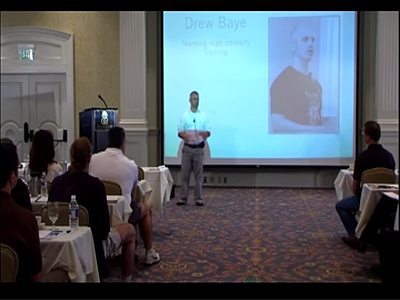
In 2011 I was invited to deliver the keynote presentation at the Indianapolis High Intensity Training Seminar hosted by Exercise Inc. The audience was almost entirely personal trainers and studio owners so decided it would be more helpful to talk about how to teach exercise than how to perform it. If you want to be a great trainer or coach it isn’t enough to be good at or know a lot about something, you also have to know how to effectively teach that to people with a variety of learning styles and speeds.


Got questions? Please post them in the comments below. Want me to speak at your event or conduct a workshop for your training staff? Email me at drew@baye.com

Post-Workout Rant: Stupid Exercise Videos

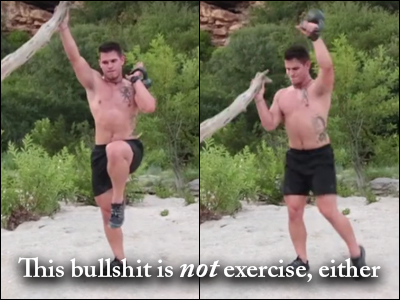
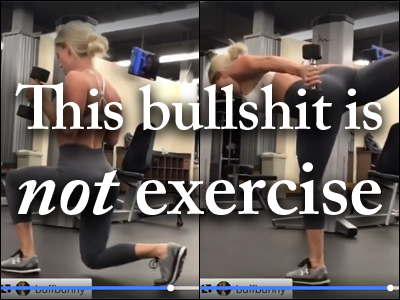
Every time I log on to social media I see videos of people performing all kinds of stupid “exercises” in what I can only assume is an attempt to appear innovative and differentiate themselves or simply for attention.

First, you can’t innovate if you don’t know what you’re doing to begin with. If these people actually understood exercise they wouldn’t be attempting to combine different exercises in ways that compromise their effectiveness and safety, wouldn’t be moving quickly, wouldn’t be on an unstable base, wouldn’t be attempting to mimic other activities with weights, etc.

The purpose of an exercise is to efficiently load the target muscles to create tension, fatigue, and microtrauma to stimulate improvements in strength and the other factors of functional ability, and a good exercise does this while minimizing the risk of overuse and acute injuries. If a movement does not provide relatively consistent, challenging resistance that is at least moderately well balanced to the strength curves of the targeted muscles, in a way that does not expose the involved tissues to potentially harmful levels of force, it is not a good exercise.

This bullshit is not exercise

Second, if you want to differentiate yourselves from the rest of the fitness industry you simply need to be competent. The vast majority of people in this field are not. Most of the people claiming to be experts don’t even really understand exercise or know what they’re doing beyond the most basic level.

You don’t have to invent and teach goofy shit. You don’t have to be the inventor or founder of something. You don’t have to have a gimmick. You just need to work hard to continuously improve your knowledge and understanding of exercise and your ability to effectively teach others about it and instruct them in performing it.

So called "functional patterns" is bullshit

Third, I don’t care if someone wants attention, but it pisses me off when people promote utterly stupid things as exercise for this purpose. The majority of people who see this nonsense don’t know any better and may decide to emulate it, wasting their time or risking injury. Feeding your ego is no justification for misleading people about something that can affect their long-term health. Besides, the few people out there who do know better just think you’re an idiot when they see this stuff.

Finally, if you record exercise videos with the camera pointed directly at your ass you are not a fitness educator, you are not a motivator, you are a bimbo.

Almost beyond stupid

This is not exercise instruction, it’s sexual signalling. You might as well stop pretending to be exercising and just stand in front of the camera moving your pelvis suggestively. You’d get just as much attention but you wouldn’t look like an idiot for trying to pass this nonsense off as exercise.


Why I Am Banned From Men’s Health’s FB Page

Proper exercise is one of the most beneficial things a person can do to improve their quality of life. Proper exercise will improve your ability to perform any physical activity and your enjoyment of it. Proper exercise will improve your health and longevity and can even reverse some of the effects of aging. Proper exercise will make you look better –especially in combination with a healthy diet – which can have many positive effects on social interaction and self esteem.

However, when exercise is not performed properly, when a program is poorly designed, includes poor exercises, and encourages a poor method of performing them it can be counterproductive for these goals. A poor exercise program can waste your time, cause overuse and acute injuries, and undermine your long term health and fitness and negatively affect your quality of life.

I’ve been teaching people how to exercise and instructing workouts for over twenty years now, and I am not exaggerating when I say I have seen people’s lives transformed and even saved by proper exercise. I have also seen a lot of people who have suffered because of misinformation, wasting years of their lives and sometimes absurd amounts of money on inefficient, ineffective nonsense that caused them more pain and frustration than results, nonsense that wreaked havoc on both their bodies and their self-esteem.

Exercise is about more than being able to stand out at the beach; it is about people’s physical and mental health and the quality of their lives. So, I get more than a little pissed off when I see outright bullshit being sold as exercise.

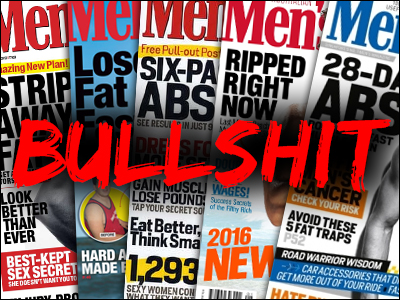
Men's Health is Bullshit

When I see fitness and bodybuilding publications like Men’s Health post bullshit on social media I call them on it. Of course, nobody likes being called out for promoting bullshit – especially when it threatens the interests of their advertisers – so they promptly banned me and I can no longer “react to” or comment on any of their posts.

What kind of bullshit? Promoting a variety of nonsensical and relatively ineffective and inefficient exercise programs with the promise they will help you lose fat, build muscle, and get six-pack abs or huge arms in a matter of weeks. These workouts will do no such thing and are actually far less effective than a proper exercise program, while requiring far more time in the gym, and are nowhere near as safe. The only thing most of them will do for your abs is overtrain them.

What is true then? Here are a few truths you won’t hear in Men’s Health and most mainstream fitness media because it doesn’t help sell bullshit programs and products:

No exercise program or diet produces results that are as fast as the magazines promise. It is not realistic for most people to expect to lose more than two pounds of fat per week on a consistent basis, or to gain anywhere near one pound of muscle per week beyond the beginner stage. You can not “get ripped abs” or “add two inches to your upper arms” in a matter of weeks.

No exercise program alone will get you ripped abs, and it is utterly stupid to perform 30 to 45 minutes of abdominal exercises when only one set of a one or two is all you need for most muscle groups. If you want to be lean you have to also follow a proper diet. I have been ripped and I have been fat and through it all my workouts never changed; just my diet. If you want to be lean you have to eat properly for the goal. There are no shortcuts.

There no “secret techniques” or “weird tricks” bodybuilders and fitness models are privy to that allow them to look the way they do – the majority of them just have very good genes for building muscle and losing fat and use drugs that make it even easier to do so in spite of training programs that are ineffective at best and would be counterproductive for genetically-average, drug-free trainees.

There is no easy way to build muscle or lose fat. Proper exercise is very hard and it is not fun or entertaining or sexy. It is called a workout because it is supposed to be work.

Why, then, do they promote the opposite? Because most people would rather buy a lie they want to believe than a truth they don’t, and publications like Men’s Health put money before people. I’ve got nothing against making money, but I believe the way to do that is to give people something of objective value, not telling them what they want to believe or promoting unrealistic fantasies as truth.

If you like exercise fantasy fiction you’ve come to the wrong place. If you like your exercise and nutrition information without all the bullshit, I’m glad to have you as a reader. Thanks to all of you long-time readers who have helped me get the word out about proper exercise over the past twenty-years since I started writing online, and welcome to all the new people.

To better understand where I’m coming from with all of this, please read My Philosophy of Exercise. If you want to learn more about proper exercise there are currently almost three hundred articles here, several books currently available, and a few more coming soon in the book store.

Q&A Muscle Fatigue, Inroad, and Intensity

Question: Is there a difference between inroad and fatigue? Some HIT trainers seem to use them interchangeably. What does inroad have to do with exercise intensity?

Answer: Fatigue and inroad are related concepts, but not the same thing. Fatigue is the reduction a muscle’s ability to produce force. Inroad is a measure of fatigue, usually expressed as the percent difference between your starting and momentary strength.  For example, if your strength at the start of an exercise is one hundred units of force and fatigue reduces it to eighty units of force your inroad would be twenty percent.

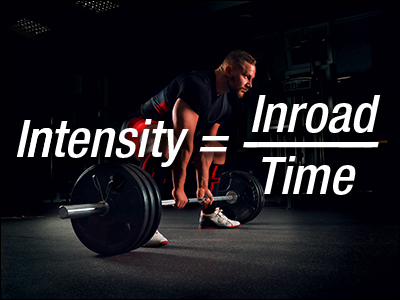
Inroad is also a measure of the average intensity of an exercise when compared with total exercise time. The higher your intensity of effort during an exercise, the greater your rate of inroad will be. You have to work harder to achieve an inroad of twenty percent within sixty seconds than an inroad of only ten percent, or to achieve an inroad of twenty percent within sixty seconds than within ninety seconds.

Intensity = Inroad / Time

For example, the deadlift is much harder when performed continuously, without setting the weight down between repetitions. When done this way momentary muscular failure will be achieved more quickly than if you rest between repetitions (and some studies suggest this will stimulate greater increases in strength and size).  In either case, if the exercise is performed to failure you will have reached maximum intensity, but if you get there faster your average intensity during the exercise was higher.

You could compare the difference in the average intensity between the two approaches by comparing the time to failure using the same approximate percentage of your one repetition maximum (for the sake of example we will ignore all of the practical problems with doing this accurately). For example, if you achieve a twenty percent inroad within forty seconds your average intensity would be twice as high as if you achieved the same inroad in eighty seconds (.5 percent inroad per second versus .25 percent). This would only be true for a single individual though; because different people with different percentages of slow, intermediate, and fast twitch muscle fiber types fatigue at different rates with the same percentage of 1RM.

Inroad is not directly proportional to exercise effectiveness, however. While some fatigue is necessary too much fatigue can be counterproductive and achieving momentary muscular failure appears to be far more important if your goal is to build bigger, stronger muscles. Studies comparing the effects of training with lighter loads and higher repetitions (higher inroad) with heavier loads and lower repetitions (lower inroad) have shown no significant differences in muscular strength and size increases, on average. If there was a direct relationship between inroad and growth stimulation we would expect to see greater increases in muscular strength and size with lighter weights and longer sets, but this is not what happens.

Instead, there appears to be a broad range of inroad that is effective, however like most things what is optimal would vary between individuals and having either too little or too much for an individual will compromise results. This is why people who have a fast fatigue response/higher percentage of fast twitch fibers tend not to respond as well to longer set durations and people who have a slow fatigue response/higher percentage of slow twitch fibers tend not to respond as well to shorter set durations.


References:

Gie?sing J, Fisher J, Steele J, Rothe F, Raubold K, Eichmann B. The effects of low-volume resistance training with and without advanced techniques in trained subjects. J Sports Med Phys Fitness. 2016;56(3):249-58.

Morton RW, Oikawa SY, Wavell CG, et al. Neither load nor systemic hormones determine resistance training-mediated hypertrophy or strength gains in resistance-trained young men. J Appl Physiol. 2016;121(1):129-38.

Choosing How To Exercise

One of the biggest problems with many arguments about how people should exercise is a focus on short-term rather than long-term results and on the effects of a single variable while often ignoring many others affected by it. When comparing different exercise methods it is important to consider all of the following:

  1. Being strong, fit, and healthy should be a lifelong pursuit.
  2. Any method of exercise can be effective if it is done hard, progressively, and consistently with a reasonable volume and frequency for the individual.
  3. Not all exercise methods are as efficient, safe, practical, or easy for everyone to adhere to.

Over time the difference in the results that can be produced by different exercise methods gets increasingly smaller, becoming insignificant after a few years. However, the differences in the total time invested, the wear on your body, the risk of injury, and difficulty of adherence continue to get larger over time. While there is a lot of variability in individual goals and how they can effectively train for them (including non-physical exercise goals like stress management), the time factor, risk potential, and adherence should always be considered when designing exercise programs. What do you want out of exercise, and what are you willing to do in exchange for it?

If two or more methods produce the same results over time but vary in the risk of acute and overuse injuries, choose the safer one.

If two or more methods produce the same results over time and are equally safe but vary in the volume and frequenty required, choose the more time efficient one (unless you value spending time in the gym as much as or more than the physical benefits of exercise).

If two or more methods produce the same results over time and are equally safe and efficient but vary in practicality or ease of adherence, choose the one you will be more likely to adhere to for the long run.

Quick and Easy Two-Ingredient Protein Drink

My brother David recently suggested a recipe for a quick, easy protein drink that has more protein and tastes better but only costs about half as much as many store-bought protein drinks (around $2 per serving). It contains only two ingredients which you can find in most grocery stores (Walmart currently carries both):

  1. One cup of Fairlife chocolate reduced-fat milk
  2. One cup of All Whites 100% liquid egg whites.

The Fairlife chocolate milk has more protein per cup than average but only thirteen grams of carbohydrates and tastes great. The liquid egg white is heat pasteurized and safe to drink, and has no noticeable texture or flavor when mixed with the chocolate milk. You don’t need a blender or a special mixing bottle either; just stir with a spoon and it’s ready to drink.

Homemade Muscle Milk

I usually don’t even bother to stir it; I just pour them both into a glass and they mix together just fine. For about two bucks and less than a minute of prep time (get a glass, pour the stuff in, you’re done) you get a little over thirty nine grams of protein, but only around two hundred and fifty calories, thirteen grams of carbohydrate, and less than five grams of fat.

It’s a great pre or post workout drink and a substitute for when you either don’t have time or don’t feel like making a regular meal. It’s also a good way to get a child to consume more protein if they’re a picky eater (or if you just suck at cooking meat).

If you’ve got a favorite quick and easy high-protein drink or snack recipe please share it in the comments below!

SOTT Radio Health & Wellness Interviews Drew Baye

I just finished an hour and forty-minute interview on the SOTT Radio Health & Wellness Show. We covered a lot of topics, including:
  • Why proper exercise is a requirement for living the longest, happiest life possible
  • Why you have a responsibility to yourself and others to be as fit as possible
  • What exercise is and what it is not, and why understanding the difference is crucial
  • Why high intensity training is a set of principles and not a specific program
  • Why it is almost always a mistake to copy the programs of elite athletes and bodybuilders
  • Starting points for beginners and how to apply HIT principles when individualizing a program
  • Warming up before and stretching after workouts
  • Repetition cadence/repetition speed
  • Proper mindset during exercise and working through the burn
  • General guidelines for exercise performance
  • Load versus resistance and the effectiveness of bodyweight exercises

Click the link below to listen, and please let me know if you have questions about any of the topics discussed:

If you enjoy the interview please comment on their page and let them know!

Why You’re Not Gaining Muscle

A lot of people who ask me for help with their workouts are frustrated because they’re not getting as strong or muscular as quickly as they want. While some of people just have unrealistic expectations (contrary to the hyperbolic claims of the muscle mags you can’t gain twenty pounds of new muscle in a month), a lot of people simply aren’t gaining muscle because they’re not following a few basic but important guidelines.

Train as intensely as possible

Your results from exercise will be proportional to the effort you put into it. Everybody thinks they’re training intensely, but over the past twenty years I’ve had a lot of people come to Orlando to have me put them through a workout and every single person has told me they’ve never worked so hard before. Most of them thought they were already training hard, too, but were doing all sorts of things during exercises that reduced their effectiveness and stopped before they reached momentary muscle failure. However hard you may think you’re training, always believe you are capable of contracting harder and try to do so. Don’t stop when the exercise starts to feel too hard, stop when you couldn’t get another rep (in proper form) if your life depended on it.

Don’t Overtrain or Undertrain 

The more intensely you exercise the less exercise you should do to avoid overtraining. For most people this means limiting their workouts to one set of one or two basic exercises for each major muscle groups and a few exercises covering smaller muscle groups, done two or three times a week on non-consecutive days. Some people may need more rest days in between. A few people may even need to limit their workouts to just a handful of exercises once a week, but not most.

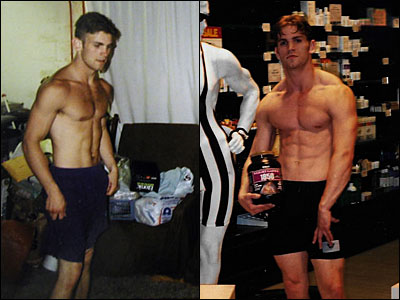
Drew Baye before and after gaining 30 pounds with HIT

Drew Baye, before and after following these basic guidelines

Ultra-brief, once-weekly workouts can be a time-efficient and effective way to train for general strength and fitness if you’re really pressed for time, but if your goal is to gain as much muscular strength and size as quickly as possible you want to stimulate as much muscle to grow as often as your recovery ability allows. When in doubt you’re better off erring on the conservative side with your workout volume and frequency, but don’t cut back so much that you are barely working each muscle group a few times a month.

If you suspect you may be overtraining consider whether you are failing to eat and rest properly to support recovery and adaptation before cutting back your workout volume and frequency (for more on this read High Intensity Workouts.)

Eat Enough Protein and Calories

No matter how effectively you train, if you don’t give your body enough protein and calories you aren’t going to recover and grow. Some people have claimed you don’t need a lot of protein because a muscle only contains about one hundred grams, which is not a lot. However, this ignores the huge cost of protein required just to repair all of the microtrauma occurring in your muscles during a workout before any size increases are produced. Some people’s bodies do this more efficiently than others, but most people who strength train require close to a gram of protein per pound of lean body mass per day to meet the increased demands for recovery and growth. When in doubt you’re better off getting more protein than you need than not enough (Bandegan A, Courtney-martin G, Rafii M, Pencharz PB, Lemon PW. Indicator Amino Acid-Derived Estimate of Dietary Protein Requirement for Male Bodybuilders on a Nontraining Day Is Several-Fold Greater than the Current Recommended Dietary Allowance. J Nutr. 2017;147(5):850-857.)

All this repair and growth requires extra calories, too. Depending on how hard you are training, how much muscle you’re working during each workout, and how fast you are capable of building muscle you may need several hundred calories above maintenance per day. Your body can get some of that energy from your fat stores if you’ve got a bit to spare, but if you’re already moderately lean you’ll need to eat more if you want to gain muscle. While eating more sounds easy to most people, part of the reason some people have difficulty gaining muscle is they just don’t have much of an appetite. Keep track of your food intake, your measurements, and your body composition, and gradually increase your calorie intake until you are steadily gaining muscle but not too much fat.

Get Enough Quality Sleep

Sleep deprivation makes it difficult for people to both build muscle and lose fat, and unfortunately this is a problem for a lot of people. If you’re not getting enough sleep you will have increases in cortisol and decreases in testosterone and growth hormone, making it more difficult for your body to recover from your workouts and build muscle. Even if you’re doing everything else right getting too little sleep can slow your progress down, and if you’re chronically sleep deprived it can grind it to a halt. If getting bigger and stronger is important to you then you need to make a commitment to getting to bed early enough to get seven to eight hours of sleep per night. If you don’t want to do this, or if you can’t due to odd work hours, the birth of a child, or other factors, then try to take one or two long naps later in the day if possible.

In conclusion…

Before you start worrying about details like the specific exercises you’re doing for each muscle group, repetition methods and advanced training techniques, or whether you need a particular bodybuilding supplement (the answer is probably “no” for the majority of them), as yourself if you’re consistently applying the above. Train intensely, do enough exercise often enough to keep stimulating your body to get bigger and stronger but not so much you overtrain, eat enough calories and protein to support recovery and growth, and get plenty of sleep. Do these consistently and you will continue to get bigger and stronger until you’ve reached the limits of your potential.

The Varying Ratio of Positive to Negative Strength

A few years ago I wrote an article titled The Ratio Of Positive To Negative Strength And Implications For Training in which I explained that rather than a fixed ratio the difference between positive and negative strength varies with different concentric contraction velocities due to the force-velocity curve. Although your negative strength does not vary at different contraction velocities, your positive strength varies inversely to contraction velocity, so the ratio changes if you lift a weight more quickly or slowly. The ratio also changes as a muscle fatigues, with negative strength decreasing more slowly than positive strength, probably due to eccentric contractions being more metabolically efficient.

This has been known since the 1950’s and it’s implications for the ratio of positive to negative strength should be obvious, but for a long time many people have believed there is a specific ratio of positive to negative strength. The most popular being the claim by Nautilus inventor Arthur Jones that negative strength is approximately forty percent higher than positive strength. Recently, exercise physiologist and HIT instructor Ryan Hall made an interesting discovery about how Arthur Jones came up with these numbers. He wrote,

Drew,

I have been working on updating my “Exercise and Genetic Variability” presentation, and correlating genes with some of the testing Jones performed on the pre-MedX Nautilus servo-powered isokinetic devices. Some of the information I ran across while perusing the earlier research reminded me of this conversation [referring to the discussion quoted in The Ratio Of Positive To Negative Strength And Implications For Training – DB].

Much of the testing that Jones observed concerning the ratio between concentric, isometric, and eccentric strength was performed on the pre-MedX isokinetic machines. I had to look closely and study each graph, which revealed something to me. Almost all of the testing was performed using a leg extension machine, which was set to 110 degrees ROM, with the speed of movement set to 25 degrees per second, for both the concentric and eccentric phases of the movement. Each repetition would be completed in a little over 4 seconds for each phase (8 seconds for the entire rep). This time interval doesn’t include the turnarounds, which were totally unloaded due to the nature of a servo-powered motor. However, having the concentric phase standardized to a predetermined speed would account for Jones’ observation of a consistent ratio between the different phases in a fresh muscle.

Jones’ testing also demonstrated that this ratio doesn’t remain the same for a fatigued muscle, which is consistent with the research literature. I just thought you would find this interesting.

Ryan

The ratio of positive to negative strength varies

Jones also believed the difference in positive and negative strength were due to intramuscular friction, which we now know is wrong. In The Future of Exercise he wrote,

Everything in the known universe that has both mass and motion also has friction, and muscles are no exception. Whether it is an automobile, an airplane, a snake or a human muscle, friction acts the same way: inhibits positive function while enhancing negative function, thus reduces your positive strength while increasing your negative strength.

He reasoned that if negative strength is approximately forty percent greater than positive strength, muscular friction must reduce positive strength by twenty percent while increasing negative strength by the same amount, and isometric strength is exactly halfway between the two (During a phone conversation in the late 1990’s when I asked Jones why he thought the ratio of positive to negative strength changed with fatigue he said it might be because friction increased as the muscles became more ‘pumped’). In The Metabolic Cost of Negative Work he wrote,

While it is certainly true that an exerciser can lower more weight than he can lift, it does not necessarily follow that his muscles are actually stronger during negative work than they are during positive work.

The muscles may be stronger; but even if so, they are not as much stronger as they appear to be. The apparent gross difference in strength is, I think, primarily a result of friction… internal muscular friction.

While lifting a weight, the muscles must contract with sufficient force to move the imposed resistance… but they also have to overcome their own internal friction. Thus, doing positive work, friction is working against the muscles.

Whereas, during negative work, friction is working for the muscles instead of against them.

Jones was wrong about isometric strength levels also. Isometric strength is relatively constant like eccentric strength so while the ratio of isometric to negative strength would be relatively constant the ratio of positive to isometric strength would vary with lifting speed. Isometric strength would only be halfway between positive and negative strength at a specific, slow lifting speed.

It is important to understand these claims about the ratio of positive to negative strength because they have influenced resistance selection recommendations for various exercise protocols like negative-only, negative-accentuated, and isometric training, as well as exercise equipment designs. For example, the typical recommendations for negative-only training and static holds are to use loads forty and twenty percent heavier than you use for normal repetitions.  This would be too much if you normally lift very slowly or too little if you normally lift more quickly than the speed of movement used in Jones’ tests. A safer approach when starting to perform exercise protocols limited to negative and/or static contractions is to err conservatively and only increase the load by around five to ten percent. If it isn’t heavy enough you can always increase the load on subsequent workouts.