
“There is no greater impediment to the advancement of knowledge than the ambiguity of words.”
— Thomas Reid, Essays on the Intellectual Powers of Man (1785)
If you’ve you’ve been following discussions about eating for maintenance or recomp versus bulking on social media recently, you’ve probably noticed many of the debates are about the terminology rather than nutritional requirements. Many of the people arguing over concepts like maintenance calories, body recomposition, bulking, and cutting, use the same words to mean different things. As a result, they may appear to disagree when they’re actually describing the same phenomenon using different definitions.
Unfortunately, over the past few months, I’ve seen this happen repeatedly in discussions about maintenance calories and muscle growth. For us to have productive conversations about physiology, we first need a common language for describing changes in the body.
To help with that, I created the DBHIT Physique Change Matrix that classifies every physique change according to just two variables:
- Body weight (Increase, Stable, or Decrease)
- Body composition (Improve, Stable, or Worsen)
These two variables create nine distinct outcomes, each with a clearly defined name and description. The goal isn’t to invent new terminology for its own sake, but to establish a shared vocabulary so discussions can focus on physiology rather than semantics.
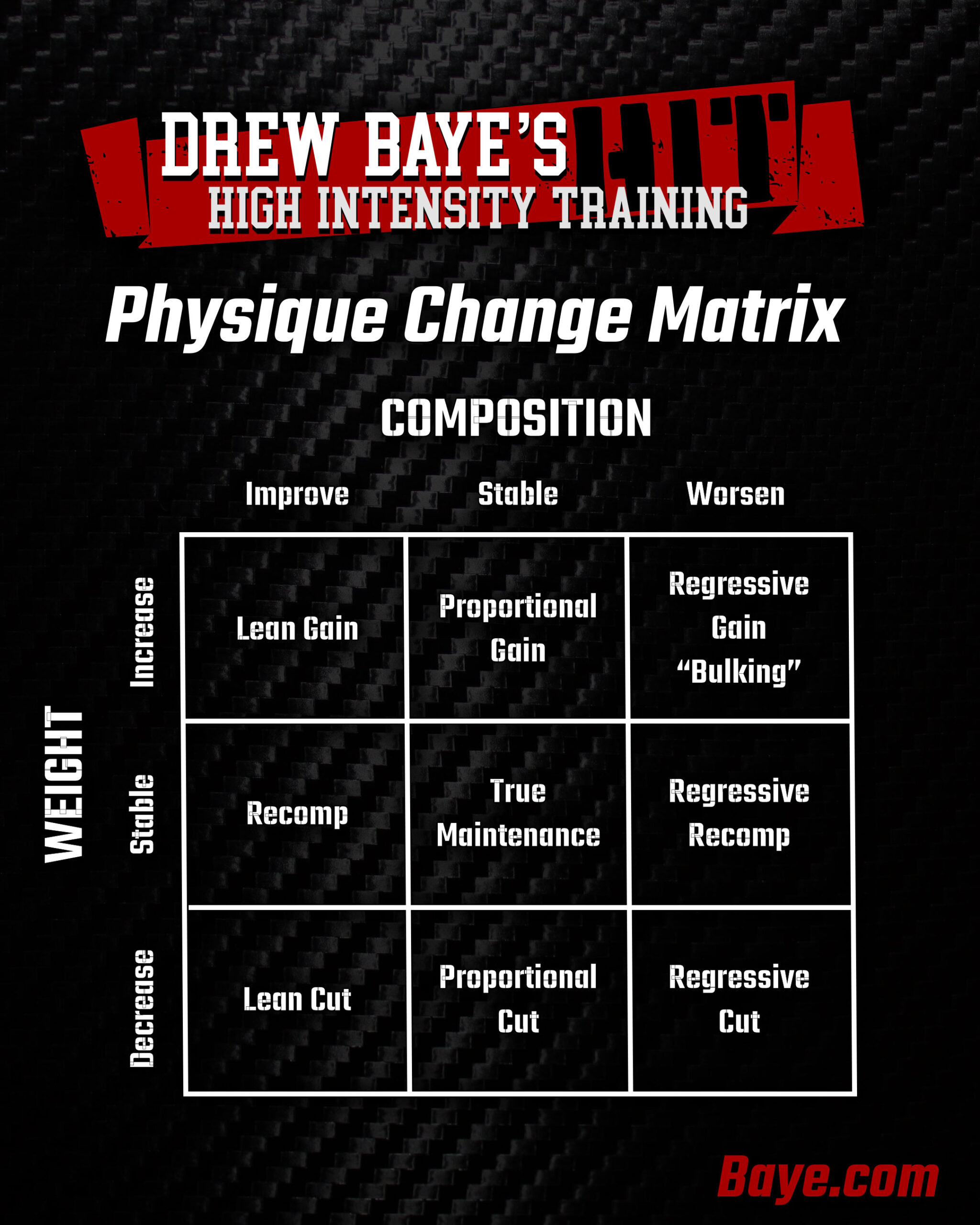 One distinction that is especially important is True Maintenance. In the matrix, True Maintenance is the only state in which both body weight and body composition are maintained. This distinguishes maintenance of the physique from the commonly used phrase maintenance calories, which is often interpreted differently by different people. By separating changes in body weight from changes in body composition, we can discuss physiology with much greater precision.
The matrix isn’t intended to settle debates about nutrition or exercise. Rather, it’s intended to provide a common framework for describing changes in body weight and body composition. If we’re all using the same definitions, we can spend less time arguing over terminology and more time discussing the evidence.
I don’t expect everyone to agree with every term I’ve chosen, and that’s fine. The important thing isn’t the specific words themselves, it’s that we use them consistently. If this framework helps people communicate more clearly and reduces unnecessary semantic disagreements, then it has accomplished what I designed it to do.
Terminology Reference
Improve Composition
Definition: A change resulting in an increased muscle-to-fat ratio.
Weight Increase = Lean Gain
- Body weight increases.
- Body composition improves.
- Muscle gain exceeds fat gain.
Weight Stable = Recomp
- Body weight remains relatively stable.
- Body composition improves.
- Fat loss is offset by muscle gain.
Weight Decrease = Lean Cut
- Body weight decreases.
- Body composition improves.
- Fat loss exceeds muscle loss.
Stable Composition
Definition: No meaningful change in the muscle-to-fat ratio.
Weight Increase = Proportional Gain
- Body weight increases.
- Muscle and fat increase proportionally.
- Body composition remains unchanged.
Weight Stable = True Maintenance
- Body weight remains relatively stable.
- Body composition remains relatively stable.
- The only state in which both body weight and body composition are maintained.
Weight Decrease = Proportional Cut
- Body weight decreases.
- Muscle and fat decrease proportionally.
- Body composition remains unchanged.
Worsen Composition
Definition: A change resulting in a decreased muscle-to-fat ratio.
Weight Increase = Regressive Gain (“Bulking”)
- Body weight increases.
- Body composition worsens.
- Fat gain exceeds muscle gain.
Weight Stable = Regressive Recomp
- Body weight remains relatively stable.
- Body composition worsens.
- Fat gain is offset by muscle loss.
Weight Decrease = Regressive Cut
- Body weight decreases.
- Body composition worsens.
- Muscle loss exceeds fat loss.
