Evidence-Based Resistance Training Recommendations: Part 1

The recent review by James Fisher, James Steele, Stewart Bruce-Low and Dave Smith should be on the “must read” list for everyone with an interest in exercise. In fact, you should download and read it before you read the rest of this post which is the first of several commentaries I will be writing on their review.

Fisher, James & Steele, James & Bruce-Low, Stewart & Smith, Dave. (2011). Evidence-Based Resistance Training Recommendations. Medicina Sportiva. 15. 147-162. 10.2478/v10036-011-0025-x.

Objective: There is considerable interest in attaining muscular hypertrophy in recreational gym-goers, bodybuilders, older adults, and persons suffering from immunodeficiency conditions. Multiple review articles have suggested guidelines for the most efficacious training methods to obtain muscular hypertrophy. Unfortunately these included articles that inferred hypertrophy markers such as hormonal measurements, used older techniques that might not be valid (e.g. circumference) and failed to appropriately consider the complexity of training variables.

Methods: The present commentary provides a narrative review of literature, summarising main areas of interest and providing evidence-based guidelines towards training for muscular hypertrophy.

Conclusions: Evidence supports that persons should train to the highest intensity of effort, thus recruiting as many motor units and muscle fibres as possible, self-selecting a load and repetition range, and performing single sets for each exercise. No specific resistance type appears more advantageous than another, and persons should consider the inclusion of concentric, eccentric and isometric actions within their training regime, at a repetition duration that maintains muscular tension. Between set/exercise rest intervals appear not to affect hypertrophy, and in addition the evidence suggests that training through a limited range of motion might stimulate similar results to full range of motion exercise.

The performance of concurrent endurance training appears not to negatively affect hypertrophy, and persons should be advised not to expect uniform muscle growth both along the belly of a muscle or for individual muscles within a group. Finally evidence suggests that short (~3 weeks) periods of detraining in trained persons does not incur significant muscular atrophy and might stimulate greater hypertrophy upon return to training.”

ACSM Position Papers and Responses and Anti-HIT Bias in the Field of Exercise

The authors correctly point out the guidelines in the 2002 and 2009 position papers on resistance training from the American College of Sports Medicine are not supported by the research in general and many of the statements were not supported by the references cited  for them. In addition to misinterpretation of the studies cited there were several relevant studies which were not considered, suggesting a selection bias.

Having read the position stands and the reviews and various responses to them by Otto, Carpinelli, Winett, and others, and much of the following discussion, the tradition-based, anti-HIT bias of much of the field is obvious. There are numerous reasons for this, but I suspect the two biggest are the influence of competitive weight lifting when athletes finally realized strength training was not going to make them muscle-bound and slow and were looking for guidance, and the industry backlash against Nautilus inventor Arthur Jones’ due to the perceived threat to competitors in the fitness equipment industry and to the egos of various “experts” in the field whose ignorance Arthur enjoyed pointing out.

In the earlier half of the last century athletes avoided strength training because they believed it would make them slow and inflexible, a condition referred to as being “muscle-bound”. This perception started to change in the 1950’s, and having previously avoided strength training most athletes and coaches had little or no knowledge of how to train and turned to the Olympic lifters, incorrectly assuming their expertise in competitive weight lifting would apply to the training of other athletes. This is where a lot of the misconceptions about lifting speed and explosiveness come from and the reason football players and other athletes are often told to perform power cleans and other quick lifts which are primarily skill based movements which have nothing to do with the skills of their sport and are relatively poor ways of building strength in the muscles involved.
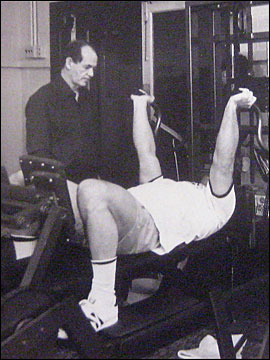
Arthur Jones training a subject on the "Happiness Machine"When Arthur Jones’ articles started appearing in Iron Man magazine in 1970 he was very critical of popular training methods, particularly the very high volume approach then popular with bodybuilders and the use of explosive lifts by athletes outside of competitive weight lifting, earning him the ire of many of the “experts” at the time. The vastly superior Nautilus machines also represented a huge threat to competitors, barbell manufacturers in particular, most of whom were advertisers in the bodybuilding and fitness magazines at that time. To appease his advertisers and to spite Arthur for not advertising in his magazines Joe Weider published a long series of articles in Muscle & Fitness attributed to various bodybuilders which attacked Jones and his Nautilus machines.

Jones had a tendency to insult and belittle those he disagreed with and nobody likes being told they’re wrong, much less called an “idiot”, especially when they are claiming to be or believe they are an expert on the subject. This certainly didn’t help matters, especially when both reputations and large sums of money were at stake. People associated the Nautilus Training Principles (later named “High Intensity Training” by Ellington Darden and eventually being abbreviated to “HIT”) with Arthur, even though the principles had been around and in practice long before Arthur started writing and talking about them. Due to both their personal dislike of Arthur and the challenges his training principles presented to their contradictory and unfounded beliefs about exercise these “experts” developed a strong bias against HIT.

Despite Arthur having been right about most things and the majority of exercise research over the past several decades reinforcing his recommendations, this anti-HIT bias is still going strong. This is particularly evident in organizations like the NSCA which bases many of its resistance training guidelines on the myths and misconceptions resulting from the early influence of competitive weight lifting on athletic training, and whose former president William Kraemer contributed to and I believe was to blame for much of the unsupported recommendations the ACSM’s 2002 position stand.

Intensity, Load and Repetition Range

Most in the field of exercise use the term “intensity” to refer to the percentage of one’s one repetition maximum load used during an exercise. Because of this, there is often a disconnect when discussing training intensity with people outside of the high intensity training community where the term is used to refer to the percentage of one’s maximum effort used during an exercise.  For the reasons stated in the review, the definition based on effort is the correct one, since percentages of one rep maximum loads can result in varying levels of difficulty for individuals with a different fatigue response.

This is one of the reasons I rarely perform one repetition maximum testing with clients to determine starting loads and discourage others from doing so without expert supervision. Different trainees will be able to perform widely different numbers of repetitions with a given percentage of their one rep max and the test itself is unreliable. A typical one repetition maximum test involves one or more light warm up sets, followed by a series of maximum attempts, starting with an individuals estimated one rep max, either based on previous test performance or on calculations or tables which give an average and are not appropriate for all individuals. Any one rep max test will involve at least two attempts. If the first attempt fails, the weight is reduced for the second. If it succeeds, the weight is increased. Even after several minutes rest there will still be a momentary reduction in strength due to microtrauma, resulting in a decrease in the strength available for subsequent tests.

The best case scenerior would be if you succeed on the first attempt and fail on the second with a slightly heavier weight, which gives you a rough idea of your max, but you still won’t know if you might have been capable of succeeding with the heavier weight if not for the first attempt.

There are additional problems with this when working with new trainees. Due to a lack of skill and familiarity with both the exercise and the ability to put forth a true, maximum effort, the one rep maximums of new trainees will understate their actual strength. If the test is being done to determine starting loads or in conjunction with a fatigue response test to determine rep range, the result may be a load that is too low or a rep range that is too high based on the individual’s actual strength and fatigue response. Loads should be lower and reps higher starting out for learning purposes, but not because the trainer or trainee is putting too much confidence in the results of one rep max testing.

In addition to the above problems with using one repetition maximum testing to measure strength (there are many more) there are problems with performing a muscular endurance test by performing a set to failure with some percentage of the estimated one rep max afterwards to determine an individual’s relative endurance or fatigue response. Like the one rep max test, both the trainee’s skill and their ability to push to a point of true muscular failure will limit the number of repetitions they perform. Additionally, the time between the one rep max test and the endurance test has an effect on performance. If the endurance test is done too soon after performance will suffer due to fatigue or a reduction in muscle force caused by microtrauma. If the endurance test is done too long after performance may be improved slightly as a result of adaptations stimulated during the one rep max efforts.

Another problem with using one rep max testing with beginners is when the above problems aren’t considered subsequent tests appear to show much greater strength gains than actually occurred. Most improvements in exercise performance during the first six to eight weeks of training are due to neural adaptations, improvements in skill and confidence, and acclimation to the discomfort associated with intense muscular work. Comparing one rep max tests performed at the start and after six to eight weeks of training will give you some impressive numbers, but it is misleading to claim these accurately represent increases in strength.

This is also a huge problem with exercise studies which rely on one rep max testing and are of too short a duration to rule out factors other than strength as major contributors to improved test performance. A bigger problem with this is neural adaptation and skill benefit from more frequent practice, so a higher number of sets or greater training frequency may result in improved test performance in shorter studies, resulting in misleading conclusions about the effects of different numbers of sets or frequency of training on strength. Due to these factors, during shorter studies with previously untrained subjects using skill based tests like one repetition maximums, the deck is stacked in favor of multiple sets and higher frequency. To accurately determine which is more effective for improving strength studies must be of long enough duration to rule out skill and neural adaptations as a significant factor in test performance. Ideally, pre-testing shouldn’t even be performed until after the first six to eight weeks and should be static to minimize the influence of skill and other factors associated with dynamic testing.

An Alternative to One Rep Max Testing

The goal for a new trainee or when starting a new exercise should be to learn and practice correct performance during the first few weeks while gradually working up to a high level of intensity, and the starting load and repetition range should be appropriate to that goal. One repetition maximum testing is not required to determine either. Start with a light load, test and increase until it feels only moderately challenging during the first few reps, and aim for 10 to 15 repetitions (approximately sixty to ninety seconds at a controlled pace).

After a reasonable level of proficiency has been gained, the repetition range can be reduced or increased based on the individual and their goals. While a wide range of loads and rep ranges will work, some people will have a preference for or respond better to higher or lower repetitions and goals must also be considered. If a person has a difficult time performing more than some lower number of repetitions but is able to handle increases in loads without their reps dropping too much, use that as their upper guide number. If a person has a hard time handling increases in resistance without first performing some higher number of reps, use that as their upper guide number.

Another problem with one rep max testing is it encourages the exact opposite mentality you want during exercise. The focus during exercise should not be on lifting as much weight as possible, which requires moving in a way that makes the exercise easier, but on using the weight to challenge the muscles as effectively as possible, which requires moving in a way that makes the exercise harder. The only people who should perform one repetition maximums are competitive lifters. There is no good reason for anyone else to do so.

A more accurate way to evaluate strength increases would be to compare the loads used for the prescribed repetition range over time, starting after the first two months of training. If, for example, during a workout three months ago you performed 10 repetitions of an exercise with 200 pounds and you recently performed 10 repetitions with 220 your strength increased by 10% during that time (assuming the same style of performance, equipment settings, etc.). If you are keeping accurate records of your workouts, or your clients’ workouts if you’re a trainer, you have all the data you need without having to perform inaccurate and unnecessarily risky one repetition maximum testing.

Part 2: Momentary Muscular Failure

The Real Objective of Exercise

How you perform each repetition of an exercise is far more important than how many repetitions you perform.”

I’ve probably said it thousands of times over the past two decades. Whenever a client seems more focused on how many repetitions they perform than how well they perform them I remind them of the real objective of exercise – not to make the barbell, weight stack or their body go up and down, but to effectively stimulate the body to produce improvements in fitness without causing injury or undermining long term health in the process.

Both of these goals require understanding and correctly performing various elements of form like body position, path, range and speed of motion, breathing, and even proper mental focus and mindset.

For example, there is far more to a barbell squat than putting a bar on your shoulders, squatting down, and standing back up;

  • The bar must be set to the correct height in the squat rack or power rack – at approximately the middle of your sternum – for you to be able to get into correct position under it and safely load it onto your shoulders and unrack it.  Too high and you may have to come up on your toes to get it out of the hooks, too low and energy is wasted unracking the bar.
  • The bar should rest on the trapezius above the spines of the scapulae, not on the back of the neck over the lower cervical vertebrae.
  • The hands should be positioned wide enough to be able to assist with balance but not so wide you don’t have plenty of clearance between the hands and the uprights of the rack, with an open grip for wrist comfort.
  • The elbows and scapulae should be pulled back, creating more of a “shelf” for the bar on the upper back.
  • The neck and back must held be in the proper position, head forward, chest high, and lower back flat or slightly extended.
  • After unracking the bar the feet must be positioned roughly shoulder width or slightly wider with the feet angled out in line with the thighs, so you are able to squat down between the thighs, rather than on top of them.
  • The starting negative should be performed in a very slow and controlled manner, with a gradual reduction in speed towards the bottom of the range of motion, where the tops of your thighs are roughly parallel to the floor.
  • Movement should gradually slow to a stop, pausing and briefly holding the body motionless without bouncing or allowing the hamstrings to rest on the calves or the heels to come off the floor.
  • Positive movement should start very slowly, and a constant, controlled speed maintained throughout the lift, before gradually slowing to a stop again ten to fifteen degrees shy of lockout.
  • Throughout the exercise your breathing should be as relaxed as possible (much easier said than done) and continuous (no breath-holding or val salva), your shoulders and trunk should remain tight, and you should focus on continuous, intense contraction of the hip and thigh muscles.

Almost every person I’ve seen squatting in gyms gets most or all of these wrong. They set the bar high up on the base of their neck instead of their scapulae. They slump their chest and round their back. They barely lower the weight half way, then bounce back up and lock their knees, rather than working over the full range of motion in a smooth and controlled manner. They make the weight go up and down, but they don’t accomplish the real goal of exercise.

Sadly, this is not limited to the barbell squat. Most people perform every exercise in a similarly inefficient manner, robbing themselves of much of the potential benefits of exercise while unnecessarily increasing their chances of injury. Part of the reason for this is they focus more on lifting the weight or completing the repetition than on using the weight to effectively work the target muscles.

The problem with this is when a person is more focused on lifting the weight they tend to move in a way that makes it easier to do, which is exactly the opposite of what you should be doing during an exercise. Instead, you should be using the weight in a way that makes the movement harder for the target muscles to provide an effective stimulus for improvement.

To get the greatest possible benefit from every repetition of every exercise you perform and maximize the safety and effectiveness of your workouts keep the real objective of exercise in mind:

How you perform each repetition of an exercise is far more important than how many repetitions you perform.”

The Ultimate Body Weight Exercise Station

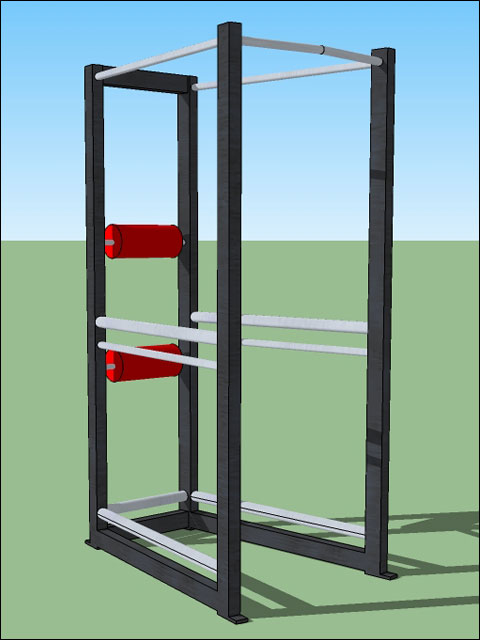
I recently completed the design for a multi exercise body weight station for my own training and am talking with an equipment manufacturer about fabricating now, and am wondering if there is enough interest to make it available commercially. The station is highly space efficient, easy to move and assemble, and will feature heavy duty, commercial grade construction and materials providing all of the following body weight exercises and many more:

  • Chin ups
  • Neutral grip pull ups
  • Parallel bar and bench-style dips
  • Inverted rows
  • Regular, incline and handstand push ups (with roller pad to aid balance)
  • Biceps close-grip rows
  • Triceps close-grip push ups
  • Wall squats or hack squats (with roller pad for back support)
  • Heel Raise
  • Roller pads also positioned to provide a leg rest to reduce weight lifted during dips and pull ups

The station features angled bars for a variety of grip widths and more comfortable hand and arm position and extra thick bars for hand comfort during the pushing movements (separate dipping and rowing bars at different diameters).

Two roller pads provide balance support during handstand push ups, wall squats and hack squats and a place to hold the legs to reduce resistance during dips and pull ups and can also be used for a variety of isometric movements and stretches. The base of the frame features attachment points for bands to add resistance to body weight exercises.

The station is designed for heavy duty, commercial-level use, but will easily fit and function in residential spaces with ceilings as low as 7’6″. We won’t know for sure until it’s built, but I estimate the weight will be around 250 pounds (heavy duty steel tubing, not that flimsy crap most home machines and bodyweight equipment is made of).

If you have questions or are interested in purchasing the station please let me know in the comments below and I will either answer questions here or contact you with more details. Once mine is built I will post photos, and I will provide a training video with exercise demonstrations with machine purchases.

Update 8/24/11:

Ultimate Body Weight Exercise StationI did a rough 3d model of the body weight station in Google Sketchup so people could get an idea what it will look like. The red cylinders on the back are the roller pads which provide support and assist with balance during handstand push ups and hack squats.

I did not draw the band attachment points on the 3d model, but they will be positioned along the insides of the lower frame and the underside of the top of the back frame.

Although it isn’t obvious from this veiw, the chinning bar in the front has a 15 degree bend at the center which provides a more optimal grip angle as well as better clearance for the head and chin during the exercise.

I should have an estimate of the cost for the station within a week, and as soon as the first one is built I’ll be posting video demonstrations of the exercises that can be performed on it.

Don’t Neglect Your Neck

I’m keeping the workouts pretty brief these days, doing sort of a “Big Three” plus a few exercises for the neck, grip, calves and abs. Reps are being performed in a modified, negative-emphasized style; a three second positive and six second negative with a brief pause at the top of pulling and simple movements, for between four and six repetitions or about forty to sixty seconds time under load. While the slower negatives were working very well, I wanted to increase the reps slightly while keeping the set duration short and compare results.

Yesterday’s workout was:

  1. Neck Extension
  2. Neck Flexion
  3. Chin Up
  4. Shoulder Press
  5. Deadlift
  6. Calf Raise

The total workout time including equipment set up was only twelve minutes. The previous workout, listed below, only took only nine minutes to complete; the time under load for each exercise was around sixty seconds and I rested less than a minute between the first four and not at all between the last three:

  1. Leg Press
  2. Chest Press
  3. Row
  4. Trunk Flexion
  5. Gripping (Right)
  6. Gripping (Left)

My total weekly workout time was less than twenty minutes. The time efficiency is improved significantly by the use of selectorized machines; it is much faster to switch pin positions on a weight stack or spring positions on the Ivanko Super Gripper than to load plates on a barbell or plate-loaded machine. Part of the reason yesterday’s workout was a few minutes longer was the time required to load plates on the Nautilus XPload deadlift. However, even when I performed similar workouts with mostly free weights I was able to keep the total workout time under twelve minutes by loading or changing plates between exercises and by using a more efficient plate-loading strategy. My total weekly training time then was still less than thirty minutes.

For example, in the workout where the standing press followed the barbell squat, I would load the bar with the weight for press first, then the additional plates required for the squat, so after the squat I only had to remove the additional plates rather than change any.

Bodyweight-only workouts could be done even more efficiently, since they require no set up beyond getting into the proper starting position.

Don’t let the brevity of these workouts fool you, though. When done correctly, the exercises are brutally hard and although the workouts are short the density of work performed is extremely high. The muscles are under a higher level of tension for a cumulative time under load comparable to typical bodybuilding workouts lasting over an hour.

It would be possible to cut the workouts down to just a “Big Three” – a hip and thigh movement, a push and a pull – and get similar results training less than ten minutes a week. The problem with this is although you can effectively train most of the major muscle groups with just a few movements, to hit some smaller but important muscle groups you need a few additional exercises. Of these, one of the most important but also the most often neglected are the muscles of the neck.

Building a bigger neck with high intensity trainingIn addition to protecting the cervical spine the muscles of the neck affect your appearance more than you might think. A thick, well developed neck gives you a powerful appearance, while a thin, undermuscled “pencil neck” can make you appear weak and frail. Your neck is also one of the few trainable body parts visible when fully clothed, so while a business suit might conceal most of the results of your disciplined eating and hard work in the gym, you can still impress with a well developed set of sternocleidomastoids.


Whether you’re more concerned with reducing your risk of injury or developing an overall well-balanced physique don’t neglect your neck.

It takes very few exercises to effectively work all the muscles of the neck. Almost all the muscles of the neck are effectively worked during extension and flexion, and alternating with or occasionally substituting either left and right rotation or lateral flexion will work the few those miss (obliquus capitus inferior and rectus capitis lateralis).

Since cleaning up my diet I’ve leaned down from over 200 pounds with a 34″ waist to my current 185 and 32″, but since incorporating the negative emphasized reps and a lower time under load my neck actually appears to have gotten larger. I’m no Joel Waldman, whose 22 and 1/4 inch neck appears in the chapter on neck training in High Intensity Workouts, but thanks to hard training I’m no pencil neck either.

If you don’t already include direct neck exercise in your workouts, start now. If you don’t have access to a properly designed neck machine like the ones made by Nautilus, MedX and Pendulum Strength Systems, manual resistance can be effective when done correctly and head harnesses can be used with either weights or a cable machine for extension, flexion and lateral flexion.

Also, if you’re not getting the results you want from your workout, rather than following the typical advice to do more exercise more often, do the opposite and train with fewer exercises, less often, but do them much harder. If you’re not sure where to begin check out the High Intensity Workouts ebook to get you started.

A Few Thoughts on Training Volume

The concept of training volume is important to understanding how to properly design and adapt a program to an individual based on their goals and their body’s response to exercise. Unfortunately, most have an overly simplistic view of this which can lead to misunderstanding and confusion, especially when comparing different protocols and training programs.

The number of exercises, sets and repetitions, or even mechanical work performed during a workout is only part of what constitutes the volume of work performed, and can only be used as a meaningful standard of comparison when all else is equal.

Mechanical versus metabolic work

Both the effectiveness of a workout and its effect on recovery have more to do with the metabolic stress it produces than the mechanical work, and the two are not directly related. During an isometric workout it is possible to have a tremendous amount of metabolic work with no mechanical work at all. If very different repetition speeds are performed it is possible to have similar metabolic demands with very different amounts of mechanical work. For example, whether you perform six repetitions at a 5/5 cadence or three repetitions at a 10/10 cadence your muscles are producing nearly the same amount of force for the same duration.

Repetitions versus time under load

The mechanical versus metabolic work is an important consideration when comparing high intensity training programs involving a single set to failure with multiple-set programs. The traditional Nautilus guidelines for set and repetition performance were to perform between eight and twelve repetitions of an exercise, lifting the weight in 2 and lowering in 4 seconds. This would average out to around 60 seconds per exercise, or longer when pausing briefly at the end point on simple and compound pulling movements. Some high intensity training protocols recommend even slower reps, like Mike Mentzer’s Heavy Duty training (4/4) and Ken Hutchins’ SuperSlow and the Renaissance Exercise protocol (10/10).

A typical bodybuilding workout consisting of three sets of ten repetitions of ten exercises would require performing three hundred repetitions. A Body by Science “Big Five” workout or the RenEx generic routine consisting of a single set of around five repetitions of five exercises would require performing only thirty reps. If you compared repetitions, the typical bodybuilding workout might appear to involve twelve times the work:

10 exercises x 3 sets x 10 repetitions = 300 repetitions

5 exercises x 1 set x 5 repetitions = 25 repetitions

However, if you multiply the total repetitions by the average repetition duration and compare the time under load of the workout, a different picture emerges. The “Big Five” or RenEx generic workout appears to involve a slightly higher volume of work:

300 repetitions x 1.5 seconds = 450 seconds (7:30)

25 repetitions x 20 seconds = 500 seconds (8:20)

Notes: The average repetition time for the typical bodybuilding workout is based on observing and timing sets performed by trainees in a local gym. The time under load recommended in Body by Science is 90 seconds, but the repetition cadence recommended is 10/10, which would result in an upper repetition guide of 4.5, which would result in an equal time under load in the second example, but the decimal would have seemed odd in the first.

Assuming the loads used are the same, time under load is a better measure of physiological demand than sets and reps. When looked at this way, it becomes apparent a lot of people performing high intensity training protocols calling for a higher time under load may be performing a much higher volume of work than they realize, and some “high volume” routines may not be.

Sets versus reps

The above leads to yet another problem with comparing sets and reps. Even if we assume equal repetition duration, does it make a difference if we do one set of twelve reps or two sets of six? What about four sets of three? What about a series of twelve singles?

Some HIT trainers prefer higher rep ranges, in some cases up to 20, or even 50 for leg exercises. How much different would this be in terms of the effect on the body than doing two sets of ten, or five?

While dividing the work up over one or more sets would allow for a heavier weight and higher tension to be used since the relatively shorter sets would involve less cumulative metabolic stress (although the fatigue from microtrauma and related factors may be higher) it probably wouldn’t increase the demands on recovery ability significantly.

While a single set program would be highly effective (and more practical and efficient) for the majority of people and goals, there may be situations where dividing the work between multiple sets while maintaining a similar total rep count or time under load would be preferred.

Intensity and density of work

Keeping all the above about total reps and time under tension in mind, there is a huge difference in the demand on the body between a single, continuous set of an exercise performed with an all out effort and several less intense sets of equal reps or duration. Also, three sets of an exercise performed with only a few seconds rest in between will be far more demanding than the same sets performed several minutes apart. It’s not just the number of reps and exercises, but the effort put into them and the pace of the workout.

Systemic effect versus number of exercises

Another problem with using exercises, sets and reps as a measure of exercise volume is regardless of the intensity of effort not all exercises place the same overall demands on the body. Both of the following workouts involve the same number of exercises, sets and reps:

Workout A:

  1. Squat: 1×20
  2. Chin Up: 1×10
  3. Parallel Bar Dip: 1×10
  4. Row: 1×10
  5. Standing Press: 1×10
  6. Stiff-Legged Deadlift: 1×15

Workout B:

  1. Calf Raise: 1×20
  2. Neck Extension: 1×10
  3. Neck Flexion: 1×10
  4. Wrist Curl: 1×10
  5. Wrist Extension: 1×10
  6. Gripping: 1×15

Despite the same number of exercises, sets and reps, workout A obviously places much greater physiological demands on the body than workout B. The amount of muscle mass being effectively worked during each of the exercises in workout A is much larger, and more muscle working means a greater metabolic stress and greater demand on the cardiovascular, nervous and endocrine systems, and a greater stress the body must recover from and more tissue to produce adaptations in.

With this in mind, as clients’ training intensity increases, rather than reduce the total number of exercises I usually substitute simple movements for compound ones focusing on areas that need it, gradually reducing the compound movements per workout to three – typically one multi-joint hip and thigh movement, one upper body push, and one upper body pull – while keeping the total number of exercises performed around the same.

What about training frequency?

A similar situation exists with frequency, although it starts to get a little more complicated because, contrary to the overly simplistic models often presented, recovery involves multiple systems and timelines, and efficiency and practicality are also important considerations. When debating full body versus split routines you have to consider systemic versus local recovery, how you would split a routine would be affected by the local recovery of individual muscles (which can vary due to fiber type and other factors), and other physical activities and demands affect all of those.

Like most things, the workout volume and frequency that works best for an individual will depend on many factors and a bit of trial and error along with accurate record keeping is required to fine tune your program. Try to look at the big picture and all it involves though, rather than focusing on just a few numbers.

2011 High Intensity Training Seminar DVD

High Intensity Training Seminar 2011 DVD

The presentations by me, Bill De Simone, Mark Sisson and Doug McGuff, MD at the 2011 Indianapolis High Intensity Training Seminar are now available on DVD at IndyHITSeminar.com

The full DVD set includes all four exercise and nutrition presentations from this year’s seminar:

Drew Baye: Teaching High Intensity Training

An extemporaneous discussion of key elements of teaching and instructing exercise and the difference between being an educator and a rep counter.

Bill DeSimone: Congruent Exercise: Biomechanics for Better Workouts

Biomechanical analysis of the structure and function of the spine and joints and the muscles acting on them and applications for exercise.

Mark Sisson: Ideal Eating Strategies

Strategies for eating for optimal health and fitness, with a focus on fat loss and tips for endurance athletes.

Doug McGuff, MD: The Synergy of High Intensity Training and The Primal Diet

An in depth look at the metabolic consequences of a healthy versus unhealthy diet and how high intensity training and the eating strategies discussed by Mark Sisson work together to produce optimal health, fitness and body composition.

If you weren’t there you missed an incredible educational opportunity (and some humorous digressions involving comparative anatomy of the spine during Bill’s presentation) and some of the best presentations on exercise since the SSEG conventions of the 90’s. I am honored to have been part of such an amazing event and excited the presentations are now available on DVD for everyone who wasn’t able to see them in Indianapolis.

Thanks again to Bo and Stephanie Railey and everybody at Exercise Inc. for putting on another great seminar and for making the presentations available on DVD.

Order your 2011 Indy HIT Seminar DVD

Update 7/11/2011: Bo just notified me DVD quantities are limited and sales will only be open for 90 days.

The Sun Tan Analogy

Drew and Luke Baye catching some rays on Anna Maria Island, FLIn my previous post on results versus time in training I wrote about the sun tan analogy, which I first learned from bodybuilding legend Mike Mentzer, then later from Nautilus inventor Arthur Jones. I’ve been using the sun tan analogy for years and have found it to be one of the most effective ways to explain several important concepts to new trainees, including the difference between stimulating and producing results, the relationship between intensity, volume and frequency of training, and individual variability in response to exercise. Although not specifically mentioned, the first part of the analogy is a basic explanation of general adaptation syndrome (GAS), the body’s response to stress, and why brief and infrequent training is necessary to keep the body in the reaction stage of GAS (adapting to exercise) and out of the exhaustion stage (overtraining).

The second part of the analogy, which was not included in the previous post, explains how individuals vary in their response to exercise and how the volume and frequency of training must be adapted to the individual.

I am posting this here for trainees and personal trainers who may not have read or heard the analogy before to provide what I’ve found to be a very effective tool for explaining these principles.

The Sun Tan Analogy Part 1: Stimulating versus Producing Improvements in Fitness, and Intensity, Volume and Frequency

Exercise is a type of stress we apply to the body to stimulate an adaptive response. The key word being “stimulate”. Exercise does not directly produce any improvements in the body, it stimulates the body to produce those improvements as an adaptive response to enable it to better handle the same stress in the future. In many ways, it is like getting a sun tan.

Exposure to sunlight does not directly produce a tan. The ultraviolet radiation in sunlight stimulates melanocytes in the skin to produce more melanin as a protective mechanism, darkening the skin. The brighter the sun, the more intense the radiation, the stronger the stimulus. The same situation occurs with exercise or any other stress – the more intense the stress the greater the stimulus for adaptation. If the sky is cloudy you can lay out all day and not stimulate any noticeable tanning because the intensity of ultraviolet radiation would be too low, but if the sun is high and the sky is clear you only have to lay out a little while to stimulate a tan. The same thing happens with exercise. If the level of effort is low you can do a large amount of exercise but not stimulate much in the way of improvements, but if the level of effort is very high very little is required for good results.

If a stress is intense enough to stimulate a significant adaptive response though, there will be a limit to how much the body can handle within some period of time. Up to a point, intense sun exposure will stimulate a tan, beyond that it starts to damage the skin, causing a burn. Up to a point intense exercise will stimulate improvements in strength, metabolic and cardiovascular conditioning and other aspects of fitness, but beyond some point the demands of the workout exceed what the body is able to recover from and adapt to and eventually can cause a loss of strength and conditioning, a situation called “overtraining”.

If you lay out to tan or use a tanning bed, when you’ve finished you don’t go back out or back to the bed and do it again five minutes later. The body needs time to recover before being exposed to the same stress again or the process of recovery and adaptation is interrupted and you risk damage. The same is true of exercise. After a workout your body requires time to recover from the effects of the workout and produce the improvements the workout stimulated. Although the amount varies between individuals, most people underestimate how much time they need for recovery between workouts.

If done properly the most exercise anyone requires for best results is around three half-hour workouts per week and many people get better results training only twice weekly or less. Longer or more frequent training will not produce better results and eventually leads to plateaus and overtraining.

The Sun Tan Analogy Part 2: Individual Variability in Response to Exercise

The volume and frequency of exercise that works best varies between people due to differences in genetics and other factors in the same way that the duration and frequency of sun exposure required for tanning varies between people with different complexions. Someone with darker skin can tolerate a longer duration of intense sun exposure and do so more frequently without burning than someone with lighter skin. Some people can do more exercise, more often without overtraining, and some can only handle very short durations and require a longer time in between to recover and adapt.

While skin color is obvious, the optimal volume and frequency of exercise for an individual is not. The only way to determine it is through experimentation. Keeping accurate records of exercise performance and paying attention to relevant variables like nutrition, sleep and other physical activities and stresses and making adjustments to the workouts and training schedule based on individual response.

When in doubt about the optimal volume and frequency of training, it is best to err on the low side. Erring low may result in a slightly lower rate of progress if the trainee recovers quickly enough to train more frequently, but would still be effective, while erring high can lead to overtraining and a stall in progress altogether.

The appropriate workout frequency depends on both the individual’s unique response to exercise and their training goals.

Optimal versus Effective

Optimal versus effective volume and frequency is an important consideration for personal trainers for financial reasons. Unless a client is a competitive athlete, in which case successful competition demands the best and fastest possible results from training, a training frequency that is simply effective will allow most clients to achieve their goals while making training more affordable for them. The effectiveness of an exercise program is proportional to the intensity of the workouts rather than how long or often they are performed, and when increasing either the volume or frequency of exercise one quickly hits a point of diminishing returns.

When training with a sufficiently high level of effort, increasing training frequency from two to three weekly workouts – a fifty percent greater time and financial investment from the client – would not result in fifty percent better results, and can even be counterproductive if the client requires more recovery time. Research and a massive amount of empirical evidence also shows if training intensity is high enough working out only once weekly can produce results comparable to twice a week.

While this would not be optimal for someone who is able to recover and adapt in a shorter time frame, it would still be far more effective than mainstream personal training programs which tend to involve several hundred percent greater weekly time investment and greater cost. If you’re in doubt, consider there are independent personal trainers and high intensity training studios thriving throughout the United States and Canada who have built their business on once-a-week training.

If you’re a trainer you may be thinking this is insane, since if you are currently training clients two or three times weekly cutting your clients’ workout frequency back by a third to a half would result in a huge loss of income. This might be the case initially, but in the long run it would work to your advantage, because it more than doubles the target market for your services. By reducing the monthly or yearly training cost by one third to one half you increase the number of people in your area who can afford you by far more than that. For studio owners considering additional locations, this also means a viable business model in areas with a lower average household income than would be required for studios using more typical personal training frequencies.

Keep in mind what you are selling is results, not your time, and by giving your clients far better results than your competition in an even smaller fraction of the time you are providing them with more than just a much greater return on their investment – you’re freeing up more time for them to enjoy their improved fitness and appearance doing other things.

My recommendation, based on what I’ve been doing with my own personal training clients for nearly two decades, is to start with twice-weekly, full-body workouts and adjust from there based on the client’s goals and their response to exercise. Encourage nutrition, sleep and stress management habits conducive to recovery from and adaptation to exercise, and don’t be afraid to suggest a brief layoff from training when required or reduce training frequency if the client needs more recovery between workouts.

1. Braith, R., J. Graves, M. Pollock, S. Leggett, D. Carpenter and A. Colvin. Comparison of two versus three days per week of variable resistance training during 10 and 18 week programs. International Journal of Sports Medicine 10: 450-454, 1989.

2. Feigenbaum, M., and M. Pollock. Prescription of resistance training for health and disease. Medicine and Science in Sport and Exercise 31 (1): 38-45, 1999.

The Style Repetition

Robert Weitzel hikingIn grade school my favorite teacher was our science teacher Mr. Weitzel, who we nick-named “Jungle Bob” after learning of his time in Africa with the Peace Corps.

I have stayed in contact with him over the years, writing or calling on occasion, and have recently been keeping up with him through Facebook. As long as I’ve known him he’s been an active outdoorsman, hiking mountain ranges, camping in tropical rain forests, and regularly cycling and kayaking over two thousand miles around Lake Superior. He blogs about his trips, and I recently visited and started reading his blog Soloing Superior, which contains the sub-title “It’s not the mile, it’s the style“.

In his blog, he describes the “style mile” as follows

…the way I was doing this trip was making it a much better trip.  I was doing 50-60 mile days . . . I could start later . . . futz around if the spirit dictated . . . stop and take pictures and video . . . if you’re going too fast to stop and take a picture, you’re not doing it the right way.  I began referring to this way of travel as “doing the style mile.”

The general principle here is, the purpose of an action dictates the manner of performance. Since he is on a trip rather than competing in a race, the purpose – enjoying the experience – dictates a pace that allows him to do so.

The same is true when performing a repetition of an exercise. The purpose of a repetition is not to make a barbell or dumbbells or the weight stack on a machine go up and down. The purpose is to stress the muscle to stimulate an adaptive response. Lifting and lowering weight is simply a means to that end, and how you do it – the style – is dictated by that purpose.

Like Mr. Weitzel’s “style mile”, this means taking it a little slower. Rather than rushing to get from the start to the end point and back, you should focus on getting as much benefit as possible from every degree of rotation or inch of movement over the full range of the exercise. By moving at least slowly enough that you can reverse direction smoothly without bouncing, yanking or heaving the weight at the start, or slamming into or “falling through” the end of the range of motion, the muscles involved will encounter a more consistent level of resistance throughout the exercise.

Robert Weitzel kayakingMore importantly, the goal of exercise isn’t just to stimulate an adaptive response, but to do so in a manner that minimizes the risk of injury and does not undermine your long term health and mobility. Although there is far more to proper style of performance than moving slowly, doing so makes it easier to maintain correct body position and follow the correct path of movement during exercise. More specifically, accelerating more slowly during the turnarounds (reversal of direction between lifting and lowering movements) minimizes the increase in force encountered by the muscles and other tissues involved at those points in the exercise, keeping it within known, safe levels.

Think of every repetition of an exercise as a trip, rather than a race. Your goal is not simply to get to the end, but to derive as much benefit as possible from the process of getting there. Don’t focus on lifting the weight, focus on intensely contracting the target muscles against the resistance the weight provides, getting as much from the weight as you can over every degree or every inch of the movement.

The Merriam-Webster dictionary defines advanced as “being beyond the elementary or introductory”, and in the context of exercise I consider an advanced trainee to be someone who is proficient in the basic techniques of exercise performance and has learned to train with a high level of intensity.

An advanced training technique or repetition method is one that either requires proficiency in the basic exercise performance techniques to be able to perform it correctly or is more physically demanding than appropriate for someone without sufficient conditioning or accustomed to working at the required level of effort.

Since people learn and improve at different rates, being an advanced trainee or readiness for advanced techniques or methods isn’t something that can be determined by how long you’ve been training, but rather by how skilled you are in exercise performance and your level of conditioning.

An example of an advanced technique requiring both a significant level of skill and being accustomed to training at a high level of intensity is static holds or Max Contraction training. These techniques require interpersonal or intrapersonal transfer of a very heavy load which must be done in a very specific and controlled manner, the ability to maintain proper positioning and alignment against greater-than-normal reactionary force while intensely contracting the target musculature, extra attention to correct breathing technique, etc. This would not be appropriate for someone just starting out or who has not learned to train at a high level of intensity.

This also applies to personal trainers. Repetition assist and modification techniques like forced reps and forced negatives, training techniques like breakdowns, and things like interpersonal resistance transfer must be performed in a very specific manner to be safe for both the trainee and trainer and to achieve the desired effect. Like the performance of the exercises themselves, these techniques and methods are skills which must be learned and practiced and you also have to know when it is appropriate to use them.

Just wanted to get this out there to clarify what I mean by an “advanced” technique or method when discussing it in other posts.

Questions? Comments? Please post below and I’ll answer them as best I can when I’m back later tonight.

Workout at Jim Flanagan’s Gym

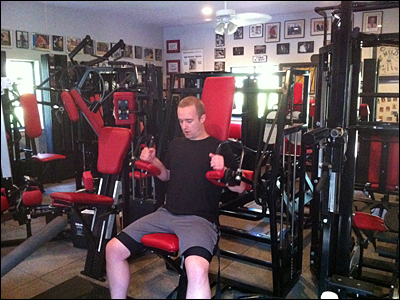
Jim Keen using the Nautilus Compound Triceps machine at Jim Flanagan's home gymI’m about to leave for a weekend at the beach for our fifth wedding anniversary, so I’m going to keep this brief.  There are just a few comments I want to make while they’re on my mind.

Someone recently asked about a “sports specific” workout. A good workout for an athlete is one that safely and effectively works all the major muscle groups in the body, with the highest priority increasing the athlete’s resistance to injury during practice and competition. This does not mean doing a bunch of plyometrics and Olympic lifts and so-called “functional” exercises that mimic the skills of the sport while using weights or weighted implements. What it does mean is performing exercises for all the major muscle groups based on muscle and joint function, not sport movements, in a manner that strengthens without being unnecessarily hard on the joints. Additionally, it means performing exercises specifically to strengthen the areas of the body most often injured to minimize the chance or severity of injury to those areas. Direct neck work for athletes in contact sports, knee extension and flexion for runners, etc.

While we’re on the topic of knee flexion, properly designed seated leg curl machines (with a coupled movement arm) are better than prone leg curl machines for several reasons. Earlier leg curl machine designs used a prone body position because they were based on the designs of leg extension and leg curl attachments developed for flat benches. The seated position for later knee extension machines was obvious since this was the position they were performed in on the bench, but rather than design knee flexion machines based on joint function, earlier machines just copied the exercise as performed with the equipment already available.

A prone leg curl is superior to an improperly designed seated leg curl machine, however (just about every leg curl machine other than Nautilus, MedX, and SuperSlow Systems). The worst seated leg curl designs incorporate a pad which presses down on the top of the thighs, often with handles for the user to hold to brace against being pulled forwards. This is a very poor method of countering the changing reactionary force over the range of the exercise, and these designs typically have a seat bottom which extends all the way to the back of the knees rather than ending just a little past the ischial tuberosities of the pelvis (the “sit” bones), which means not only are you sitting on the muscles you are attempting to contract, but you also have a restraining pad pushing the thighs down into the seat.

On a prone leg curl machine the weight of the thighs is on the quadriceps, not the hamstrings which you are trying to contract, which is a big improvement.

A properly designed seated leg curl also has the advantage of easier entry and exit and with the coupled movement arm reactionary force is countered without the need for the user to pull (prone designs) or push (seated designs with thigh pads and handles) with the arms to maintain proper positioning and alignment. It is also easier for people to learn the exercise when the movement is occurring in front of them (Ken Hutchins’ heirarchy of motor learning difficulty).

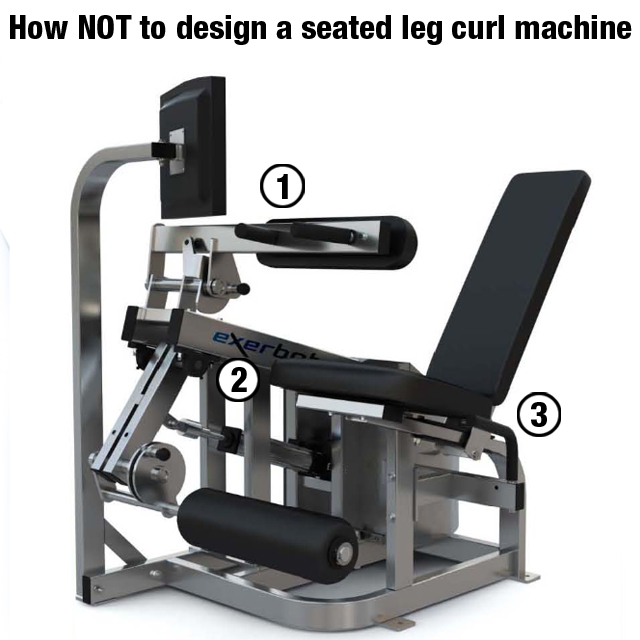
The optimal seat design for the leg curl is very different than what is optimal for a leg extension, which is also a big problem for companies which make “combo” machines providing both functions. The Exerbotics leg curl is a great example of how not to design a leg curl machine:

1. A thigh restraint with handles is a very poor solution for countering reactionary force and maintaining proper positioning and alignment during seated leg curls. The Exerbotics machine uses a thigh restraint with handles instead of a coupled movement arm (which can be designed to work in both flexion and extension with a simple position change).

2. The seat bottom should only extend far enough to provide support for the pelvis so the user is not sitting on the hamstrings while trying to contract them. The thigh restraint pressing down on the thighs makes this even worse. The Exerbotics seat bottom extends too far.

3. A seat belt is required for optimal countering of reactionary force during leg extensions while minimizing tension in the neck and shoulders from pulling up on the handles, and also a better solution for countering forwards reactionary force along with a coupled movement arm during seated leg curls. The Exerbotics machine has no seat belt.

Exerbotics leg extension / seated leg curl is a great example of how NOT to design a seated leg curl machine

Although the point isn’t to bash Exerbotics specifically, since most equipment companies get this stuff wrong, I should point out in addition to the problems related to using motorized resistance the rest of Exerbotic’s machine designs contain numerous flaws.

On a related topic, one of the other considerations of machine design is avoiding positions of active or passive muscular insufficiency – something Arthur Jones was actually trying to do in the design of the early Nautilus compound biceps and triceps machines. Although I much prefer triceps extensions and arm curl machine designs which position the upper arms at around 90 degrees of shoulder flexion, those machines certainly produce an intense sensation when used correctly. Jim Flanagan put me through a set on the Nautilus compound triceps and biceps machines (pictured above, with Jim Keen in the compound triceps machine, and the compound biceps machine to his right) and shortly afterwards I did a set of weighted dips and weighted chin ups and the effect was impressive. The pump was almost uncomfortable and my arms still feel “heavy” almost 24 hours after the workout.

Have to head out to the beach so that’s all for now, but there’ll be more on this later.