Question:
How do you choose the right weights and reps on different exercises for a new client? Most of the trainers where I work either do one rep max tests or estimate one rep max based on how many reps they can do with a weight, then do a test with a percentage of that to determine rep range. I am not comfortable having new people do one rep maxes or even going all out with less weight, but I don’t want to just guess either.
Answer:
When working with a new subject your first priority should be teaching them to perform the exercises correctly rather than working them hard. The weight selection and rep count needs to be appropriate for learning and practicing proper form, and as their form and confidence improves the resistance can be increased and you can adjust the rep range based on their level of skill and response to exercise. It is important that they learn to train intensely, but unless they learn proper form first they’re more likely to get hurt in the long run.
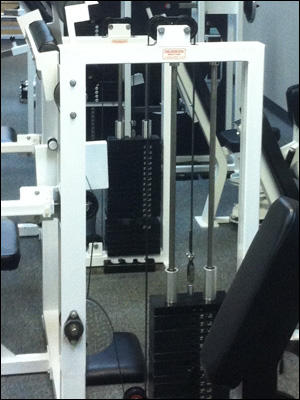 When learning a new exercise the weight must not be so heavy the subject has difficulty learning how to correctly perform the movement, but heavy enough for the subject to be able to feel the effect in the target muscles and to provide adequate reactionary force for the subject to learn to brace against to maintain proper positioning and/or alignment. A good starting weight will allow for the performance of a moderate to high number of repetitions with only the last few repetitions being somewhat challenging.
Through trial and error you will get a feel for roughly how much weight to use starting out on different exercises for someone based on their sex, age, size, appearance and previous training experience, but it is always best to err on the light side if you’re not sure. When you are instructing them, tell them the purpose of the first few workouts is to learn and practice proper form and you will be selecting a weight for that purpose, and that it should only start to feel moderately challenging after a few repetitions.
Tell them if the weight feels somewhat light that is fine and you will increase it by an appropriate amount the next workout, but if it feels too heavy after a repetition or two to set it down or go to the start position and let you know (but make it absolutely clear they are not to compromise proper body position or the neutral position of the head and neck while under load, by turning towards you to talk, for example). If necessary reduce the weight somewhat and have them start over.
When teaching a new exercise I recommend starting the subject with a slightly higher rep range. I use an upper repetition count total of fifteen at first (which is high when using a cadence of 4/4) and reduce it to a range of six to ten for compound pushing movements and five to eight for other exercises involving a squeeze technique once the subject has become proficient at performing the exercise. More advanced subjects may use an even lower range depending on their response.
I strongly advise against one rep max testing as it is highly skill dependent, poses a high risk of injury and is completely unnecessary. A beginner’s lack of familiarity, skill and confidence with the exercise prevents the test from providing any useful information. I am aware of some personal training studios who do one rep max testing knowing the lack of familiarity will cause new subjects’ starting strength level to be understated because it gives them the appearance of having gained much more strength then they actually have when they are retested. This practice is highly unethical as it is both dishonest and dangerous for the subject.
Even higher repetition maximum tests should not be performed with beginning subjects. Although it is safer than one rep max testing, the lack of skill and familiarity with how far they can safely push themselves will result in an understatement of their actual strength. It is also impossible to accurately determine a subject’s one repetition maximum from a higher repetition maximum test since the relationship between the two varies considerably between individuals. One person might only be able to perform three or four reps with 80% of their 1RM, while another might be able to perform twice or even three times as many.
If you start a subject with a moderate weight and increase it gradually based on their performance they will eventually progress to the point where they are achieving momentary muscular failure within the prescribed repetition range. From that point on you have a relatively objective means of comparing exercise performance over time – the weight they are able to perform a particular number of repetitions with in the prescribed form (e.g., ten repetitions at 4/4, five repetitions at 10/10, etc.). There is no need to perform separate testing. You just need to keep accurate records of subjects’ workouts.
While a wide range of repetitions can be effective some people will do better with slightly higher or lower repetitions. This can be determined by with accurate record keeping and experimentation without doing a specific fiber type or fatigue response test.
Subjects who may respond better to fewer repetitions often have difficulty performing an exercise for more than a specific number of repetitions or time under load without a significant weight reduction. If you increase the weight on an exercise by a small amount on a regular basis they are able to consistently perform roughly the same number of repetitions or amount of time, but not many more.
Subjects who may respond better to more repetitions may go up in reps regularly, but often have difficulty with weight increases and their form deteriorates if weight is increased before they are capable of performing some higher number of repetitions. If you wait until they are able to perform more repetitions before increasing the resistance they have no problems.
If a subject is stuck at a particular repetition count total on an exercise for a period of time despite everything else appearing to be in order (workout volume, recovery time, rest, nutrition, accounting for other activities and stresses, etc.) try adding a small amount of weight (2.5 lbs or 2.5%, whichever is smaller). If they are consistently able to achieve that repetition count total with the smaller increases and it is not too low for safety set it as their new repetition count total.
If a subject has a difficult time achieving a repetition count total within the prescribed rep range or if their form deteriorates with resistance increases, back the resistance down and wait until they are able to achieve a few more reps before increasing the weight. If they have no problem with the heavier weight after that, raise their upper repetition goal number.
Updated 1/29/13 to reflect change in recommended repetition cadence to 4/4