Keeping Track

“What gets measured, gets managed.” – Peter Drucker

Keeping accurate records of your workouts, food intake, and goal-specific measurements provides several benefits. It allows you to determine whether the things you want to improve are really improving, and if so how much. It also helps you to improve the effectiveness of your workouts and diet by indicating whether changes need to be made, and when changes are made what effect they have on your results.

Keeping records of these things also keeps you mindful of them and encourages you to make better decisions about them. Even if you’re not accurately weighing or measuring all of your food, just recording what you eat causes you to think more carefully about it and make better choices. When you keep records of your workouts you’re more likely to consistently put forth your best effort because you want to see those numbers improve. Records of goal specific measurements posted in a conspicuous place can help remind you of your goals and keep you focused on achieving them.

Goal-Specific Measurements

If your goal is to produce some change in your body composition or size you need to measure the thing you want changed and compare over time. If your goal is to improve some aspect of athletic performance or your ability to perform a specific sport or vocational task you need to measure and track it. If these measurements show steady improvement you’re doing things right, if not you know you need to re-evaluate your program, diet, practice, etc. and make changes. When you do, further measurements will allow you to determine whether the changes were beneficial, harmful, or made no difference.

Workout Charts

Workout charts allow you to evaluate progress over time and to compare the effects of changes in your program on goal-specific measurements. Minimally, you should record the date of each workout, the amount of weight used and the number of repetitions completed in good form (poorly performed reps should not be counted) on each exercise, and the order the exercises were performed in if it varies from the written order. I also recommend keeping track of the workout start and end time and notes on overall performance, such as exercise form and how you felt over the course of the workout. Recording the start time can help you determine whether you do better training during some times of the day than others, and recording the end time allows you to track overall workout duration and evaluate improvements conditioning and your ability to minimize rest between exercises.
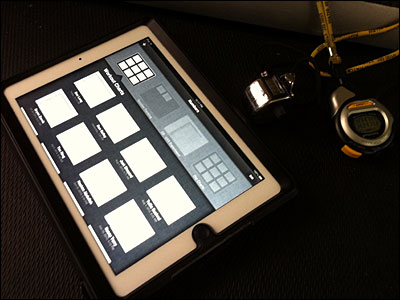
Workout Charts on iPad

When charting workouts it is important to keep in mind the records are for comparison and evaluation over time for the sake of adjusting your program to your body’s response to exercise, and not an end in themselves. Your goal is not to make numbers go up on paper, but to effectively stimulate improvements in functional ability, health, and appearance. If you focus on doing that, the numbers will show you how well you are doing. If you focus on the numbers you will tend to perform your exercises in a way that makes it easier to complete more repetitions rather than harder, which is the opposite of what you want.

Keep in mind the better you are at an exercise the harder it is, and if two people of equal strength perform an exercise with the same amount of weight the one who is better at the exercise will achieve momentary muscular failure more quickly and complete fewer repetitions because they are performing the repetitions in a way that is more challenging. When you increase the resistance used for an exercise it should be because you were capable of performing some number of repetitions despite attempting to make the exercise as hard as possible. Because of this, and because many other factors affect workout performance, it is important to evaluate your workout records over periods of many weeks rather than on a workout to workout basis. This is also why you should only count properly performed repetitions, and why you should make additional notes on performance.

Diet Journal

Depending on  your goals a diet journal may simply be a list of what you eat over the course of a day, or a detailed record of the weight or volume of everything you consume along with breakdowns of calorie, macronutrient, and micronutrient content, meal times, blood glucose and urine tests, etc., or something in between.

This is helpful whether you are trying to lose fat, build muscle, or improve athletic performance or overall health, not only because it allows you to compare changes in these with your diet but also because when you are recording it you will tend to be more conscious about your eating and make better choices.

Accountability

Being accountable to someone else for this can help you be more disciplined about keeping track. More importantly, other people will usually be more objective in evaluating your records and can help give you needed reality checks when something isn’t working, or when it is working well and you’re being too hard on yourself or have unrealistic expectations.

It helps to partner with someone with similar goals and be accountable to each other, and agree to perform measurements and to regularly review and evaluate workout and diet records and give objective feedback and advice when required. As long as it is not your wife or girlfriend. Don’t even try to give your wife or girlfriend objective feedback on her eating, weight, or body fat. It’s just not worth the trouble. Have her partner with a friend instead, or get her a personal trainer.

If you are a trainer, make your clients do this. I’ve done it on and off with different clients over the years, and the ones who are measured or tested on a regular basis and who keep track of their eating consistently get better results than those who don’t.
Q&A: Massed Versus Distributed Exercise

Question:

Assuming the same number of exercises and sets over a period of a week or two is it better to work out longer but less frequently, or shorter but more frequently?

Answer:

I am frequently asked a lot of variations of this question, usually along the lines of whether I recommend a full body or split routine, and if so how far to split up the workout and in what way. Like most things, the answer depends on the individual.

Recovery from and response to exercise involves multiple, interrelated local and systemic processes which can take more or less time depending on the individual, the muscles, how intensely they work them, and other factors. Local processes include repair of microtrauma and synthesis of new muscle tissue, and the microtrauma results in an inflammatory response which affects the rest of the body. The harder the training, the more muscles worked, or the higher the volume of exercise the greater the inflammatory response. If adequate time is not allowed for recovery and inflammation becomes chronic you will enter an overtrained state, and depending on the degree of overtraining either stop progressing or even regress and lose muscle mass. (Cytokine hypothesis of over training: a physiological adaptation to excessive stress?,” Medicine & Science in Sports and Exercise, Vol 32, No. 2, pp 317-331, 200).

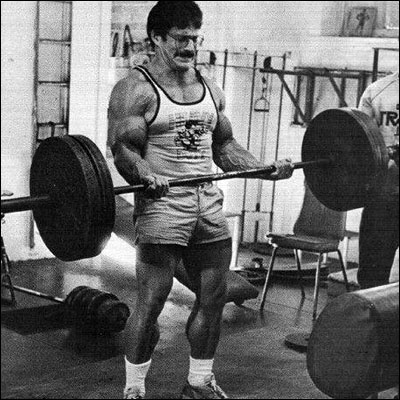
Some people prefer to split up exercises into workouts organized by muscle group or body area, under the assumption you can work some muscles without affecting the recovery of others. However, regardless of how you split up exercises or what equipment you use there can be a lot of overlap in the muscles affected. You can do exercises that target different muscle groups in different workouts, but even when performing relatively isolatory exercises you will still use other muscles to maintain proper positioning and/or alignment and some of these may be under considerable tension depending on the loads used. A good example of this is the standing barbell curl. While it targets the biceps and other arm flexors, you use many other muscle groups to maintain proper positioning, most notably, your chest and shoulders maintain your upper arm position preventing your shoulders from extending (unless you are doing drag curls) and your back and hip extensors maintain your posture while the weight is held in front of you.

Mike Mentzer curling a 225 pound barbell

Although assuming a constant volume of exercise differences in distribution may have little effect on systemic recovery, training too frequently may still interfere with local recovery depending on the degree of overlap in muscular involvement between workouts. Just because two or more workouts target different muscle groups doesn’t mean you don’t need to rest between them.

There are downsides to training too infrequently, however. While there appears to be very little difference in muscular strength increases between training once, twice, or three times per week for most people (and some may require an even lower lower volume or frequency to avoid overtraining), metabolic conditioning appears to start to suffer at frequencies below twice weekly.

While individual recovery ability, goals, and situations vary considerably, I have found two full-body workouts a week to be a good starting point for most people. It is infrequent enough that most people will not overtrain if they keep the workouts relatively brief (only one set of around ten exercises including work for smaller muscle groups like neck, forearms, or calves) while frequent enough that metabolic and cardiovascular conditioning is not compromised. Some people do appear to get better results from split routines, though, possibly due to local recovery requiring longer than systemic (which may be the case for predominantly fast-twitch muscles).

If your recovery ability allows it you can distribute the exercises over slightly more frequent workouts, but I do not recommend working out more than three, non-consecutive days per week and it is better to err on the lower side with volume and frequency to avoid overtraining. If you need more time for recovery between workouts or circumstances prevent you from working out more frequently, you can also still make good progress on even very infrequent training provided when you do work out you do so very intensely.

Also, consider the optimal volume and frequency of training may vary depending on your body’s response to exercise and goals. You may get stronger faster with extremely brief and infrequent training, but your conditioning may improve more quickly with a slightly higher volume and frequency.

The best way to determine what you should do is to clearly define your training goals and track measurements specific to those goals along with your workouts, experiment, and adjust your workouts based on how your body responds.

Will The Real HIT Please Stand Up?

If you’re a regular reader of this web site or if you know who Arthur Jones, Mike Mentzer, and Ellington Darden are nothing that follows will be news to you. This is for the people who keep misusing the term “high intensity training” to refer to things like sprint interval training and various faddish infomercial exercise programs. Whenever you come across one, please share this with them and hopefully it can help reduce confusion over what HIT is and is not.

The term “high intensity training” was coined by Ellington Darden, PhD, during a presentation at Duke University in 1975 to describe the Nautilus training principles:

  • Intensity – train with a high level of effort, performing each exercise to the point of momentary muscular failure
  • Progression – gradually increase the resistance you use as you get stronger and better conditioned
  • Form – always maintain strict form to more efficiently load the targeted muscles and minimize risk of injury
  • Duration – keep your workouts brief to avoid overtraining, perform only one set per exercise
  • Frequency – allow adequate time for recovery and adaptation between workouts, training no more than three non-consecutive days per week
  • Order – as a general rule perform exercises in order of the sizes of the muscle groups worked, from largest to smallest

In What Is High Intensity Training? I describe HIT as “…a form of progressive resistance exercise characterized by a high level of effort and relatively brief and infrequent workouts, as opposed to typical training methods involving low to moderate levels of effort and longer, more frequent workouts.”

Ellington Darden, Drew Baye, Jim Flanagan

Drew Baye with experts on real HIT, Ellington Darden, PhD (left) and Jim Flanagan (right)

Unfortunately, the term “high intensity training” is vague enough it can apply to almost anything done with a high level of effort including non-exercise activities. “High” is relative, “intensity” is usually incorrectly defined by others talking about exercise, and “training” can mean teaching, learning, or practicing a variety of skills and behaviors. Because of this vagueness, people currently use “HIT” to describe everything from sprint interval training to various resistance training programs done at a relatively fast pace.

If “high intensity training” is so vague, why does it matter how we use it? Because to effectively communicate it is necessary for terms to have specific, agreed upon meanings. If a word can mean anything it might as well mean nothing.

Additionally, a big problem is people getting injured doing other programs and incorrectly claiming they got hurt doing HIT. Having ignorant trainers out there teaching unscientific and often downright stupid exercise methods and programs and calling it HIT reflects negatively on those of us practicing and teaching real HIT (unfortunately, the same goes for many trainers and organizations who practice and teach real HIT very poorly, but I’ll write about that some other time).

While the term is vague, Ellington Darden set the precedent for its use in the context of exercise to refer to the kind of hard, brief, infrequent exercise described by the Nautilus training principles, and it has generally been used in that manner for almost four decades now.

If you’re performing max effort sprints (running, cycling, rowing, swimming, etc.) you are doing sprint interval training, not high intensity training. It shouldn’t even be called “high intensity interval training” or HIIT since the terms are too similar.

Unless you are performing proper exercises (with positioning and movements based on principles of efficient muscular loading) to momentary muscular failure (real high intensity) in strict form (with a controlled speed of movement and smooth turnarounds while maintaining proper body positioning and/or alignment and path of movement) you are not doing HIT.

Stated differently, if you’re doing so-called “functional” movements (movements mimicking sport or vocational skills rather than designed around specific muscle and joint functions), not consistently training to momentary muscular failure (after the initial learning stage/break-in period and with a few other exceptions), or doing your exercises in a fast, jerky manner emphasizing quantity of work over quality, you might be working hard, but you are not doing HIT.

CrossFit and its clones are not high intensity training. P90X, Insanity, and similar programs are not HIT. Those people jumping around, doing sloppy calisthenics, and sprinting in the park and calling it “boot camp” are not doing HIT. The majority of programs claiming to be high intensity training are not HIT. Regardless of what you’re calling it, unless your exercise program is based on the Nautilus training principles outlined above you are not doing or teaching HIT.

Q&A: Training To Momentary Muscular Failure

Question:

In this Q&A I’m going to address a few common questions about training to momentary muscular failure (MMF); what it is, whether it is necessary, and if it’s more effective to train past it.

Answer:

What is momentary muscular failure?

Your muscles fail when fatigue has momentarily reduced their strength to below the level required to continue an exercise in the prescribed form.

When performing typical dynamic exercise protocols your muscles fail when you are unable to continue positive movement (positive failure). When performing yielding isometric protocols like static holds your muscles fail when you are unable to hold the weight motionless preventing negative movement (static failure). When performing negative-only your muscles fail when you are unable to lower the weight as slowly as prescribed (negative failure).

Is it necessary to train to momentary muscular failure?

No. It is not necessary to train to MMF to stimulate improvements in muscular strength and size or other aspects of functional ability, you just have to consistently work your muscles harder than you did previously. However, since results from exercise are proportional to intensity of effort, you should train to MMF.

Exercise intensity is best defined as how hard you are working relative to your momentary ability. If at the beginning of an exercise your muscles are capable of producing one hundred pounds of force but you are only working against a resistance of eighty pounds your intensity is eighty percent. As your muscles fatigue over the course of an exercise the eighty pounds of resistance requires an increasing percentage of your decreasing momentary strength. When your strength has been reduced to just below eighty pounds all of your momentary strength will be required to  just hold  the resistance and you will be working at one hundred percent intensity.

With most equipment it is impossible to know your exact strength or intensity of effort at the beginning of or at any point during an exercise (and both one rep maximum and max effort isometric testing should be avoided for safety). The only time you know how intensely you are working is when you reach MMF, at which point your intensity is maximum.

Is it better to train past momentary muscular failure?

Yes, but only very briefly.

When performing normal dynamic repetitions the only way to be certain you have achieved MMF is to continue attempting to move positively for a few seconds. Occasionally when you think you have achieved MMF if you attempt to gradually contract harder you will find you are able to continue positive movement. You may only move a few more degrees or inches, or you may end up completing  another repetition. There is no way to be sure you have achieved positive failure unless you keep trying for at least a few seconds. However, beyond some point additional contraction post-failure appears to be counterproductive. Advanced trainees who routinely perform extended static holds, multiple forced reps, or  multiple rest-pause reps beyond failure often find they require a much longer time to recover between workouts. A little seems to go a long way, and it is very easy to overdo or misuse these techniques.

Some of these have uses when training beginners who are still learning to train with a very high level of intensity, but only very few, and they need to be done correctly and used very judiciously or they will not have the desired effect.

For most people I recommend only continuing to contract for about five seconds after positive movement stops. If you’re really contracting as hard as you can and the weight doesn’t move after five seconds you’re probably not going to move it, and you should just slowly lower it and unload.

When performing static holds, once you are unable to maintain the prescribed position you should slowly lower the weight, unload, and terminate the set. If you used an appropriate load and time additional reps are unnecessary and potentially counterproductive. I recommend a conservative range of around sixty to ninety seconds.

When performing negative-only repetitions you should unload and terminate the set when you are unable to perform the negative at least slowly enough to maintain a ten-second cadence. Never attempt to continue a negative-only set beyond this point.

Q&A: Bodyweight Training For Muscular Strength And Size

 Question:

Is it possible to get as strong and muscular with bodyweight training as you can training with weights?

Answer:

As long as you train hard, progressively, and consistently you can get bigger and stronger with just about anything, including your own body weight; and I think most people can get just about as big and strong with bodyweight training as anything else if they do it correctly. The key is learning how to perform bodyweight exercises to make them progressively harder as you become stronger.

When using free weights and machines resistance progression is simple; as you become stronger and require more resistance you just add more weight to the bar, use heavier dumbbells, or pin more weight on the stack. Resistance progression is trickier with bodyweight. You can use weighted vests and belts to increase resistance, or you can manipulate other variables like leverage and timing, using body positioning to increase the leverage against the target muscles and spending proportionally more time in more challenging portions of the range of motion. For example, bodyweight squats can be made more challenging by only performing the harder lower half of the range of motion, and holding at parallel for a few seconds before slowly starting the positive (as opposed to only going down halfway and bouncing back up like most people).

Another option, if you have the motor control and discipline to do it, is what I call intentional antagonistic co-contraction or IAC. By intentionally contracting the antagonists of the target muscles during an exercise you can increase the intensity considerably. Assuming you have relatively balanced strength, if you learn to use IAC effectively no matter how strong you become you will be able to make any exercise as hard as you need it to be. There are several disadvatages to IAC, however. It takes time to learn, requires good motor control and focus, and makes evaluating workout performance more subjective.

A slightly less efficient but more easily quantifiable way to increase resistance is to wear a weighted vest or belt. While technically not pure bodyweight exercise, people who have difficulty with IAC will find it more practical and it allows more objective evaluation of workout performance.

A very challenging but less safe and efficient option for stronger trainees is to perform some exercises unilaterally. If you’re skeptical of how challenging bodyweight exercises can be I suggest you attempt a set of strict one armed chin ups, push ups, or squats. Unless you can do a high number of these in slow, strict form, pausing and squeezing at the top of chin ups or pausing and holding motionless at the start of squats and push ups, you are not so strong you won’t be challenged by a proper bodyweight workout.

In his column My First Half Century In The Iron Game in Iron Man magazine in 1986 Nautilus inventor Arthur Jones had the following to say about this,

…chins and dips, if properly performed, will stimulate muscular growth in your upper body and arms that will eventually lead to muscular size and strength that is very close to your potential. Adding full squats, eventually leading up to one-legged full squats, and one-legged calf raises, will do much the same thing for your legs and hips. Using this very simple routine, when you get strong enough to perform about ten repetitions of one-armed chins with each arm, your arms will leave very little to be desired.

So, whether you are limited to bodyweight training by location, time, space, budget, or other circumstances, or you prefer it for it’s efficiency and convenience, you don’t have to worry you might be compromising effectiveness.

While the exercises Arthur Jones recommended are a good foundation, and have been the cornerstones of my workouts for a very long time, I would add a few more exercises to round out your workout. Minimally, I like to have people perform six basic movements: a squat, a trunk extension, a vertical push and pull, and a horizontal push and pull. It doesn’t hurt to add a heel raise and timed static contraction neck extension and flexion to round things out, and although they can get worked pretty hard during other exercises some people may want to add a direct exercise for the abdominal muscles. The following is an example of how this could be done with bodyweight only:

  1. Hip Raise or Hyperextension
  2. Squat
  3. Chin Up or Parallel Grip Pull Up
  4. Dip or Push Up
  5. Inverted Row
  6. Pike Push Up or Handstand Push Up
  7. Crunch
  8. Heel Raise
  9. TSC Neck Extension
  10. TSC Neck Flexion

Bodyweight "Big Six" On The UXS

A few tips for performance:

  • Move slowly and focus on contracting the target muscles continuously throughout the exercise, taking at least four seconds each to perform the positive and negative
  • Hold for at least two seconds at the end point of pulling and simple (rotary) movements and at the start point of pushing movements (parallel with the ground for squats, in a slight stretch for dips and push ups, just above the ground for pike and handstand push ups)
  • Start, stop, and reverse direction as smoothly as possible, the lower the acceleration the better. Imagine you’re trying to sneak through the turnarounds.
  • When you think are unable to continue positive movement in strict form, continue to contract as hard as you can for about five more seconds, just to be sure, but do not loosen your form.
  • Move quickly between exercises. Once you’ve finished an exercise try to begin the next as soon as possible. If you begin to feel light headed, dizzy, or nauseous and wait for it to pass before continuing, however.

Give it a try, and let me know how it goes in the comments below.

Positive Versus Negative Strength

Over the past year there have been several arguments in high intensity training circles over whether there is a difference between positive (concentric) and negative (eccentric) strength. Some of these have been semantic arguments about the definition of strength, some attempted to provide alternative explanations for the observed difference during test results, some are still talking about the debunked theory of intramuscular friction. Some of these arguments were part of criticisms of the practice of hyperloading the negative portion of an exercise and equipment designed for this purpose, which will be addressed in a second article.

Negative strength is greater than positive strength.

Strength is the ability of your muscles to produce force. A muscle must produce force to lift a weight. A muscle must produce force to hold a weight motionless. A muscle must produce force to lower a weight more slowly than the acceleration due to gravity (if it didn’t the weight would simply drop). Strength can be positive (concentric contraction, lifting), static (isometric contraction, holding), or negative (eccentric contraction, lowering).

When a muscle contracts concentrically heads on the myosin filaments attach to the actin filaments forming cross-bridges which bend and pull, then release and repeat, causing muscle fibers to shorten. When a muscle contracts isometrically or eccentrically it forms more of these attachments. If the force against the muscle exceeds the force of contraction it begins to lengthen, and as the cross-bridges are stretched forcing detatchment they immediately reattach (approximately two hundred times faster than during concentric contractions). This difference in cross-bridging mechanics makes the motor units significantly stronger when contracting isometrically or eccentrically, so to stop lifting or begin lowering a weight your body recruits fewer motor units in the working muscles to reduce the force produced. Because of this it is less metabolically demanding to hold or lower a certain amount of weight than to lift it.

Another protein in muscle fibers called titin also contributes to the increase in eccentric strength. It is “wound” by the action of the myosin and actin during concentric contractions, then stiffens to resist lengthening during eccentric contractions.

This difference in positive and negative strength is easy to demonstrate. Perform a few strict test repetitions on a good biceps machine or barbell curls until you find a weight that is just slightly too heavy for you to lift. Rest for several minutes (to satisfy those who suspect congestion due to pump and the resulting friction is a contributing factor). Increase this weight by approximately twenty five percent and have someone help you lift it, then hold the movement arm or barbell motionless while they gradually transfer it to you. Although it is too heavy for you to lift you will find you are able to hold it, and lower it slowly under strict control.

While the implications for training will be discussed in more detail in another article there is one important consequence of this I want to mention now. Occasionally a novice trainee will stop exercises short of momentary muscular failure (MMF) because they are afraid they will drop the weight or movement arm and possibly injure themselves. While this concern may be reasonable when performing exercises where grip strength can be a limiting factor it is usually unfounded because of the difference in positive and negative strength (if this difference did not exist you would drop the weight whenever you reached MMF during an exercise).

Even after you have achieved MMF (the inability to continue positive movement in the prescribed form) you will be strong enough to hold the weight motionless for a period of time afterwards and lower it slowly. It is important to teach this to novice trainees to improve their confidence in their safety and willingness to continue to contract intensely as they approach failure when learning high intensity training.

A Return To The Dark Ages?

If the advent of Nautilus and high intensity strength training in the 1970’s was a renaissance in exercise, the current rising popularity of so-called “functional training” is a return to the dark ages.

In her recent New York Times article, Fitness Playgrounds Grow As Machines Go, Courtney Rubin writes,

Simple exercises with no-tech equipment (call them paleo or playground exercises, depending on how much fun they are) have long found disciples at niche gyms and in movements such as CrossFit. But in the last year and a half, major health-club chains have begun making hefting sandbags and shaking 25-pound ropes the standard, ditching the fancy weight machines that have dominated gym floors for more than 30 years.

In other words they’re replacing productive, efficient, and safe tools and methods with less productive, inefficient, and riskier ones.

The so-called “functional training” trend is primarily based on the beliefs that exercises must mimic other physical activities like daily living or vocational tasks or sports skills to improve your ability to perform them and that exercises should be performed on unstable surfaces or unilaterally to improve balance and more effectively strengthen your “core” muscles.

These beliefs aren’t just wrong, they are completely backwards.

Functional Training Playground

Your functional ability – how well you are able to perform various physical activities – is determined by several factors. Some of these factors, like your muscular strength, cardiovascular and metabolic conditioning, and flexibility are general; improving them helps you better perform any physical activity. One factor of functional ability, skill, is specific; improving your skill in a particular physical activity only helps you better perform that specific activity.

While the number of possible body movements a person can perform is practically infinite, all of them are just different combinations of a few basic joint movements. Regardless of the specific exercises performed, as long as you strengthen all the muscle groups which produce those joint movements your general ability to perform any movement will improve. For example, it doesn’t matter that the exercise movement performed on a leg extension machine does not resemble some other movement; if your quadriceps are stronger your ability to perform any movement involving knee extension or requiring you to resist knee flexion will improve.

Since the improvements in functional ability from strength gains are general there is no advantage to performing exercises in a manner that mimics other activities. Instead, exercise movements should be based on the requirements for effectively and safely working specific muscles or muscle groups to stimulate increases in strength. This includes both compound (multi-joint, linear) and simple (usually single joint, rotary) or so-called “isolation” exercises. As a corollary, the tools used for exercise should be appropriate for or designed around these movements, and this can include anything from low-tech barbells and dumbbells and basic bodyweight apparatus to high-tech machines.

Attempting to mimic another activity with exercise usually results in inefficient muscular loading and can interfere with the skills of the movement being mimicked (negative skill transfer). Attempting to mimic sport movements involving rapid acceleration during exercise also unnecessarily increases the risk of injury.

If you want to improve your ability to perform a specific movement don’t try to mimic it during exercise; instead learn and practice the movement as you would normally perform it, and if it involves a tool, instrument, or sporting implement practice using that exact tool, instrument, or implement.

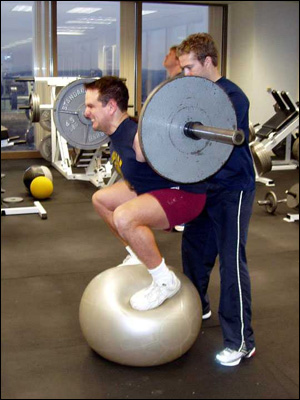
Performing an exercise on an unstable surface will improve your skill at performing that specific exercise on that unstable surface but will not improve your skill in other balance tasks. Also, activation of the target muscle groups and the stimulus for strength increases is reduced, not improved, when exercise is performed on an unstable surface. The more focus required to maintain your balance the less you can devote to contraction of the target muscle groups.

Stability Ball Squat

Proponents of so-called “functional training” often claim exercise on unstable surface is more effective because it involves more muscles. They fail to distinguish between muscular involvement and efficient loading. Just because a muscle is involved in an exercise in some manner does not mean it is subject to loading sufficient to stimulate significant increases in strength and size. Since maintaining balance requires the center of gravity of the body to be maintained directly over its base the muscles involved in balance work against minimal moment arms, thus minimal resistance and receive little exercise benefit.

As an example of this myth, the article quotes Adam Campbell, fitness director for the Men’s Health brand as saying,

…machines like the leg press strengthen muscles, but asked: “What’s the real logic in sitting or laying down to train your legs?” Functional fitness is “far more bang for your buck” because it works multiple muscles simultaneously, he said, providing better overall strength and mobility, and a higher calorie burn.

Adam Campbell doesn’t know what he’s talking about.

The logic of sitting or laying down to train your legs is these machines allow the target muscles to be loaded more efficiently and more safely than conventional barbell movements, and much more effectively than squatting on a ball like the idiot pictured above. While many so-called “functional” exercises involve more muscle groups than machine exercises or conventional barbell exercises they do so in a manner that loads those muscles haphazardly and inefficiently.

Exercises performed in a manner that efficiently loads the targeted muscles, using equipment designed for this purpose will provide “better overall strength and mobility” than exercises which mimic other movements or involve unstable surfaces or spread the work over a larger number of muscle groups in a way that loads them inefficiently (like exercise “complexes” which combine several different movements into a single exercise).

And, while exercising to burn calories is generally a waste of time, the calories burned during or metabolic demand of an exercise are not determined solely by the amount of muscle involved but also how hard the involved muscles are working.  If you don’t experience a tremendous metabolic demand performing a circuit of machine exercises you aren’t using them correctly.

Later, Josh Bowen, formerly of Urban Active is quoted as saying,

Gyms are way out of the times if all they have is machines.

Bullshit.

A gym with nothing but forty-year-old first and second generation Nautilus machines is way ahead of any gym whose equipment consists mostly of so-called “functional training” staples like stability balls, ropes, medicine balls, truck tires, plyo boxes, and kettlebells.

After a few more paragraphs of ignorant machine bashing the author quotes several people on how odd so-called “functional training” looks to people used to more conventional training. One person is quoted as saying his wife “looks like a circus clown” when doing her “functional” exercises. Another worries people are watching him thinking it’s the dumbest thing they’ve ever seen.

While I have seen and heard about people doing a lot of really dumb things over the years, and so-called “functional training” might not be the dumbest, it is definitely close to the top of the list. It violates motor learning principles, violates principles of safe and efficient muscular loading, and gives people less exercise benefit with more risk. Forget about looking stupid, getting injured because you lose your balance and fall or drop something on yourself is a great way to quickly (and in some cases permanently) reduce your functional ability.

Like the guy who was badly injured when he lost his balance and fell through a plate glass window a few years back because his idiot trainer had him doing dumbbell flys on a stability ball.

Like the college quarterback who is now paralyzed because he broke his back when he lost his balance doing weighted step-ups.

Like the CrossFitter who smashed his foot doing sledgehammer swings.

If you want the greatest possible improvement in general functional ability don’t follow the so-called “functional training” crowd. Work hard, progressively, and consistently on a few basic exercises involving all the major muscle groups. Move slowly during exercises to keep consistent tension on the target muscles and minimize risk of injury, but move quickly between exercises to maximize cardiovascular and metabolic conditioning. Separately from your workouts, learn and practice the correct performance of the specific sport or vocational skills you want to improve at.

And finally, if other people in the gym are doing so-called “functional training” exercises, make sure to give them plenty of clearance so when they do lose their balance or grip and fall, or drop something heavy, or lose control while swinging or throwing something, they don’t reduce your functional ability in the process.

The New UXS Exercise Demo

Update on Availability

I am no longer selling the UXS bodyweight multi-exercise station, however I am selling the plans which include a license to build a single UXS for personal use. E-mail me at drew@baye.com for details.

Introducing the UXS v3

I recorded a video last night to demonstrate a few of the exercises that can be performed on the newly redesigned UXS (Ultimate Exercise Station):

After working out and training people on the original for almost a year I made several improvements to the design. The sides are angled in more to provide a closer grip spacing near the back and better accommodate smaller people. The roller pads in the back have been replaced with a single roller pad on a movable arm in the front, both to provide clearance in the back for various exercises and to provide better positioning for the leg exercises and the ability to change the body angle for push ups and rows. A set of handles has been added to the top back for close parallel grip pull ups and another set of handles has been added at the bottom back for shoulder push ups as a safer and more scalable alternative to handstand push ups.

My motivation for designing the original UXS was my dissatisfaction with the design and construction of existing chin up and dip stations; most have handles or bars that are the wrong diameter, angle, and/or width and many felt flimsy and unstable. I had originally considered modifying existing equipment, but with everything I wanted to do it made more sense to design my own from the ground up. Once I decided to do that I also decided that to justify the time and expense involved it had to provide more exercises than just chin ups and dips. I wanted it to minimally provide the ability to perform a bodyweight “big five”: chin ups, dips, rows, handstand push ups, and squats.

Of course, you don’t need anything to perform squats other than a place to stand. However, when I decided to use a roller pad for a support for handstand push ups it occurred to me a second, lower one could be used as a support for a squatting movement similar to the wall squat often performed with a ball or roller, and that the roller and bars could be used for support so one-legged squats could be performed with the foot in a further forwards position, reducing the stress on the knee (the pros and cons of unilateral exercises are a topic for another post).

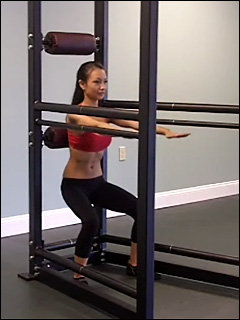
In using the design I found the combination of the lower roller pad and the various bars provided the ability to perform several other exercises. There was a problem, however. The original UXS was too big for very small people, and if they used the handles at the narrowest point the pads got in the way during dips and parallel grip rows. During a photo shoot on the original UXS with the model in the picture below, who is approximately four feet and ten inches tall and around eighty pounds,  we had to leave out several exercises because the station was too big for her to perform them on correctly.

Bodyweight squats on the UXS

This was solved by angling the sides in more and moving the lower pad to the front, which also works better for all the leg exercises and provides the ability to change the body angle for parallel grip push ups and rows. I will probably have her model the new one as well, along with someone over 6’2″ to show how well it accommodates a broad range of height and body sizes.

The close parallel grip pull up handles started out as an additional set of more sharply angled chin up handles but they seemed redundant since the angle of the front chinning bar feels just about perfect, so they were changed. They also work nicely as a place to hang your dipping belt, stopwatch, or tally counter.

The shoulder push up handles are the result of a lot of experimentation with angled push up handle designs, trying to find a way to provide a safer alternative to handstand push ups since it is not something I am comfortable recommending to most people due to the greater difficulty and risk of injury, and because it’s generally not a good idea to have the head below the remainder of the body for too long while training intensely. Handstand push ups can still be performed on the UXS if someone is strong enough and wants to, but they either need to place their shins on the roller pad (half handstand push up), have someone hold their feet, or have good enough balance to perform them unassisted. A word of warning though, the greater range of motion possible on the handles makes them much harder.

If you want to try these (starting at 3:02 on the video) you can do something similar with a set of handles you can make yourself by connecting two eight inch lengths of 1-1/2″ PVC with a 90 degree joint and placing T joints at the ends for stability. Place them against a wall to keep them from sliding, and perform them on a surface your feet will not slip on.

In addition to the dynamic bodyweight exercises several isometric exercises are demonstrated in the video. The UXS is obviously not required for these, they can be done in a variety of ways with all sorts of equipment, but I included them to show how they should be done with the UXS and to get people thinking about how all these exercises can be combined. Here are a few examples of pre-exhaustion using a simple exercise performed isometrically using timed static contraction protocol followed by a dynamic compound exercise:

  • pullover to chin up
  • chest fly to push up
  • lateral raise to shoulder push up
  • simple row to parallel grip row
  • arm curl to chin up
  • triceps extension to dip

Over two dozen exercises are demonstrated in the video, but the UXS can be used for a lot more, including a variety of trunk or “core” movements from either a hanging or support position. Although the station was designed with a single user in mind it is possible for two or three people to simultaneously perform certain combinations of exercises without getting in each other’s way.

Exercises

0:20 Chin Up
0:29 Pull Up
0:37 Parallel Grip Pull Up
0:46 Close Parallel Grip Pull Up
0:58 Parallel Grip Row
1:15 Parallel Grip Decline/Low Row
1:28 Overhand Row
1:34 Underhand “Yates” Row
1:41 Arm Curl
2:00 Isometric Arm Curl
2:05 Isometric Simple Row (Rear Delts)
2:14 Isometric Pullover
2:29 Parallel Bar Dip
2:38 Parallel Grip Push Up
2:46 Parallel Grip Incline Push Up
3:02 Shoulder Push Up
3:16 Overhand Grip Push Up
3:21 Close Grip Triceps Push Up
3:33 Easy Overhand Grip Push Up
3:38 Easy Close Grip Triceps Push Up
3:46 Isometric Triceps Extension
3:53 Isometric Chest Fly
4:01 Isometric Lateral Raise
4:10 Isometric Front Raise
4:20 Squat
4:35 Leg Extension
4:52 Leg Curl
5:08 Heel Raise
5:25 Reverse “Hyperextension”
5:45 Isometric Unilateral Hip Flexion
6:02 Unilateral Squat

As I mentioned in the recent Q&A on rest between exercises the UXS allows for very quick movement from one exercise to the next. Without rushing I was still able to move from one exercise to the next in seconds because everything is right there and other than opening or closing the roller pad arm the only thing that needs adjusting is your body position. If you want an effective tool for overall strength and conditioning, this is it.

Specs

These specifications are for the UXS v3 I had built here in Florida. They may vary slightly from the one being manufactured by the other company.

  • The frame is built with heavy 11 gauge and 3 gauge (step/foot brace), cold-rolled steel tubing and half-inch steel plate.
  • The finish is a durable powder coat.
  • The roller is upholstered with high grade, bacteria-resistant, easy-care BoltaFlex with PreFix protective finish.
  • Assembled dimensions: 52” L x 43” W x 84.5” H
  • Weight: approximately 260 lbs

Strength and Heroism

There is a story in the news about a man and dog who rescued two young girls who fell through the ice into the Saskatchewan river in Edmonton. Adam Shaw was in a nearby park with his family and dog Rocky when he heard the girls scream. He and Rocky ran down to the edge of the river through deep snow, where he rescued the first girl who was clinging to the edge of the ice. They then ran down the edge of the river chasing the other girl who was quickly being pulled away by the current, who Rocky was able to jump in and rescue.

Adam Shaw and Rocky

Adam Shaw and Rocky

There are many stories about people performing heroic physical feats to save others:

Almost every year there are stories of people lifting cars to save people. In 2011 college football player Danous Estenor lifted a car off a man trapped underneath in Tampa and a group of people in Utah lifted a burning car off a man trapped under it after it struck his motorcycle.

The pro wrestler Chris Masters once uprooted a tree and threw it through the window of his mother’s house to save her from a fire started by a neighbor.

In 2009 Shelly Johnston, a 115 pound female college athlete, carried her 160 pound boyfriend down a hill it took them forty five minutes to climb after he fell about 120 feet from a waterfall and sustained severe head injuries.

In 2006 a woman fought off a polar bear long enough for hunters to arrive and save her son and two other children.

I love stories like these because they show people at their best; heroic, compassionate, and strong. However, I can’t help but wonder how many stories with similar beginnings ended tragically because an otherwise heroic person lacked the necessary strength or stamina. Whatever the number, it is far too high.

What if the Edmonton man didn’t have the stamina to run through the snow quickly enough to reach the first girl before she also slipped into the river? What if the various people who have saved people by lifting cars off of them lacked the strength?

Sometimes when I’m out I watch people and wonder if there were some disaster or emergency whether any of them would be able to help themselves, much less others. Sadly, the answer is usually no; most people are weak, slow, and frail compared to what they can and should be. While proper strength training will not turn everyone into Superman, most people would be amazed at the strength, stamina, and toughness their body is capable of if they are willing to put in the time and effort.

I think most people are good and will do what they can to help others in a bad situation, but what most people can do physically isn’t much. Wanting to help is not enough – you must also be able.

While most of you reading this already work out regularly, all of you know people who don’t. You never know if you or someone you know – a relative, friend, classmate, coworker, etc. – will find themselves in a situation where lives might depend on them.

Offer to take them to the gym with you and teach them how to work out. Buy or offer to help them pick out some home equipment and teach them how to use it if they don’t want to join a gym. In addition to the health, fitness and appearance benefits to them, every person you help start exercising is another person more capable of helping others and someday might even save a life.

Proper exercise is one of the most important things a person can do to improve their quality of life and human well-being in general. Help spread the word:

High Intensity Training Basics

Effective exercise is simple. You must work your major muscle groups hard enough to send a message to your body that it needs to increase their strength and improve the supporting factors (cardiovascular and metabolic conditioning, bone and connective tissue strength, flexibility, etc.) then provide your body proper nutrition and rest and enough time between workouts to do so.

While proper exercise is hard work, very little of it is required to be effective. One set of one exercise for each of the major muscle groups is all it takes. While individual response to exercise varies, most people will get good results training only once or twice weekly. In most cases more does not produce better results and in some cases less exercise works better.

Examples of basic, full-body workouts covering all the major muscle groups using different equipment:

Machines

  1. Leg Press
  2. Pull Down
  3. Chest Press
  4. Compound Row
  5. Overhead Press
  6. Trunk Extension

Free Weights (Barbells and/or Dumbbells)

  1. Squat
  2. Pullover
  3. Bench Press
  4. Bent Over Row
  5. Seated Press
  6. Stiff-Legged Deadlift

Bodyweight Only

  1. Squat
  2. Chin Up
  3. Push Up
  4. Inverted Row
  5. Shoulder Press Up or Handstand Push Up (static, half, or full depending on ability)
  6. Hip Raise

Optionally, additional exercises can be performed at the end of the workout to more directly work smaller muscle groups like the neck and calves, or the abdominal muscles (although those are worked in almost all other exercises).

A variety of repetition methods and cadences can be effective. For simplicity, safety, and efficiency I recommend taking four seconds to lift and lower the weight over a conservative range of motion (avoid extreme stretches).

  • Move slowly and focus on intensely contracting the muscles you are working during each exercise.
  • On compound pushing movements reverse direction immediately but smoothly at full extension without pausing to avoid unloading the target muscles. Reverse direction or “turnaround” about ten to fifteen degrees short of full extension on lower body pushing movements like squats and leg presses.
  • On compound pulling and simple (rotary) movements pause and hold the weight at the top for a few seconds before reversing direction, unless there is little resistance in this position (for example, free weight pullovers and stiff-legged deadlifts). Starting with the third rep, “squeeze” the target muscles during this hold.
  • As soon as you complete a repetition begin the next without stopping to rest or setting down the weight.
  • Breathe continuously. Do not hold your breath.
  • Do not have anything in your mouth during exercise, like gum.
  • Keep your head and neck still, looking straight forward with your chin slightly down.

A variety of repetition ranges can be effective. I recommend a moderate range of  six to ten repetitions on compound pushing movements and five to eight on pulling movements (taking into account the additional time spent holding at the end point) which allows for loads heavy enough to be challenging without compromising form or safety for most people. When you can perform the upper number in strict form (only count good repetitions) increase the weight slightly the next time you perform the exercise.

For bodyweight exercises attempt to increase the difficulty as you become stronger by deliberately contracting the antagonistic muscles during each exercise, for example contracting your upper back muscles, rear deltoids and biceps during push ups to make them harder for your chest, anterior deltoids, and triceps.

Move slowly during exercises, but quickly between them to maximize the cardiovascular and metabolic benefits of the workout. Attempt to gradually reduce the time you rest between exercises until you are able to move from one to the next in only a few seconds. When done with a high level of effort these workouts effectively improve cardiovascular and metabolic conditioning more safely and efficiently than traditional endurance activities.

Keep accurate records of your workouts and attempt to gradually increase the amount of weight you use on each exercise, while maintaining strict form (how you do each exercise is far more important than how many repetitions you perform or how much weight you use).