
If your primary goal is bigger muscles and you’re not making regular gains in strength and size you’re probably making one or more of the following common training mistakes. These are some of the biggest mistakes a bodybuilder can make, and correcting them can often make the difference between outstanding gains and none at all:
1. Not Training Hard Enough
To stimulate muscular strength and size increases you have to work your muscles harder than they are accustomed to, and the harder the better.
Specifically, you should perform each exercise until it is impossible to continue in good form, using a heavy enough weight that you are only able to perform between five and twenty slow, controlled reps (by slow I mean taking at least three seconds to lift and three seconds to lower the weight, and reversing direction between the lifting and lowering movements without bouncing, yanking, or jerking the weight).
The exercise is not over when the muscles start to burn or when things start to become uncomfortable. The real valuable work is just starting. The exercise isn’t even over when your muscles feel like they’re on fire and your heart is pounding through your chest, you’re just getting to the best part. The greatest stimulus for muscular strength and size increases occur during the last few hardest reps, and if you give up at any point short of an all-out effort, you aren’t going to get nearly the same growth stimulation.
2. Not Training Progressively
As you become stronger you must attempt to lift progressively heavier weights to stimulate further improvement. If you continue to use the same weights on all your exercises despite increasing in strength, the weights will no longer be challenging enough to stimulate further improvements. Assuming you are using very strict form, attempt to either perform more repetitions or use a slightly heavier weight on every exercise, every time you train.
3. Doing Too Many Exercises and Sets
It is the intensity of muscular work that stimulates strength and size increases, not the volume. Doing any more exercise than minimally necessary will reduce rather than improve gains, by interfering with the process of recovery and adaptation.
In most cases, all you need is one hard set of only one or two exercises per major muscle group. More is rarely necessary, and usually counterproductive.
4. Training Too Frequently
The body must be allowed adequate time between workouts to fully recover and adapt, or gains will not occur. Exercise does not produce any improvements in the body, exercise can only stimulate the body to produce the improvements, if it is intense enough, or prevent the improvements from being produced, if it too much is performed, too often. The body produces the muscular strength and size increases stimulated by exercise, but only if it allowed adequate time between workouts to do so.
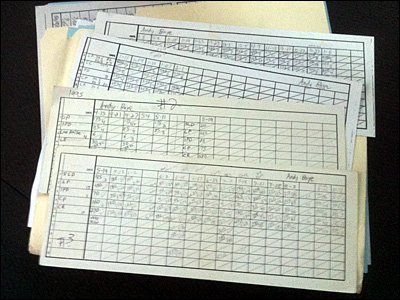
5. Not Keeping A Workout Journal or Progress Charts
Proper adjustment of training volume and frequency to avoid overtraining requires objective evaluation of progress. If you’re not keeping accurate records of your workouts, you can not objectively evaluate the effectiveness of your program and make the necessary changes to keep gaining or get your progress back on track.
6. Using Sloppy Form
Poor form reduces the effectiveness of an exercise and increases the likelihood of injury. While an entire book could be written on the specifics of proper exercise form, one of the most effective ways to improve exercise form in general can be summed up in two words: slow down. Moving more slowly makes it easier to maintain proper positioning and alignment, and allows for better focus on performing the exercise correctly and on intensely contracting the target muscles.
7. Switching Exercises or Routines Too Frequently
Real gains are made by consistent progress on the basic exercises over time. Changing routines too frequently prevents the body from getting past the initial, primarily neural/skill adaptation stage and into the more productive training that follows.
The belief that one must change their routines regularly to avoid plateaus because the muscles become resistant to further improvement with specific exercises is based on the observation that the fastest improvements in performance on an exercise routine occur over the first six to eight weeks after which it begins to slow down, and that changing the routine appears to solve this problem.
During the first several weeks performing a new exercise or routine a larger percentage of the improvements in exercise performance are due to neural or skill adaptations. After this initial period of neural adaptation, performance improvements slow down and the majority of adaptation is occurring in the muscles. This is where the real progress starts, however, and it is important to not change the routine at this point. It will be slower than during the initial six to eight weeks, but you will make progress if you properly adjust your workout volume and frequency.
Contrary to bodybuilding myth and uninformed opinion, the muscles do not stop adapting to a particular exercise, method, or routine – if there is sufficient overload a muscle will be stimulated to grow, and as long as volume and frequency are not excessive, and adequate rest and nutrition are provided, and one hasn’t already reached the limits of their potential, it will grow stronger and larger.
If you only performed a few, basic barbell exercises, covering all the major muscle groups, and trained hard and progressively you would eventually become as big and as muscular as your genetics allow. There is no need to constantly switch up angles, rep methods, or anything else.
8. Not Training Legs
Heavy leg work, squats, deadlifts, leg presses, etc., can be brutal when done properly, and as a result many would-be bodybuilders avoid it, preferring to focus on the relatively easier upper body exercises. This is a huge mistake, as heavy leg work appears to have a beneficial effect on growth throughout the entire body, particularly squats and deadlifts.
Do not skip training legs. Doing so robs you of potential full-body size increases, and having a well developed upper body and chicken legs looks stupid.
9. Not Eating Enough Quality Food
Your body requires both material and energy to produce new muscle tissue. Often, when skinny guys complain they have a hard time gaining muscle mass, it turns out they simply aren’t eating enough food in general or protein in particular to support the growth they stimulate during their workouts. If you want to get big, you have to eat big. This doesn’t mean pigging out, but getting enough quality food and protein daily to add at least a few pounds per month, but not so much your waist size or abdominal skinfold increases significantly.
Just like your workouts, you have to keep track of your eating and make adjustments based on how your body responds.
10. Wasting Money on Bogus Bodybuilding Supplements
While stopping wasting your money on supplements might not make your muscles suddenly start growing, it will stop your wallet from shrinking.
There are a few supplements which have proven to be beneficial, but most provide little or no benefit. If you want to know which supplements work and which don’t, don’t read about them in the bodybuilding magazines – they make a large amount of their money selling advertising to supplement companies and are hardly unbiased sources of information on the subject. Almost everything you read in muscle magazines is bullshit. If you want reliable information on supplements or their ingredients, read the scientific journals, and even then, do so critically.
Comments on this entry are closed.
Nice article-simple but to the point. It’s funny how often a training fix can be based in very basic information and principals. Drew-I would like to hear your opinion on how much protein is necessary for someone wanting to increase muscle mass. Ellington Darden feels only .35 grams per pound of body weight is necessary (the RDA). Others say higher-up to 1-2 grams per pound of body weight and still others base it on per pound of muscle. What do you think?
Sometimes it’s good to just be reminded of the basics. Even though I agree with everything you say, I still find myself straying. It’s so easy to just switch up exercises rather than really pushing hard enough. I DO find it difficult to know if I’m training too frequently or infrequently though. Do you have any advice on the best way to find your personal balance?
Ben,
You may be training too frequently if you are not improving at least a little on most of your exercises every time you work out. Try increasing the rest days between workouts for a few weeks and compare your progress. If it improves significantly, you’ll know you needed the extra time.
Hi Drew,
To most weight trainees – mention any of the 10 bodybuilding mistakes you recieve a blank stare “Keep accurate records” whats that?
Hope the book is due for release soon . Keep up the good work
Hi Drew,
Arthur Jones wrote (approx 1996), “But there is a shortage of facts, at least 99 percent of everything that has ever been published on the subject of exercise is nothing short of outright bullshit,”. Thirteen years on nothing much as changed the 99 percent is still the same and the one percent is still the same – “you form part of that one percent”.
Actually when you think about there is a difference the pile of bullshit has got bigger.
Steven,
While the internet is an incredible tool for communication and education, like any tool it can be misused or used with disastrous results when in the hands of idiots. While it has made it possible those who possess it to share valid training information with people all over the world, it has also allowed countless thousands of uninformed people to share their ignorance and confusion on the subject of exercise, increasing the amount of bullshit exponentially.
Sadly, this is probably not limited to the subject of exercise, and the vast majority of writing on the internet about any subject probably contains a large amount of bullshit. The best we can do is think critically, do our research, and filter out the bullshit as well as we can.
Yeah, training hard is a strange concept. The same people who tell me one set of squats is not enough are the same ones who marvel when I put up 335 for a set of 5 at a bodyweight of 140.
Drew,
Long time no talk. Hope all is well with the family!
Really busy on my side of town with work, family, etc.
Great article! Hope the book includes this straight-forward basic information, if it does I can’t wait to purchase a copy.
Great article Drew. I am looking forward for more such informative posts.
I also read about the paleo diet. There was another related article in that about the drawbacks of a complete cereal diet. It was quiet an eye opener for me as my primary diet is based on cereals (I am from India). I have planned to go on a paleo diet and do HIT as suggested by you. I have a lean framework with a pot belly :-), I will keep you posted on the resutls..
Good luck to you
GREAT post… BUT:
“3. Doing Too Many Exercises and Sets
…in most cases, all you need is one hard set of only one or two exercises per major muscle group. More is rarely necessary, and usually counterproductive.”
At 62 years of age, having strength trained since my teens, I question this statement. The object of the exercise (so to speak) is to TRASH a muscle or muscle group, allow sufficient time for recovery and growth and then TRASH it again. One set will NOT trash a muscle group as well as (at least) 3 sets for these reasons The first set is a “warm up” set, its purpose is simply to bring blood flow to that muscle group. The second set is to stress the muscle somewhat and prepare it for the third set. Now, the muscle group is metabolically prepared for the stress of an all out effort (to failure).
I do partials exclusively as they are easier on the joints and tend to develop the tendons ahead of the muscle body proper, protecting against injury. The point is to stress the muscle and full range reps simply limit the amount of poundage handled due to mechanical considerations.
As an example, I currently (as of last night) do over 100 reps of 1,000 pounds on the leg sled (on my third set). I have charted my recovery times and now allow 5 weeks for recovery and growth (on legs). I do 50+ reps of 335 on bench and allow 3 weeks of recovery.
My point is that a muscle group cannot be properly trashed before 1 or 2 sets have been completed to metabolically “set up” the muscle for the final effort. You can not “Trash” a muscle with one set, no how, no way…
Again, this was a GREAT post, but this “one set” idea is… In my view… Nonsense.
The object of an exercise is not to “TRASH” a muscle or muscle group. It is to stimulate strength and size increases without causing injury in the process. This does not require multiple sets. In most cases a separate warm up is not necessary; blood flow increases, metabolism gears up, etc. during the first few reps of a set to prepare for the later, harder reps.
One set, if performed with a high level of intensity, is all that is necessary. Additional sets will stimulate little or no further improvement while significantly increasing the stress the body must recover from. More work is not the answer – harder work is.
Partials do not develop the tendons ahead or independent of the muscles to any degree. If there is tension on the tendons, there is tension on the muscles and both will adapt to the demands placed on them.
Whether they are easier on the joints or not depends on what part of the range of motion you are performing on which exercises. This can be true in some cases, wrong in others.
Just because a person can use heavier poundages during partials does not mean they are placing a greater demand on the muscles. It is not the weight that matters but the resistance, which is the product of weight and lever. If you are able to lift a significantly heavier weight when doing partials it is because you are limiting the range of motion to positions where you have a greater mechanical advantage. This makes the exercise less effective, not more.
The only case where limiting range of motion makes sense is avoiding positions of active or passive muscular insufficiency because of the effects of the length-tension relationship on the load that can be used. Too little overlap of myofibrils in a stretched position and overlapping of myofibrils in extremely shortened position reduce the tension a muscle can produce and the resistance that can be used. Avoiding these extremes only reduces the range of motion near the ends by a few degrees, not so much that strength does not improve over the full range of motion (research shows strength gains are specific to the ROM trained in most of the population, but within a range of about 12 to 20 degrees of the positions trained).
I am sure he is referring to one working set which means that you have to work up to that final set with multiple lighter and progressively heavier sets. All professional bodybuilders I have trained with and watched training use a pyramid rep/set scheme, starting light and working up to a heavy final set. Even the classic Delorme 3 Sets of 10 protocol was actually 50% on the first set, 75% on the second set and 100% on the third and final set of 10 reps.
No Philippe,
I mean only one set. No separate warm-up sets or build-up sets are required. If done intensely enough one is all you need.
“The primary, on-going debate regarding the required volume of exercise for strength relates to the recommended number of sets. The ACSM [15] cited a meta-analysis [132, 133] suggesting that the largest effect sizes (ES) for strength increases with athletes occurred when performing 8 sets per muscle group. Carpinelli [19] considered this meta-analysis, criticizing the authors for the inclusion of studies that failed to meet their own criteria. In addition their conclusions were unsupported as there were no significant differences between the ES of the different training volumes. In fact, most research to date suggests that there is no significant difference in strength increases between performing single or multiple set programs [51, 134-137). For example, Carpinelli and Otto [134] found that single sets produced similar results in 33 out of 35 studies they reviewed.”
Fisher J, Steele J, Bruce-Low S, Smith D. Evidence Based Resistance Training Recommendations. Medicine Sportiva Med Sport 01/2011; 15:147-162.
Hi Drew,
I am a textbook ectomorph who has been training HIT style for the past 3 months. I have recently been experiencing involuntary muscle twitching in my neck/head. This stated shortly after I began HIT training. I rest 4 days between workouts and have consistent strength gains. What recommendations could you give me?
Thanks
Ramsey,
Some people experience this after exercise. Assuming you’re eating a well balanced diet it shouldn’t be due to a mineral deficiency, but if it continues for more than a few weeks try eating more foods containing potassium, magnesium and calcium like various squashes, egglplant, asparagus, cucumber, etc. If this doesn’t help and the twitching continues for a long period of time see a doctor about it.
Drew,
is working each muscle group one time a week enough to build muscle to maximum potential? ex. upper body one day and lower body one day with the other 5 days off
Phil,
Any frequency of training not too high to prevent recovery and adaptation or too low to allow decompensation will eventually get an individual to their maximum muscular potential. The ideal frequency which allows one to maximize their potential as quickly as possible varies considerably between individuals and requires some experimentation to determine. Two full body workouts per week is a good starting point and most will require a lower frequency or a reduction in workout volume as they improve and the intensity of their workouts increases.
Drew,
Great post!
What are your thoughts on static contraction, max contraction, and isometric training(pete sisco, john little and paul o’brian). These systems claim to be cutting edge for gaining strength and size. They say that there is no need to train full R.O.M. to become bigger and stronger and it much safer. They claim it is pure science and it is all valid. Are they valid? What are your thoughts?
Jake,
You don’t need to train full ROM to become bigger and stronger and certain isometric protocols are much safer. I wrote about this in the chapters Motion and Range of Motion in Elements of Form and will be writing about some of the work we are doing with timed static contraction within the next few months.
You trashed super slow weight lifting as a cult, if I remember correctly, during the 21 Convention but now you are saying doing a rep for 10 seconds is good. Why did you change from the 3 seconds up 3 seconds down you once said was the optimal way to perform exercise? What lead to this change?
Ernie,
I switched from SuperSlow to a more moderate cadence years ago suspecting it would still allow for controlled turnarounds and efficient loading and the additional mechanical work might provide an advantage. It did not. Also, I found most clients could not perform reasonably good turnarounds unless they moved much more slowly, and proper turnaround performance is important for both safety and efficient loading.
Any reasonably controlled speed of movement will be effective, but for safety and efficiency it is better to err on the slow side, and a 10/10 cadence is a good halfway point between the fastest most people can go while maintaining reasonably good form (about 5/5) and the slowest most people can go without the movement becoming “stuttered” instead of continuous (about 15/15).
Drew,
How do you judge when to terminate a TSC. Without some sort of gauge, it’s hard to get a feel for it. With max contraction the weight falls down but with TSC it appears to go on indefinately.
Brian,
Whether performed with or without equipment with measuring capability Timed Static Contraction protocol is performed for a specific duration. I am working on an article on this which will go up on the site after I finish other writing projects.
I’d add a subset of #5: Not appreciating that even the smallest improvement is important. Early strength increases are bound to slow down. What slow reps will reveal to be a valuable couple of extra pounds, added seconds, &/or improved form, will appear to be a frustrating plateau in methods using rapid cadences, little regard for form, & larger jumps in weight.
Hi Drew,
Recently I have moved to 10/10 with most of my exercises, I have found 10/10 to be safer on my joints and with better results. I have also found at 10/10 the muscle has to do all the work. I think that the speed of movement in exercise is greatly misunderstood most people move way too fast.
A person with a mechanical background explained to me that with cars regardless of the size of the engine that at some point “inertia” (speed of movement of the car) can take over requiring minimal work output from the engine. I presume that it would be the same with muscles once the speed of movement becomes too fast a major factor for muscle strengthening is greatly reduced.
Steven,
The scales of speed and distance are much different, but the same principles apply. The greater the acceleration the more kinetic energy is imparted to the weight being moved, reducing the amount of effort required to keep it moving for some time after positive acceleration has ceased. With proper turnaround technique and adequately slow speed of movement the effect of this is small enough to be unnoticeable.
Drew,
For the last month or two I decided to try much slower reps after reading about your slow rep recommendations. I ended up doing 15 second reps (6 seconds up 7 down with a pause at both ends). I split the workout into 2 with 3 major compounds in each and do a workout every 4 or 5 days. I really liked the metabolic conditioning/fitness level I got to but I got a hankering to lift heavier.
So I started doing rest pause sets for the 3 compounds in each workout. I increased the weight of each exercise by 30%. I pick up (unrack) the weight, do 1 rep and then put the weight down, rest about 10 seconds then do another rep until failure. Usually I get 5-7 reps before I’m spent. I plan on doing this type of training for a couple months until I go back to slow reps (and after awhile perhaps alternate again).
Have you ever done this type of rest pause training? If so, what can I expect? I warm up well and keep my form perfect.
thanks,
Ritchie
Ritchie,
I have experimented with variations of rest pause training and have had good results with it. However, every time I did I also started experiencing joint pain within about two months and had to stop despite extremely good form.
I recommend dropping it and going back to continuous reps. Your results depend more on the effort you put into each exercise and the overall workout than the amount of weight being lifted, and continuous repetitions are far more efficient for this purpose.
Everybody thinks their form is perfect. Ninety percent of people think they’re above average drivers as well. Obviously, this is not the case. Less obviously, the distribution is more of a Pareto law than Gaussian, with the percent of people with poor form and who are poor drivers being much greater than half. You might be an exception, but nearly every person I’ve trained including many personal trainers who believed they had perfect form were far from it. It is better to err more conservatively where safety is concerned and use weights you can handle as strictly as possible for continuous repetitions and focus on achieving deep inroad an high intensity effort rather than just moving a lot of weight.
Drew,
I have a question about frequency. I am training twice per week using one set to failure. I do upper body and lower body split. I have been recording the weight and the time. Over the last 3 sessions I have failed to improve on TUL. Why could that be? Is it that I need to rest longer than 7 days or do I need to train harder? I am achieving positive failure and contracting for a further 5 – 10 seconds. How does one know when to increase the weight? I fail at around 1:15 on most exercises. Is there a certain time that I cannot exceed perhaps and therefore should I just increase the weight anyway? It’s just that a rest of longer than 7 days just seems to much. Thanks in advance.
Robert,
There are a lot of other factors involved, including diet, rest, other stresses, etc., and without knowing what’s going on with those it is impossible to say. Assuming you’re eating well, getting plenty of sleep, etc. you may need to train harder, alter your workouts in some way, or allow more time for recovery in between. If you’re interested in discussing these in detail I’m available for phone consultations.
As a long time follower of HIT training since the late 70’s, I couldn’t agree more with the premise of your article. However, I do disagree with the reliance of a routine comprised solely of compound exercises. I’ve been performing a full body routine of 8 isolation exercises every 5 days for several years and making excellent size gains. I had used a “consolidation” routine of three compound exercises of squats/leg presses, dips and pulldowns prior to this, and though I had made significant strength gains, I was very disappointed in the way of size gains. I have a clean diet and perform no “cardio” exercises. I’m 5’8″, 180 lbs. with about 10% B.F. Maybe I’m just an outlier.
Andy,
Compound exercises are more efficient for general strengthening and conditioning, easier for most people to learn and perform correctly, and will get most people about as big and strong as they are capable of becoming. Simple exercises can be more effective for working specific muscle groups but dividing the body up too much can be counterproductive as the total number of movements per workout increases. I wouldn’t consider eight exercises excessive though.
To paraphrase an earlier post: “If you ‘enjoy’ your workout, you’re not exercising.” (Assuming that getting as many people as possible to exercise properly is a concern), factor in that many of the people who most need to begin exercising don’t want to work hard, and you have a recipe for failure, (the bad kind). This where a session of 3 to 5 compound movements shines: Go ahead and work hard; the end is clearly in sight.
Drew –
Sorry if I missed it but the sorts of lifting tempos you prescribe would appear to be problematic for squats and deadlifts.
How should I approach these particular movements ?
Dale,
I recommend the same cadence for squats and deadlifts. Moving very slowly makes these exercises much more challenging, but also much safer. To do them correctly and over a full range of motion at a 10/10 cadence you will need to reduce the weight from what you would use for a more typical cadence. I realize many are reluctant to do this, but keep in mind it is the relative effort you put into an exercise and not the absolute load that matters.
I would only add the word continuous before relative effort because your goal is to make the exercise hard (effective) for every inch and every second … no unloading at all.
Drew,
I think one of the hang-ups some of us have about the presentation of the approach to slow training is the assertion of 10/10 as the standard. I think the scientific evidence is persuasive that relative effort (and not external load) is the key to strength (and perhaps muscle hypertrophy) gains. So, on that, we’re in agreement. However, I think there’s much less scientific evidence to support 10/10 as the default standard. The evidence provided has always been anecdotal; or, we’re asked to rely upon the experience of a small group of trainers with their trainees. That type of evidence is interesting, and worth reporting as relevant data points, but not dispositive of the matter. If one can achieve maximum relative effort at 6/6, 5/5, 8/4, then that’s good. 10/10 is simply not necessary to achieve proper turn-arounds for safety purposes either (maybe for some, not for all). Whether 10/10 is ‘harder’ or not, obviously depends upon the trainee, what their past training experiences are, and so forth. For me, the ‘aesthetics’ of training (a type of enjoyment of the physical activity) are part of the larger training effect I seek through the time spent training. I don’t mean to valorize a ‘1 n’ approach to thinking about all this, but, for my purposes, a somewhat faster cadence is best – I lose absolutely nothing in terms of form, achievement of maximum relative effort, safety, and overall training effect.
Will,
The goal when performing a turnaround is to minimize variation in force due to acceleration. We’ve found most people have a difficult time doing this at cadences shorter than 5/5 over typical ranges of motion (something we can measure with the RenEx machines). We have also found most people have a difficult time moving smoothly at cadences longer than 15/15; below some speed movement tends to occur in short starts and stops rather than a slow, continuous movement. The recommendation for 10/10 is an average based on these.
While a 5/5 cadence is reasonably safe with good form, the majority of people have horrible form so I think it is best to err on the side of caution and recommend it as a standard.
Everybody thinks they have good form, but in my experience most people including the majority of HIT trainers out there are pretty sloppy and have a very poor sense of time and cadence (with the exception of musicians I’ve trained). If I tell people 5/5 they’ll go about twice as fast. If I tell them 10/10, maybe they’ll go 5/5 and at least be moving reasonably slowly.
Drew
It’s great that you take the time to answer all these questions.
John
John,
I try to answer as much as I can when time permits. I’ve been a lot busier with training recently which has made keeping up with the web site and other writing a lot more difficult though.
Hi Drew,
I wouldn’t constrain the 10 biggest mistake to “body builders” from my observations these 10 mistakes are made by most trainees. What surprises me when it is clearly evident that something is wrong with the training program and they continue to train in a such sloppy fashion. It also surprises me that for the many many hours that some people train that they never analyse their training or their training progress.
The single biggest mistake in bodybuilding?: The belief that any exercise is better than no exercise at all. Most so-called exercise is at best a waste of time, at worst a cause of injury.
Mark,
I wrote about that in Something Is Not Always Better Than Nothing.
Drew,
if one trains once a week instead of twice a week (one x two identical workouts)..if we assume he wouldn’t overtrain twice a week, but doesn’t have time/doesn’t want to risk it. If all other factors are constant, does this mean he just gets slower to his potential, or he will never get there because of being too conservative? I believe he “wastes some days” in terms of speed of this progression, but doesn’t compromise the progression itself in the very long run, because in the end he should achieve the same physique…what is your opinion on that?
Thanks.
Ondrej,
If a person trains less frequently than they are capable of but not so infrequently as to allow their body to fully decompensate between workouts they will take longer to reach the limits of their potential. Once weekly is not so infrequent for this to occur and some people actually require less frequent training just to progress.
Questions like this make me wonder about the lifestyles & goals of trainees. Of course, if one’s livelihood will be enhanced by effecting the most rapid possible development, the concept of “wasted days”, is relevant, but other than competitive bodybuilding, I don’t see a situation that validates working out as soon as one has recuperated. Just as athletes need fully-recuperated time to successfully exhibit their strength-enhanced skills in competition, most(?) of us want a few days to -enjoy- our improvements. If I thought the only advantage of working out was to have better workout next time, (isn’t that all the ultimately efficient schedule would allow?), I’d quit.
Thank you both. I have in fact the same opinion, it’s better to be few days above baseline than to overtrain. And it even better incorporates to busy lifestyle, once a week frequency allows everyone to train at the weekend, to prepare for the session and concentrate. It’s just that almost everyone considers training twice a week as a good starting point, but I don’t see that much benefit over starting once a week. Nevertheless, lot of HIT books consider training once a week as a less optimal variant, except Body by Science. I guess it might be the fear of less frequent client visits of the exercise centres…
Ondrej,
Even if your body recovers quickly enough for you to make good progress training twice a week you can get very good results training once weekly. In the case of someone who recovers faster it comes down to whether a faster rate of progress is worth the additional time and effort. For some people just getting “good” results is enough, for others it is worth it to train as frequently as their recovery ability allows. In either case it is better to err on the side of more recovery than less.
I perform full body, one set workouts twice a week and have consistently, even if minimally, gone up in weight or reps almost every workout over the past two years. My question is, how would I know when I’ve reached my “maximum muscular potential? And how long of a time should I expect it to take to get there? Also, while my strength has steadily increased, my size has not increased as much as I’d like. What should the relationship look like? Is there a way to improve one more than the other, or vice versa?
Joe,
There is no way to know exactly what a person’s maximum muscular potential is, but if after a few years of steady progress your size and strength gains gradually level out you’re probably getting pretty close to it. I believe with proper training, nutrition and rest most people should expect to get most of the way there within a year or two. The closer you get to it the harder it gets to progress further.
The relationship between muscular strength and size increases is largely genetic. Despite claims of training for strength versus size, myofibrilar versus sarcoplasmic hypertrophy, etc. regardless of how they train some people will gain a lot of strength without much of a size increase, some will put on a lot of size without getting very strong, and most of us will be somewhere in between.
Hi Drew,
What about all the noise I’m hearing lately about the difference between training for size and strength. Do you require explosive pumping reps and sets to enlarge the sacroplasm?
I followed Mentzer’s consolidation routine for awhile – got stronger but you wouldn’t know from looking at me that I worked out.
Training for strength and size are the same. Read Q&A: High Intensity Training for Strength vs Size vs Power
Squats, leg presses and deadlifts are all very good lower torso compound exercises. But it seems to me the shortcoming lies with compound upper torso exercises, which seem to place the focus primarily on the arms more than anything else(especially bench presses).
This is not a problem when those exercises are performed correctly.
Drew why not have the best of 2 speed of movements?
Use the best safer time (10″) and use neg. emphasized
Then the result is a 5″ concentric +10 ” eccentric .. 3 to 5 reps
There is no significant difference in long term strength and size gains between any reasonably slow repetition cadences.