
This article is posted with the written permission of the author, Professor Eyal Lederman of CPDO Ltd. in London. Thanks to Steve Turner for making me aware of the article and to Professor Lederman for allowing me to post it here.
This is important reading for anyone involved in exercise, either professionally or for their own health and fitness, and especially for those who train individuals with or have lower back pain, as it addresses many of the myths of the current core and stability training trends.
The Myth of Core Stability
Professor Eyal Lederman
CPDO Ltd.,
15 Harberton Road,
London N19 3JS,
UK,
E-mail: cpd@cpdo.net
Tel: 0044 207 263 8551
Abstract
The principle of core stability has gained wide acceptance in training for prevention of injury and as a treatment modality for rehabilitation of various musculoskeletal conditions in particular the lower back. There has been surprising little criticism of this approach up to date. This article will re-examine the original findings and the principles of core stability and how well they fare within the wider knowledge of motor control, prevention of injury and rehabilitation of neuromuscular and musculoskeletal systems following injury.
Key words: Core stability, transverse abdominis, chronic lower back and neuromuscular rehabilitation
Introduction
Core stability (CS) arrived in the latter part of the 1990’s. It was largely derived from studies that demonstrated a change in onset timing of the trunk muscles in back injury and chronic lower back pain (CLBP) patients [1, 2]. The research in trunk control has been an important contribution to the understanding of neuromuscular reorganisation in back pain and injury. As long as four decades ago it was shown that motor strategies change in injury and pain [3]. The CS studies confirmed that such changes take place in the trunk muscles of patients who suffer from back injury and pain.
However, these findings combined with general beliefs about the importance of abdominal muscles for a strong back and influences from Pilates have promoted several assumptions prevalent in CS training:
- That certain muscles are more important for stabilisation of the spine, in particular transverses abdominis (TrA).
- That weak abdominal muscles lead to back pain
- That strengthening abdominal or trunk muscles can reduce back pain
- That there is a unique group of “core” muscles working independently of other trunk muscles
- That a strong core will prevent injury.
- That there is a relationship between stability and back pain
As a consequence of these assumptions, a whole industry grew out of these studies with gyms and clinics worldwide teaching the “tummy tuck” and trunk bracing exercise to athletes for prevention of injury and to patients as a cure for lower back pain [4, 5]. At that point core stability became a cult and TrA its mantra.
In this article some of these basic assumption will be re-examined. In particular, it will examine:
- The role of TrA as a stabiliser and relation to back pain: is TrA that important for stabilisation?
- The TrA timing issue: what are the timing differences between asymptomatic individuals and patients with LBP? Can timing change by CS exercise?
- Abdominal muscle strength: what is the normal strength needed for daily activity? Can CS exercise affect strength?
- Single muscle activation: can single muscle be selected? Does it have any functional meaning during movement?
Assumptions about stability and the role of TrA muscle
In essence the passive human spine is an unstable structure and therefore further stabilisation is provided by co-contraction of trunk muscles. Erroneously, these muscles are often referred to in CS approach as the “core” muscles, assuming that there is a distinct group, with an anatomical and functional characteristics specifically designed to provide for the stability. One of the muscles in this group to have received much focus is TrA. It is widely believed that this muscle is the main anterior component of trunk stabilisation. It is now accepted that many different muscles of the trunk contribute to stability and that their stabilasing action may change according to varying tasks (see further discussion below).
The TrA has several functions in the upright posture. Indeed stability, but this function is in synergy with every other muscle that makes up the abdominals wall and beyond [6-8]. It acts in controlling pressure in the abdominal cavity for vocalization, respiration, defecation, vomiting etc. [9]. TrA forms the posterior wall inguinal canal and where its valve-like function prevents the viscera from popping out through the canal [10].
How essential is TrA for spinal stabilisation? One way to asses this is to look at situations where the muscle is damaged or put under abnormal mechanical stress. Would this predispose the individual to lower back pain?
According to Gray’s Anatomy (36th edition 1980, page 555) TrA is absent or fused to the internal oblique muscle as a normal variation in some individuals. It would be interesting to see how these individuals stabilise their trunk and whether they suffer more back pain.
Pregnancy is another state that raises some important questions about the role of TrA or any abdominal muscle in spinal stabilisation. During pregnancy the abdominal wall muscles undergo dramatic elongation, associated with force losses and inability to stabilise the pelvis against resistance [11, 12]. Indeed, in a study of pregnant women (n=318) they were shown to have lost the ability to perform sit-ups due to this extensive elongation and subsequent force losses [12]. Whereas all non-pregnant women could perform a sit-up, 16.6% of pregnant women could not perform a single sit-up. However, there was no correlation between the sit-up performance and backache, i.e. the strength of abdominal muscle was not related to backache. Despite this, CS exercises are often prescribed as a method for retraining the abdominal muscles and ultimately as a treatment for LBP during pregnancy. There is little evidence that localized musculoskeletal mechanical issues, including spinal stability play a role in the development of LBP during pregnancy. Often sited predisposing factors are, for example, body mass index, a history of hypermobility and amenorrhea [13], low socioeconomic class, existence of previous LBP [14], posterior/fundal location of the placenta and a significant correlation between fetal weight and LBP with pain radiation [14]. It is surprising that such dramatic postural, mechanical and functional changes to the trunk and lumbar spine seem to have an insignificant role in the development of back pain during pregnancy.
Another interesting period for us concerning stabilisation is immediately after delivery. Postpartum, it would take the abdominal muscle about 4-6 weeks to reverse the length changes and undergo re-shortening. Rectus abdominus takes about 4 weeks postpartum to re-shorten, and it takes about 8 weeks for pelvic stability to normalize [11]. It would be expected that during this period there would be minimal spinal support / stabilisation from the slack abdominal muscles and their fascia. Would this increase the likelihood for back pain?
In a recent study, the effects of a cognitive-behavioural approach were compared with standard physiotherapy on pelvic and lower back pain immediately after delivery [15]. An interesting aspect of this research was that out 869 pregnant women who were recruited for the study, 635 were excluded because of their spontaneous unaided recovery within a week of delivery. This would have been during a period, well before the abdominal muscles had time to return to their pre-pregnancy length, strength or control [11]. Yet, this was a period when back pain was dramatically reduced. How can it be that back and pelvic pain is improving during a period of profound abdominal muscle inefficiency? Why does the spine not collapse? Has the relationship between abdominal muscles and spinal stability been over-emphasised?
Another potential source of information on the relationship between altered abdominal muscle function and back pain is the literature on obesity. One would expect, as in pregnancy, the distention of the abdomen to disrupt the normal mechanics and control of the trunk muscle, including TrA. According to CS model this should result in an increased incidence of back pain among this group. Yet, epidemiological studies demonstrate weight gains and obesity are only weakly associated with lower back pain [16]. According to the CS model we should be seeing an epidemic of back pain in over-weight individuals.
Another area that can shed light on control of stability and abdominal muscles is the study of abdominal muscles that have been damaged by surgery. Would such damage affect spinal stability or contribute to back pain? In breast reconstruction after mastectomy, one side of the rectus abdominis is used for reconstruction of the breast. Consequently, the patient is left with only one sided rectus abdominis and weakness of abdominal muscles. Such alteration in trunk biomechanics would also be expected to result in profound motor control changes. Despite all these changes there seems to be no relationship to back pain or impairment to the patient’s functional / movement activities, measured up to several years after the operation [17, 18].
One area for further study would be that of subjects who have had inguinal hernia repair. In this operation the TrA is known to be affected by the surgical procedure [19, 20]. Up to date there is no known epidemiological study linking such surgery and back pain (perhaps because it doesn’t exist?).
We can conclude from the above that healthy abdominal musculature can demonstrate dramatic physiological changes, such as during pregnancy, post-partum and obesity, with no detriment to spinal health. Similarly, damage to abdominal musculature does not seem to impair normal movement or contribute to LBP.
The timing issue
In one of the early studies it was demonstrated that during rapid arm / leg movement, the TrA in CLBP patients had delayed onset timing when compared with asymptomatic subjects [1, 2]. It was consequently assumed that the TrA, by means of its connection to the lumber fascia, is dominant in controlling spinal stability [8]. Therefore any weakness or lack of control of this muscle would spell trouble for the back.
This assumption is a dramatic leap of faith. Firstly, in our body all structures are profoundly connected in many different dimensions, including anatomically and biomechanicaly. You need a knife to separate them from each other. It is not difficult to emphasise a connection that would fit the theory, i.e. that the TrA is the main anterior muscle to controls spinal stability. In normal human movement postural reflexes are organised well ahead in anticipation of movement or perturbation to balance. TrA is one of the many trunk muscles that takes part in this anticipatory organisation [21]. Just because in healthy subjects it kicks off before all other anterior muscles, does not mean it is more important in any way. It just means it is the first in a sequence of events [22]. Indeed, it has been recently suggested that earlier activity of TrA may be a compensation for its long elastic anterior fascias [23].
It can be equally valid to assume that a delay in onset timing in subjects with LBP may be an advantageous protection strategy for the back rather than a dysfunctional activation pattern. Furthermore, it could be that during the fast movement of the outstretched arm the subject performed a reflexive pain evasion action that involved delayed activation of TrA, an action unrelated to stabilisation [24, 25]. An analogy would be the reflex pulling of the hand from a hot surface. One could imagine that a patient with a shoulder injury would use a different arm withdrawal pattern from a normal individual. This movement pattern would be unrelated to the control of shoulder stability but would be intended to produce the least painful path of movement, even if the movement is not painful at the time. A similar phenomenon has been demonstrated in trunk control where just the perception of a threat of pain to the back resulted in altered postural strategies [26].
In the original studies of CS onset time differences between asymptomatic individuals and patients with CLBP were about 20 Ms, i.e. one fiftieth of a second difference [27]. It should be noted that these were not strength but timing differences. Such timings are well beyond the patient’s conscious control and the clinical capabilities of the therapist to test or alter.
Often, in CS exercise there is an emphasis on strength training for the TrA or low velocity exercise performed laying or kneeling on all fours [28]. It is believed that such exercise would help normalise motor control which would include timing dysfunction. This kind of training is unlikely to help reset timing differences. It is like aspiring to play the piano faster by exercising with finger weights or doing slow push ups. The reason why this ineffective is related to a contradiction which CS training creates in relation to motor learning principles (similarity / transfer principle) and training principles (specificity principle, see further discussion below). In essence these principles state that our bodies, including the neuromuscular and musculoskeletal systems, will adapt specifically to particular motor events. What is learned in one particular situation may not necessarily transfer to a different physical event, i.e. if strength is required – lift weights, if speed is needed – increase the speed of movement during training and along these lines if you need to control onset timing switch your movement between synergists at a fast rate, and hope that the system will reset itself [29].
To overcome the timing problem the proponents of CS came up with a solution – teach everyone to continuously contract the TrA or to tense/brace the core muscle [4, 30]. By continuously contracting it would overcome the need to worry about onset timing. What is proposed here is to impose an abnormal, non-functional pattern of control to overcome a functional organisation of the neuromuscular system to injury: a protective control strategy that is as old as human evolution.
We now know that following injury, one motor strategy is to co-contract the muscles around the joint (amongst many other complex strategies). This injury response has also been shown to occur in CLBP patients [31-34], who tend to co-contract their trunk flexors and extensors during movement [35]. This strategy is subconscious, and very complex. It requires intricate interactions between the relative timing, duration, force, muscle lengths and velocities of contraction of immediate synergist [27, 36]. Further complexity would arise from the fact that these patterns would change on a moment-to-moment basis and different movement/postural tasks [37-39]. Whichever muscle activity is observed in standing with the arm out-stretched will change in bending forward, twisting or even the arm in a different position. Indeed, in the original studies of the onset timing of TrA delay in onset timing were observed during fast but not during slow arm movements [1]. Even during a simple trunk rotation or exercise the activity in TrA is not uniform throughout the muscle [40, 41].
These studies demonstrate the complexity that a patient re-learning trunk control may have to face. How would a person know which part of the abdomen to contract during a particular posture or movement? How would they know when to switch between synergists during movement? How would they know what is their optimal co-contraction force? If CLBP patients already use a co-contraction strategy why increase it? It is naïve to assume that by continuously contracting the TrA it will somehow override or facilitate these patterns. No study to date has demonstrated that core stability exercise will reset onset timing in CLBP patients.
The strength issue
There is more confusion about the issue of trunk strength and its relation to back pain and injury prevention. What we do know is that trunk muscle control including force losses can be present as a consequence of back pain / injury. However, from here several assumptions are often made:
- That loss of core muscle strength could lead to back injury,
- That increasing core strength can alleviate back pain
To what force level do the trunk muscles need to co-contract in order to stabilise the spine? It seems that the answer is – not very much. During standing and walking the trunk muscles are minimally activated [42]. In standing the deep erector spinal, psoas and quadratus lumborum are virtually silent! In some subjects there is no detectable EMG activity in these muscles. During walking rectus abdominis has a average activity of 2% maximal voluntary contraction (MVC) and external oblique 5% MVC [43]. During standing “active” stabilisation is achieved by very low levels of co-contraction of trunk flexors and extensor, estimated at less than 1% MVC rising up to 3% MVC when a 32 Kg weight is added to the torso. With a back injury it is estimated to raise these values by only 2.5% MVC for the unloaded and loaded models [44]. During bending and lifting a weight of about 15 kg co-contraction increases by only 1.5% MVC [45].
These low levels of activation raise the question of why strength exercises are prescribed when such low levels of co-contraction forces are needed for functional movement. Such low co-contraction levels suggest the strength losses are unlikely ever to be an issue for spinal stabilisation. A person would have to loose substantial trunk muscle mass before it will destabilise the spine!
The low levels of trunk muscle co-contraction also have important clinical implications. It means that most individuals would find it impossible to control such low levels of activity or even be aware of it. If they are aware of it they are probably co-contracting well above the normal levels needed for stabilisation. This would come at a cost of increasing the compression of the lumbar spine and reducing the economy of movement (see discussion below).
Is there a relationship between weak abdominals (e.g. TrA) and back pain? A common belief amongst therapists and trainers who use CS is that trunk strength will improve existing back pain. It has been shown that a muscle such as multifidus [46] can undergo atrophy in acute and CLBP (although this is still inconclusive). However, strengthening these muscles does not seem to improve the pain level or disability in CLBP patients [47]. Improvement appeared to be mainly due to changes in neural activation of the lumbar muscles and psychological changes concerning, for example, motivation or pain tolerance [48]. Similarly, it is well established that the motor strategy changes in the recruitment of the abdominal muscles in patients with CLBP [31, 49, 50], with some studies demonstrating weakness of abdominal muscles [36, 51, 52]. No studies to date have shown atrophy of abdominal muscles and no studies have shown that strengthening the core muscles, in particular the abdominal muscles and TrA, would reduce back pain (see discussion below).
There are also examples where abdominal muscle activity is no different between asymptomatic and CLBP subjects. For instance, in studies of elite golfers, abdominal muscle activity and muscle fatigue characteristics were similar between asymptomatic and CLBP subjects after repetitive golf swings [53]. Yet, this is the type of sportsperson who would often receive CS exercise.
Doubts have been also raised concerning the effectiveness of many of CS exercise in helping to increase the strength of core muscles. It has been shown that during CS exercise, the maximal voluntary contraction (MVC) of the “core muscles” is well below the level required for muscle hypertrophy and is therefore unlikely to provide strength gains [54-56]. Furthermore, in a study of fatigue in CLBP, four weeks of stabilisation exercise failed to show any significant improvement in muscle endurance [57]. A recent study has demonstrated that as much as 70% MVC is needed to promote strength gains in abdominal muscle [58]. It is unlikely that during CS exercise abdominal muscle would reach this force level [59].
The single / core muscle activation problem
One of the principles of CS is to teach the individuals how to isolate their TrA from the rest of the abdominal muscles or to isolate the “core muscle” from “global” muscles.
It is doubtful that there exists a “core” group of trunk muscle that operated independently of all other trunk muscles during daily or sport activities [37, 60]. Such classification is anatomical but has no functional meaning. The motor output and the recruitment of muscles is extensive [61, 62], effecting the whole body. To specifically activate the core muscles during functional movement the individual would have to override natural patterns of trunk muscle activation. This would be impractical, next to impossible and potentially dangerous – “Individuals in an externally loaded state appear to select a natural muscular activation pattern appropriate to maintain spine stability sufficiently. Conscious adjustments in individual muscles around this natural level may actually decrease the stability margin of safety”[63].
Training on single muscle is even more difficult. Muscle-by-muscle activation does not exist [64]. If you bring your hand to your mouth the nervous system “thinks” hand to mouth rather than flex the biceps, than the pectoral etc. Single muscle control is relegated in the hierarchy of motor processes to spinal motor centers – a process that would be distant from conscious control (interestingly even the motor neurons of particular muscles are intermingled rather than being distinct anatomical groups in the spinal cord [65]). Indeed, it has demonstrated that when tapping the tendons of rectus abdominis, external oblique and internal oblique the evoked stretch reflex responses can be observed not only in muscle tapped, but it spreads equally to muscles on the ipsilateral and contralateral sides of the abdomen [66]. This suggests sensory feedback and reflex control of the abdominal muscles is functionally related and would therefore be difficult to separate by conscious effort.
This simple principles in motor control poses two problems to CS training. First, it is doubtful that following injury only one group or single muscles would be affected. Indeed, the more EMG electrodes applied the more complex the picture becomes [67]. It is well documented that other muscle are involved – multifidus [68], psoas [69], diaphragm [8], pelvic floor muscles [70], gluteals [71] etc. Basically in CLBP we see a complex and wide reorganisation of motor control in response to damage.
The second problem for CS is that it would be next to impossible to contract a single muscle or specific group. Even with extensive training this would be a major problem [72]. Indeed, there is no support from research that TrA can be singularly activated [62]. The novice patient is more likely to contract wide groups of abdominal muscles [6, 41, 73]. So why focus on TrA or any other specific muscle or muscle group?
CS and training in relation to motor learning and training issues
Further challenges for the CS model arise from motor learning and training principles.
CS training seems to clash with three important principles:
- The similarity (transfer) principle in motor learning and specificity principle in training
- Internal-external focus principles
- Economy of movement
Similarity / specificity principles – when we train for an activity we become skilled at performing it. So if we practice playing the piano we become a good pianist, hence a similarity principle. We can’t learn to play the piano by practicing the banjo. This adaptation to the activity is not only reserved to learning processes, it has profound physical manifestations – hence the specificity principle in training [74]. For that reason a weight trainer looks physically different to a marathon runner.
If a subject is trained to contract their TrA or any anterior abdominal muscle while lying on their back [75], there is no guarantee that this would transfer to control and physical adaptation during standing, running, bending, lifting, sitting etc. Such control would have to be practiced in some of these activities. Anyone who is giving CS exercise to improve sports performance should re-familiarise themselves with this basic principle.
It seems that such basic principles can escape many of the proponents of CS. This is reflected in one study which assessed the effect of training on a Swiss ball on core stability muscles and the economy of running [76]! In this study it was rediscovered that practicing the banjo does not help to play the piano. The subjects got very good at using their muscles for sitting on a large inflatable rubber ball but it had no effect on their running performance.
Trunk control will change according to the specific activity the subject is practicing. Throwing a ball would require trunk control, which is different to running. Trunk control in running will be different in climbing and so on. There is no one universal exercise for trunk control that would account for the specific needs of all activities. Is it possible to train the trunk control to specific activity? Yes, and it is simple – just train in that activity and don’t worry about the trunk. The beauty of it all is that no matter what activity is carried out the trunk muscles are always specifically exercised.
Internal and external focus in training – CS has evolved over time in response to many of the model’s limitations described above. Currently, the control of TrA is attempted in different standing and moving patterns [30]. Speed of movement, balance and coordination has been introduced to the very basic early elements of CS. The new models encourage the subjects to “think about their core” during functional activities. One wonders if David Beckham thinks about the “core” before a free kick or Michael Jordan when he slam-dunks or for that matter our patient who is running after a bus, cooking or any other daily activities. How long can they maintain that thought while multitasking in complex functional activities?
Maybe thinking about the core is not such a good idea for sports training. When learning movement a person can be instructed to focus on their technique (called internal focus) or on the movement goal (called external focus). When a novice learns a novel movement focusing on technique (internal focus) could help their learning [77]. For a skilled person, performance improves if training focuses on tasks outside the body (external-focus) but it reduces when the focus is on internal processes within the body [78, 79]. For example, there is greater accuracy in tennis serves and football shots when the subjects use external-focus rather than internal-focus strategies [80, 81]. This principle strongly suggests that internal focus on TrA or any other muscle group will reduce skilled athletic performance. (Tensing the trunk muscle has even been shown to degrade postural control! [82])
What about movement rehabilitation for a CLBP patients, would internal focus on specific muscles improve functional use of trunk muscles? Lets imagine two scenarios where we are teaching a patient to lift a weight from the floor using a squat position. In the first scenario, we can give simple internal focus advice such bend your knees, and bring the weight close to your body, etc [83, 84]. This type of instruction contains a mixture of external focusing (e.g. keep the object close to your body and between your knees) and internal focus about the body position during lifting. In the second scenario which is akin to CS training approach, the patient is given the following instructions: focus on co-contracting the hamstrings and the quads, gently release the gluteals, let the calf muscles elongate, while simultaneously shorten the tibialis anterior etc. Such complex internal focusing is the essence of CS training, but applied to the trunk muscles. It would be next to impossible for a person to learn simple tasks using such complicated internal focus approach.
Economy of movement – The advice given to CS trainees is to continuously tighten their abdominal and back muscles could reduce the efficiency of movement during daily and sports activities. Our bodies are designed for optimal expenditure of energy during movement. It is well established that when a novice learns a new motor skill they tend to use a co-contraction strategy until they learn to refine their movement [85]. Co-contraction is known to be an “energy waster” in initial motor learning situations. To introduce it to skilled movement will have a similar “wasteful” effect on the economy of movement. Minetti states: “to improve locomotion (and motion), mechanical work should be limited to just the indispensable type and the muscle efficiency be kept close to its maximum. Thus it is important to avoid: …. using co-contraction (or useless isometric force)” [86].
Such energy wastage is likely to occur during excessive use of trunk muscles as taught in CS. In sporting activity this would have a detrimental effect on performance. Anderson in a study on the economy of running states: “At higher levels of competition, it is likely that ‘natural selection’ tends to eliminate athletes who failed to either inherit or develop characteristics which favour economy” [87].
CS in prevention of injury and therapeutic value
Therapist and trainers have been exalting the virtues of CS as an approach for improving sports performance [88], preventing injury and as the solution to lower back. No matter what the underlying cause for the complaint CS was going to save the day. However, these claims are not supported by clinical studies:
Abdominal / stability exercise as prevention of back pain
In one study, asymptomatic subjects (n=402) were given back education or back education + abdominal strengthening exercise [89]. They were monitored for lower back pain for one year and number of back pain episode were recorded. No significant differences were found between the two groups. There was a curious aspect to this study, which is important to the strength issue in CS. This study was carried out on asymptomatic subjects who were identified as having weak abdominal muscles. Four hundred individuals with weak abdominal muscles and no back pain!
Another large-scale study examined the influence of a core-strengthening program on low back pain (LBP) in collegiate athletes (n=257). In this study too, there were no significant advantage of core strengthening in reducing LBP occurrence [90].
CS a treatment for recurrent LBP and CLBP
At first glance, studies of CS exercise for the treatment of recurrent LBP look promising – significant improvements can be demonstrated when compared to other forms of therapy [91-94].
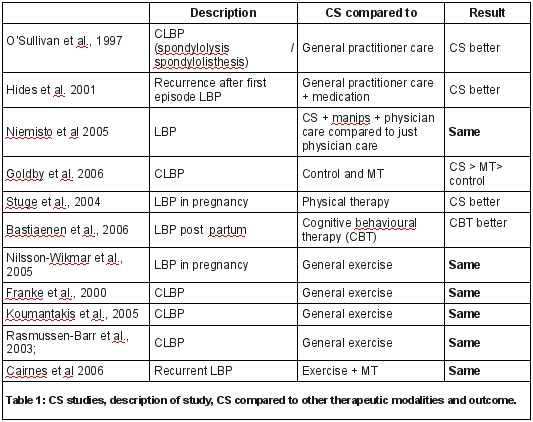
However an interesting trend emerges when CS exercise are compared to general exercise (Table 1). Both exercise approaches are demonstrated to be equally effective [82, 95-101]. Systematic reviews repeat this message [102].
These studies strongly suggest that improvements are due to the positive effects that physical exercise may have on the patient rather than on improvements in spinal stability (it is known that general exercise can also improve CLBP [95, 96])
So why give the patient complex exercise regimes that will both be expensive and difficult to maintain? Indeed it is now recommended that patients should be encouraged to maintain their own preferred exercise regime or given exercise that they are more likely to enjoy. This of course could include CS exercise. But the patient should be informed that it is only as effective as any other exercise.

- Core Stability Study Comparison
CS in relation to etiology of back pain
Why has CS not performed better than any other exercise? In part, due to all the issues that have been discusses above. More importantly, in the last decade our understanding of the etiology of back pain has dramatically changed. Psychological and psychosocial factors have become important risk and prognostic factors for the onset of acute back pain and the transition of acute to chronic pain states [103]. Genetic factors [104] and behavioural / “use of body” are also known to be contributing factors. Localised, minor asymmetries of the spine, which would include stability issues, have been reduced in their importance as contributing factors to back pain.
It is difficult to imagine how improving biomechanical factor such as spinal stabilisation can play a role in reducing back pain when there are such evident psychological factors associated with this condition. Even in the behavioural / biomechanical spheres of spinal pain it is difficult to imagine how CS can act as prevention or cure. This can be clarified by grouping potential causes for back injury into two broad categories:
- Behavioural group: individuals who use their back in ways that exert excessive loads on their spine, such as bending to lift [105] or repetitive sports activities [106-108].
- Bad luck group: individuals who had suffered a back injury from sudden unexpected events, such as falls or sporting injuries [107].
In the behavioural group, bending and lifting is associated with a low level increase in abdominal muscle activity, which contributes to further spinal compression [109]. In patients with CLBP lifting is associated with higher levels of trunk co-contraction and spinal loading [33]. Any further tensing of the abdominal muscle may lead to additional spinal compression. Since the spinal compression in lifting approach the margins of safety of the spine, these seemingly small differences are not irrelevant [110]. It is therefore difficult to imagine how CS can offer any additional protection to the lumbar spine during these activities.
Often in CS advice is given to patients to brace their core muscle while sitting to reduce or prevent back pain. Although sitting is not regarded as a predisposing factor for LBP, some patient with existing back pain find that standing relieves the back pain of sitting [111]. This phenomenon has been shown in CLBP patients who during sitting exhibit marked anterior loss of disc space in flexion or segmental instability [111]. Sitting, however, is associated with increased activity of abdominal muscle (when compared to standing) [112] as well as increased stress on the lumbar discs (compared to standing) [113]. Increasing the co-contraction activity of the anterior and back muscles is unlikely to offer any further protection in the patients with disc narrowing / pathology, and may even result in greater spinal compression. It is unknown whether core tensing can impede the movement of the unstable segments. This seems unlikely because even in healthy individual creep deformation of spinal structures will eventually take place during sitting [114]. The creep response is likely to be increased by further co-contraction of trunk muscles.
In the bad luck group, CS will have very little influence on the outcome of sudden unexpected trauma. Most injuries occur within a fraction of a second, before the nervous system manages to organise itself to protect the back. Often injuries are associated with factors such as fatigue [115] and over training [116]. These factors when combined with sudden, unexpected high velocity movement are often the cause of injury [107]. It is difficult to see the benefit of strong TrA, abs or maintaining a constant contraction in these muscles in injury prevention.
Potential damage with CS?
Continuous and abnormal patterns of use of the trunk muscles could also be a source of potential damage for spinal or pelvic pain conditions. It is known that when trunk muscles contract they exert a compressive force on the lumbar spine [45] and that CLBP patients tend to increase their co-contraction force during movement [44]. This results in further increases of spinal compression. The advice in CS for patients to increase their co-contraction is likely to come at a cost of increasing compression on the already sensitised spinal joints and discs [33, 63]. Another recent study examined the effects of abdominal stabilization maneuvers on the control of spine motion and stability against sudden trunk perturbations [117]. The abdominal stabilization maneuvers were – abdominal hollowing, abdominal bracing and a “natural” strategy. Abdominal hollowing was the most ineffective and did not increase stability. Abdominal bracing did improve stability but came at a cost of increasing spinal compression. The natural strategy group seems to employ the best strategy – ideal stability without excessive spinal compression.
An increase in intra-abdominal pressure could be a further complication of tensing the trunk muscles [118]. It has been estimated that in patients with pelvic girdle pain, increased intra-abdominal pressure could exert potentially damaging forces on various pelvic ligaments [119]. This study for example recommends teaching the patients to reduce their intra-abdominal pressure, i.e. no CS.
Maybe our patients should be encouraged to relax their trunk muscle rather than hold them rigid? In a study of the effects of psychological stress during lifting it was found that mental processing / stress had a large impact on the spine. It resulted in a dramatic increase in spinal compression associated with increases in trunk muscle co-contraction and less controlled movements [120].
Psychological factors such as catastrophising and somatisation are often observed in patients suffering from CLBP. One wonders if CS training colludes with these factors, encouraging excessive focusing on back pain and re-enforcing the patient’s notion that there is something seriously wrong with their back. Perhaps we should be shifting the patient’s focus away from their back. (I often stop patients doing specific back exercise).
Furthermore, CS training may shift the therapeutic focus away from the real issues that maintain the patient in their chronic state. It offers a simplistic solution to a condition that may have complex biopsychosocial factors. The issues that underline the patient’s condition may be neglected, with the patient remaining uninformed about the real causes of their condition. Under such circumstance CS training may promote chronicity.
Conclusion
Weak trunk muscles, weak abdominals and imbalances between trunk muscles groups are not pathological, just a normal variation. The division of the trunk into core and global muscle system is a reductionist fantasy, which serves only to promote CS.
Weak or dysfunctional abdominal muscles will not lead to back pain.
Tensing the trunk muscles is unlikely to provide any protection against back pain or reduce the recurrence of back pain.
Core stability exercises are no more effective than, and will not prevent injury more than, any other forms of exercise. Core stability exercises are no better than other forms of exercise in reducing chronic lower back pain. Any therapeutic influence is related to the exercise effects rather than CS issues.
There may be potential danger of damaging the spine with continuous tensing of the trunk muscles during daily and sports activities. Patients who have been trained to use complex abdominal hollowing and bracing maneuvers should be discouraged from using them.
Epilogue
Many of the issue raised in this article were known well before the emergence of CS training. It is surprising that the researchers and proponents of this method ignored such important issues. Despite a decade of extensive research in this area, it is difficult to see what contribution CS had to the understanding and care of patients suffering from back pain.
Acknowledgement
I would like to thank Jaap H van Dieen, Ian Stevens and Tom Hewetson for their help in preparing this article.
References
1. Hodges, P.W. and C.A. Richardson, Inefficient muscular stabilization of the lumbar spine associated with low back pain. A motor control evaluation of transversus abdominis. Spine, 1996. 21(22): p. 2640-50.
2. Hodges, P.W. and C.A. Richardson, Delayed postural contraction of transversus abdominis in low back pain associated with movement of the lower limb. J Spinal Disord, 1998. 11(1): p. 46-56.
3. Freeman, M.A., M.R. Dean, and I.W. Hanham, The etiology and prevention of functional instability of the foot. J Bone Joint Surg Br, 1965. 47(4): p. 678-85.
4. Jull, G.A. and C.A. Richardson, Motor control problems in patients with spinal pain: a new direction for therapeutic exercise. J Manipulative Physiol Ther, 2000. 23(2): p. 115-7.
5. Richardson, C.A., et al., The relation between the transversus abdominis muscles, sacroiliac joint mechanics, and low back pain. Spine, 2002. 27(4): p. 399-405.
6. Sapsford, R.R., et al., Co-activation of the abdominal and pelvic floor muscles during voluntary exercises. Neurourol Urodyn, 2001. 20(1): p. 31-42.
7. Hodges, P.W., et al., Contraction of the human diaphragm during rapid postural adjustments. J Physiol, 1997. 505 ( Pt 2): p. 539-48.
8. Hodges, P., et al., Intervertebral stiffness of the spine is increased by evoked contraction of transversus abdominis and the diaphragm: in vivo porcine studies. Spine, 2003. 28(23): p. 2594-601.
9. Misuri, G., et al., In vivo ultrasound assessment of respiratory function of abdominal muscles in normal subjects. Eur Respir J, 1997. 10(12): p. 2861-7.
10. Bendavid, R. and D. Howarth, Transversalis fascia rediscovered. Surg Clin North Am, 2000. 80(1): p. 25-33.
11. Gilleard, W.L. and J.M. Brown, Structure and function of the abdominal muscles in primigravid subjects during pregnancy and the immediate postbirth period. Phys Ther, 1996. 76(7): p. 750-62.
12. Fast, A., et al., Low-back pain in pregnancy. Abdominal muscles, sit-up performance, and back pain. Spine, 1990. 15(1): p. 28-30.
13. Mogren, I.M. and A.I. Pohjanen, Low back pain and pelvic pain during pregnancy: prevalence and risk factors. Spine, 2005. 30(8): p. 983-91.
14. Orvieto, R., et al., [Low-back pain during pregnancy]. Harefuah, 1990. 119(10): p. 330-1.
15. Bastiaenen, C.H., et al., Effectiveness of a tailor-made intervention for pregnancy-related pelvic girdle and/or low back pain after delivery: Short-term results of a randomized clinical trial [ISRCTN08477490]. BMC Musculoskelet Disord, 2006. 7(1): p. 19.
16. Leboeuf-Yde, C., Body weight and low back pain. A systematic literature review of 56 journal articles reporting on 65 epidemiologic studies. Spine, 2000. 25(2): p. 226-37.
17. Mizgala, C.L., C.R. Hartrampf, Jr., and G.K. Bennett, Assessment of the abdominal wall after pedicled TRAM flap surgery: 5- to 7-year follow-up of 150 consecutive patients. Plast Reconstr Surg, 1994. 93(5): p. 988-1002; discussion 1003-4.
18. Simon, A.M., et al., Comparison of unipedicled and bipedicled TRAM flap breast reconstructions: assessment of physical function and patient satisfaction. Plast Reconstr Surg, 2004. 113(1): p. 136-40.
19. Condon, R.E. and S. Carilli, The Biology and Anatomy of Inguinofemoral Hernia. Semin Laparosc Surg, 1994. 1(2): p. 75-85.
20. Berliner, S.D., Adult inguinal hernia: pathophysiology and repair. Surg Annu, 1983. 15: p. 307-29.
21. Hodges, P.W. and C.A. Richardson, Feedforward contraction of transversus abdominis is not influenced by the direction of arm movement. Exp Brain Res, 1997. 114(2): p. 362-70.
22. Cresswell, A.G., L. Oddsson, and A. Thorstensson, The influence of sudden perturbations on trunk muscle activity and intra-abdominal pressure while standing. Exp Brain Res, 1994. 98(2): p. 336-41.
23. Macdonald, D.A., G. Lorimer Moseley, and P.W. Hodges, The lumbar multifidus: Does the evidence support clinical beliefs? Man Ther, 2006. 11(4): p. 254-63.
24. Moseley, G.L., et al., The threat of predictable and unpredictable pain: differential effects on central nervous system processing? Aust J Physiother, 2003. 49(4): p. 263-7.
25. Moseley, G.L., M.K. Nicholas, and P.W. Hodges, Pain differs from non-painful attention-demanding or stressful tasks in its effect on postural control patterns of trunk muscles. Exp Brain Res, 2004. 156(1): p. 64-71.
26. Moseley, G.L. and P.W. Hodges, Reduced variability of postural strategy prevents normalization of motor changes induced by back pain: a risk factor for chronic trouble? Behav Neurosci, 2006. 120(2): p. 474-6.
27. Radebold, A., et al., Muscle response pattern to sudden trunk loading in healthy individuals and in patients with chronic low back pain. Spine, 2000. 25(8): p. 947-54.
28. Richardson, C.A. and G.A. Jull, Muscle control-pain control. What exercises would you prescribe? Man Ther, 1995. 1(1): p. 2-10.
29. Lederman, e., The science and practice of manual therapy. 2nd ed. 2005, London: Elsevier.
30. O’Sullivan, P.B., Lumbar segmental ‘instability’: clinical presentation and specific stabilizing exercise management. Man Ther, 2000. 5(1): p. 2-12.
31. Hubley-Kozey, C.L. and M.J. Vezina, Differentiating temporal electromyographic waveforms between those with chronic low back pain and healthy controls. Clin Biomech (Bristol, Avon), 2002. 17(9-10): p. 621-9.
32. Arena, J.G., et al., Electromyographic recordings of low back pain subjects and non-pain controls in six different positions: effect of pain levels. Pain, 1991. 45(1): p. 23-8.
33. Marras, W.S., et al., Functional impairment as a predictor of spine loading. Spine, 2005. 30(7): p. 729-37.
34. Nouwen, A., P.F. Van Akkerveeken, and J.M. Versloot, Patterns of muscular activity during movement in patients with chronic low-back pain. Spine, 1987. 12(8): p. 777-82.
35. van Dieen, J.H., J. Cholewicki, and A. Radebold, Trunk muscle recruitment patterns in patients with low back pain enhance the stability of the lumbar spine. Spine, 2003. 28(8): p. 834-41.
36. Shirado, O., et al., Concentric and eccentric strength of trunk muscles: influence of test postures on strength and characteristics of patients with chronic low-back pain. Arch Phys Med Rehabil, 1995. 76(7): p. 604-11.
37. McGill, S.M., et al., Coordination of muscle activity to assure stability of the lumbar spine. J Electromyogr Kinesiol, 2003. 13(4): p. 353-9.
38. Cordo, P.J., et al., The sit-up: complex kinematics and muscle activity in voluntary axial movement. J Electromyogr Kinesiol, 2003. 13(3): p. 239-52.
39. Moseley, G.L., P.W. Hodges, and S.C. Gandevia, External perturbation of the trunk in standing humans differentially activates components of the medial back muscles. J Physiol, 2003. 547(Pt 2): p. 581-7.
40. Urquhart, D.M. and P.W. Hodges, Differential activity of regions of transversus abdominis during trunk rotation. Eur Spine J, 2005. 14(4): p. 393-400.
41. Urquhart, D.M., et al., Abdominal muscle recruitment during a range of voluntary exercises. Man Ther, 2005. 10(2): p. 144-53.
42. Andersson, E.A., et al., EMG activities of the quadratus lumborum and erector spinae muscles during flexion-relaxation and other motor tasks. Clin Biomech (Bristol, Avon), 1996. 11(7): p. 392-400.
43. White, S.G. and P.J. McNair, Abdominal and erector spinae muscle activity during gait: the use of cluster analysis to identify patterns of activity. Clin Biomech (Bristol, Avon), 2002. 17(3): p. 177-84.
44. Cholewicki, J., M.M. Panjabi, and A. Khachatryan, Stabilizing function of trunk flexor-extensor muscles around a neutral spine posture. Spine, 1997. 22(19): p. 2207-12.
45. van Dieen, J.H., I. Kingma, and P. van der Bug, Evidence for a role of antagonistic cocontraction in controlling trunk stiffness during lifting. J Biomech, 2003. 36(12): p. 1829-36.
46. Hides, J.A., et al., Evidence of lumbar multifidus muscle wasting ipsilateral to symptoms in patients with acute/subacute low back pain. Spine, 1994. 19(2): p. 165-72.
47. Mannion, A.F., et al., [Increase in strength after active therapy in chronic low back pain (CLBP) patients: muscular adaptations and clinical relevance]. Schmerz, 2001. 15(6): p. 468-73.
48. Mannion, A.F., et al., Active therapy for chronic low back pain part 1. Effects on back muscle activation, fatigability, and strength. Spine, 2001. 26(8): p. 897-908.
49. Ng, J.K., et al., Fatigue-related changes in torque output and electromyographic parameters of trunk muscles during isometric axial rotation exertion: an investigation in patients with back pain and in healthy subjects. Spine, 2002. 27(6): p. 637-46.
50. Ng, J.K., et al., EMG activity of trunk muscles and torque output during isometric axial rotation exertion: a comparison between back pain patients and matched controls. J Orthop Res, 2002. 20(1): p. 112-21.
51. Helewa, A., et al., An evaluation of four different measures of abdominal muscle strength: patient, order and instrument variation. J Rheumatol, 1990. 17(7): p. 965-9.
52. Helewa, A., C.H. Goldsmith, and H.A. Smythe, Measuring abdominal muscle weakness in patients with low back pain and matched controls: a comparison of 3 devices. J Rheumatol, 1993. 20(9): p. 1539-43.
53. Horton, J.F., D.M. Lindsay, and B.R. Macintosh, Abdominal muscle activation of elite male golfers with chronic low back pain. Med Sci Sports Exerc, 2001. 33(10): p. 1647-54.
54. Hubley-Kozey, C.L. and M.J. Vezina, Muscle activation during exercises to improve trunk stability in men with low back pain. Arch Phys Med Rehabil, 2002. 83(8): p. 1100-8.
55. Vezina, M.J. and C.L. Hubley-Kozey, Muscle activation in therapeutic exercises to improve trunk stability. Arch Phys Med Rehabil, 2000. 81(10): p. 1370-9.
56. Souza, G.M., L.L. Baker, and C.M. Powers, Electromyographic activity of selected trunk muscles during dynamic spine stabilization exercises. Arch Phys Med Rehabil, 2001. 82(11): p. 1551-7.
57. Sung, P.S., Multifidi muscles median frequency before and after spinal stabilization exercises. Arch Phys Med Rehabil, 2003. 84(9): p. 1313-8.
58. Stevens, V.K., et al., The effect of increasing resistance on trunk muscle activity during extension and flexion exercises on training devices. J Electromyogr Kinesiol, 2006.
59. Stevens, V.K., et al., Electromyographic activity of trunk and hip muscles during stabilization exercises in four-point kneeling in healthy volunteers. Eur Spine J, 2006.
60. Kavcic, N., S. Grenier, and S.M. McGill, Determining the stabilizing role of individual torso muscles during rehabilitation exercises. Spine, 2004. 29(11): p. 1254-65.
61. Hodges, P.W., et al., Three dimensional preparatory trunk motion precedes asymmetrical upper limb movement. Gait Posture, 2000. 11(2): p. 92-101.
62. Cholewicki, J., P.C. Ivancic, and A. Radebold, Can increased intra-abdominal pressure in humans be decoupled from trunk muscle co-contraction during steady state isometric exertions? Eur J Appl Physiol, 2002. 87(2): p. 127-33.
63. Brown, S.H., F.J. Vera-Garcia, and S.M. McGill, Effects of abdominal muscle coactivation on the externally preloaded trunk: variations in motor control and its effect on spine stability. Spine, 2006. 31(13): p. E387-93.
64. Georgopoulos, A.P., Neural aspects of cognitive motor control. Curr Opin Neurobiol, 2000. 10(2): p. 238-41.
65. Luscher, H.R. and H.P. Clamann, Relation between structure and function in information transfer in spinal monosynaptic reflex. Physiol Rev, 1992. 72(1): p. 71-99.
66. Beith, I.D. and P.J. Harrison, Stretch reflexes in human abdominal muscles. Exp Brain Res, 2004. 159(2): p. 206-13.
67. Cholewicki, J., et al., Neuromuscular function in athletes following recovery from a recent acute low back injury. J Orthop Sports Phys Ther, 2002. 32(11): p. 568-75.
68. Carpenter, D.M. and B.W. Nelson, Low back strengthening for the prevention and treatment of low back pain. Med Sci Sports Exerc, 1999. 31(1): p. 18-24.
69. Barker, K.L., D.R. Shamley, and D. Jackson, Changes in the cross-sectional area of multifidus and psoas in patients with unilateral back pain: the relationship to pain and disability. Spine, 2004. 29(22): p. E515-9.
70. Pool-Goudzwaard, A.L., et al., Relations between pregnancy-related low back pain, pelvic floor activity and pelvic floor dysfunction. Int Urogynecol J Pelvic Floor Dysfunct, 2005. 16(6): p. 468-74.
71. Leinonen, V., et al., Back and hip extensor activities during trunk flexion/extension: effects of low back pain and rehabilitation. Arch Phys Med Rehabil, 2000. 81(1): p. 32-7.
72. Beith, I.D., R.E. Synnott, and S.A. Newman, Abdominal muscle activity during the abdominal hollowing manoeuvre in the four point kneeling and prone positions. Man Ther, 2001. 6(2): p. 82-7.
73. Urquhart, D.M., P.W. Hodges, and I.H. Story, Postural activity of the abdominal muscles varies between regions of these muscles and between body positions. Gait Posture, 2005. 22(4): p. 295-301.
74. Roels, B., et al., Specificity of VO2MAX and the ventilatory threshold in free swimming and cycle ergometry: comparison between triathletes and swimmers. Br J Sports Med, 2005. 39(12): p. 965-8.
75. Karst, G.M. and G.M. Willett, Effects of specific exercise instructions on abdominal muscle activity during trunk curl exercises. J Orthop Sports Phys Ther, 2004. 34(1): p. 4-12.
76. Stanton, R., P.R. Reaburn, and B. Humphries, The effect of short-term Swiss ball training on core stability and running economy. J Strength Cond Res, 2004. 18(3): p. 522-8.
77. Beilock, S.L., et al., When paying attention becomes counterproductive: impact of divided versus skill-focused attention on novice and experienced performance of sensorimotor skills. J Exp Psychol Appl, 2002. 8(1): p. 6-16.
78. McNevin, N.H., G. Wulf, and C. Carlson, Effects of attentional focus, self-control, and dyad training on motor learning: implications for physical rehabilitation. Phys Ther, 2000. 80(4): p. 373-85.
79. McNevin, N.H., C.H. Shea, and G. Wulf, Increasing the distance of an external focus of attention enhances learning. Psychol Res, 2003. 67(1): p. 22-9.
80. Wulf, G., et al., Enhancing the learning of sport skills through external-focus feedback. J Mot Behav, 2002. 34(2): p. 171-82.
81. Wulf, G., et al., Attentional focus on suprapostural tasks affects balance learning. Q J Exp Psychol A, 2003. 56(7): p. 1191-211.
82. Reeves, N.P., et al., The effects of trunk stiffness on postural control during unstable seated balance. Exp Brain Res, 2006. 174(4): p. 694-700.
83. van Dieen, J.H., M.J. Hoozemans, and H.M. Toussaint, Stoop or squat: a review of biomechanical studies on lifting technique. Clin Biomech (Bristol, Avon), 1999. 14(10): p. 685-96.
84. Kingma, I., et al., Foot positioning instruction, initial vertical load position and lifting technique: effects on low back loading. Ergonomics, 2004. 47(13): p. 1365-85.
85. Lay, B.S., et al., Practice effects on coordination and control, metabolic energy expenditure, and muscle activation. Hum Mov Sci, 2002. 21(5-6): p. 807-30.
86. Minetti, A.E., Passive tools for enhancing muscle-driven motion and locomotion. J Exp Biol, 2004. 207(Pt 8): p. 1265-72.
87. Anderson, T., Biomechanics and running economy. Sports Med, 1996. 22(2): p. 76-89.
88. Kibler, W.B., J. Press, and A. Sciascia, The role of core stability in athletic function. Sports Med, 2006. 36(3): p. 189-98.
89. Helewa, A., et al., Does strengthening the abdominal muscles prevent low back pain–a randomized controlled trial. J Rheumatol, 1999. 26(8): p. 1808-15.
90. Nadler, S.F., et al., Hip muscle imbalance and low back pain in athletes: influence of core strengthening. Med Sci Sports Exerc, 2002. 34(1): p. 9-16.
91. O’Sullivan, P.B., et al., Evaluation of specific stabilizing exercise in the treatment of chronic low back pain with radiologic diagnosis of spondylolysis or spondylolisthesis. Spine, 1997. 22(24): p. 2959-67.
92. Hides, J.A., G.A. Jull, and C.A. Richardson, Long-term effects of specific stabilizing exercises for first-episode low back pain. Spine, 2001. 26(11): p. E243-8.
93. Goldby, L.J., et al., A randomized controlled trial investigating the efficiency of musculoskeletal physiotherapy on chronic low back disorder. Spine, 2006. 31(10): p. 1083-93.
94. Stuge, B., et al., The efficacy of a treatment program focusing on specific stabilizing exercises for pelvic girdle pain after pregnancy: a two-year follow-up of a randomized clinical trial. Spine, 2004. 29(10): p. E197-203.
95. Ariyoshi, M., et al., Efficacy of aquatic exercises for patients with low-back pain. Kurume Med J, 1999. 46(2): p. 91-6.
96. van der Velde, G. and D. Mierau, The effect of exercise on percentile rank aerobic capacity, pain, and self-rated disability in patients with chronic low-back pain: a retrospective chart review. Arch Phys Med Rehabil, 2000. 81(11): p. 1457-63.
97. Cairns, M.C., N.E. Foster, and C. Wright, Randomized controlled trial of specific spinal stabilization exercises and conventional physiotherapy for recurrent low back pain. Spine, 2006. 31(19): p. E670-81.
98. Nilsson-Wikmar, L., et al., Effect of three different physical therapy treatments on pain and activity in pregnant women with pelvic girdle pain: a randomized clinical trial with 3, 6, and 12 months follow-up postpartum. Spine, 2005. 30(8): p. 850-6.
99. Franke, A., et al., [Acupuncture massage vs Swedish massage and individual exercise vs group exercise in low back pain sufferers–a randomized controlled clinical trial in a 2 x 2 factorial design]. Forsch Komplementarmed Klass Naturheilkd, 2000. 7(6): p. 286-93.
100. Koumantakis, G.A., P.J. Watson, and J.A. Oldham, Supplementation of general endurance exercise with stabilisation training versus general exercise only. Physiological and functional outcomes of a randomised controlled trial of patients with recurrent low back pain. Clin Biomech (Bristol, Avon), 2005. 20(5): p. 474-82.
101. Rasmussen-Barr, E., L. Nilsson-Wikmar, and I. Arvidsson, Stabilizing training compared with manual treatment in sub-acute and chronic low-back pain. Man Ther, 2003. 8(4): p. 233-41.
102. van Tulder, M., et al., Exercise therapy for low back pain: a systematic review within the framework of the cochrane collaboration back review group. Spine, 2000. 25(21): p. 2784-96.
103. Hasenbring, M., D. Hallner, and B. Klasen, [Psychological mechanisms in the transition from acute to chronic pain: over- or underrated?]. Schmerz, 2001. 15(6): p. 442-7.
104. MacGregor, A.J., et al., Structural, psychological, and genetic influences on low back and neck pain: a study of adult female twins. Arthritis Rheum, 2004. 51(2): p. 160-7.
105. Gallagher, S., et al., Torso flexion loads and the fatigue failure of human lumbosacral motion segments. Spine, 2005. 30(20): p. 2265-73.
106. Reid, D.A. and P.J. McNair, Factors contributing to low back pain in rowers. Br J Sports Med, 2000. 34(5): p. 321-2.
107. Fairclough, J.A., R. Evans, and G.A. Farquhar, Mechanisms of injury–a pictorial record. Br J Sports Med, 1986. 20(3): p. 107-8.
108. Renström, P., An introduction to chronic overuse injuries. In: Oxford Textbook of Sports Medicine (ed. Harries et al.). Oxford: Oxford University Press., 1996: p. pp 531 – 545.
109. de Looze, M.P., et al., Abdominal muscles contribute in a minor way to peak spinal compression in lifting. J Biomech, 1999. 32(7): p. 655-62.
110. Biggemann, M., D. Hilweg, and P. Brinckmann, Prediction of the compressive strength of vertebral bodies of the lumbar spine by quantitative computed tomography. Skeletal Radiol, 1988. 17(4): p. 264-9.
111. Maigne, J.Y., et al., Pain immediately upon sitting down and relieved by standing up is often associated with radiologic lumbar instability or marked anterior loss of disc space. Spine, 2003. 28(12): p. 1327-34.
112. Snijders, C.J., et al., Oblique abdominal muscle activity in standing and in sitting on hard and soft seats. Clin Biomech (Bristol, Avon), 1995. 10(2): p. 73-78.
113. Harrison, D.D., et al., Sitting biomechanics part I: review of the literature. J Manipulative Physiol Ther, 1999. 22(9): p. 594-609.
114. Hedman, T.P. and G.R. Fernie, Mechanical response of the lumbar spine to seated postural loads. Spine, 1997. 22(7): p. 734-43.
115. Gabbett, T.J., Reductions in pre-season training loads reduce training injury rates in rugby league players. Br J Sports Med, 2004. 38(6): p. 743-9.
116. Smith, L.L., Tissue trauma: the underlying cause of overtraining syndrome? J Strength Cond Res, 2004. 18(1): p. 185-93.
117. Vera-Garcia, F.J., et al., Effects of abdominal stabilization maneuvers on the control of spine motion and stability against sudden trunk perturbations. J Electromyogr Kinesiol, 2006.
118. Cresswell, A.G., P.L. Blake, and A. Thorstensson, The effect of an abdominal muscle training program on intra-abdominal pressure. Scand J Rehabil Med, 1994. 26(2): p. 79-86.
119. Mens, J., et al., Possible harmful effects of high intra-abdominal pressure on the pelvic girdle. J Biomech, 2006. 39(4): p. 627-35.
120. Davis, K.G., et al., The impact of mental processing and pacing on spine loading: 2002 Volvo Award in biomechanics. Spine, 2002. 27(23): p. 2645-53.

Comments on this entry are closed.
Hi Drew,
Thanks for publishing Professor Lederman’s research article I am surprised that no one to this point has commented. What I found from Professor Lederman’s article was that with all the claims of Core Stability Training” (CST) that no scientific studies have backed up many of the claims made by the “tummy tuck specialists”. And of the one or two studies conducted world wide they clearly showed NO benefits from doing “CST”. Core Stability Training has no measureing tools that can accurately measure “Timing” “Activation” and so on. At best CST claims could only be described as speculation or opinions without scientific basis/support.
Arthur Jones spent 50 years trying to come up with accurate measuring tools to measure strength. Therefore it should not be too much to ask the CST gurus to do the same – develop measuring tools.
My feedback from many trainees is that they are sick and tired of spending an hour personal training session doing circus tricks on a swiss ball, tummy tucking, activating TA and so on.
I am training a 24 year old lad who spent six months training 3 x per week with a PT the whole hour doing only “Core Stability” becuase he had to strengthen his “CORE” before he could undertake weights. Four months later doing one HIT session per week his strength gains have been nothing short of amazing and not one CST exercise.
Steve,
The popularity of “core stability” training is just another an indication of how utterly clueless most people are about proper exercise. I’ve worked with a lot of people with a variety of back problems including some pretty severe ones (one grade three spondylolisthesis) and all improved considerably with basic, brief high intensity training routines made up of conventional machine and free weight exercises. No balance balls, Bosu, wobble boards, twist boards, or any other circus nonsense.
Drew, I have an unrelated question. Have been reading of late the work of Art Devany and was interested in his take on not going to failure. He believes (hopefully paraphrasing accurately) that going to failure in a continuous set, results in failing because of the buildup of lactic acid rather than true muscular failure. His suggestion which he calls alactic sets, but seems almost exactly like rest pause to me, allows a few seconds between reps for lactic acid to (dissipate?) Do you believe his explanation is scientifically accurate? I believe your upcoming book will deal with rest pause fairly significantly, and of course Mike Mentzer and others brought it up for similar reasons years ago.
Richard,
While rest-pause would allow the lactic acid to be carried away from the working muscles more efficiently, it is not lactic acid buildup that causes muscle failure. It is more likely that muscle failure occurs as a result of increases in inorganic phosphate from the breakdown of creatine phosphate.
Ok, so does that make working to failure less productive then rest pause, as Mr. Devany suggests? thanks for your input.
Training to failure and performing rest-pause are not mutually exclusive. Failure occurs during a rest-pause set when it is impossible to perform another repetition in proper form after the prescribed rest period. Whether rest-pause is better than continuous loading depends on the goal. In the rest-pause experiment I performed with identical twins the twin performing rest-pause had a greater increase in strength, while the twin performing continuous repetitions had a greater increase in muscular endurance.
Mr. Baye, for the purpose of hypertrophy, isn’t it important to provide a local hormonal/chemical environment that is more occlusive in nature which rest-pause would hinder?
Not at all. Where hypertrophy is concerned tension is far, far more important, and with rest-pause a much heavier weight can be used. In his book on Max Stim training, a variation on rest-pause, Dan Moore presented a large amount of research which suggested certain aspects of fatigue may interfere with rather than contribute to a greater hypertrophic response. While I am aware of some Japanese studies which produced significant hypertrophy with occlusion at lower training loads, my experience training clients with rest-pause has been it produces greater strength and hypertrophy increases than continuous reps.
Mr. Baye, in your past training/coaching experience what level of load is necessary to produce hypertrophy changes? Do you find that it is the amount of the load that is significant or the way the load is utilized? Can lesser loads be used to produce significant gains?
In my experience the best increases in strength and size have come from negative-only and rest pause training, which allows the use of heavier weight than regular repetitions. The method of lifting and the load used are related, and are both important. This is discussed more detail in the upcoming book on HIT and mass gains.
Just to build upon what I have asked previous, which cadence, if you found it important, do you recommend in your training for hypertrophy? And I know we each have a different physiology in regards to recovery but in general what have you found is the optimal number of times per week to work a bodypart? There does tend to be a wide range of opinions. Also, hoping I am not being too demanding of your time, if you have a trainee who has problems with higher loads, do you alter the type of training and if you do, how would you organize there program?
I recommend people move just slowly enough to be able to maintain proper body positioning and alignment, to be able to maintain the proper path of movement, to be able to turnaround smoothly between the positive and negative with no jerking, heaving or bouncing, and to be able to focus on contracting the target muscles. For most exercises, 2 to 4 seconds is slow enough so I recommend 3/3 as an average cadence.
Ideal frequency per muscle group not only varies between individuals, but may even vary between muscle groups for a particular individual. Part of the reason there is such a wide range of opinions is because people tend to recommend what has worked best for them, and what works best will vary considerably between individuals. How to figure out the best frequency per muscle group for an individual is covered in detail in the book.
If a trainee was having problems with a higher load the changes would depend on the type of problem. If the loads are too heavy for an individual it could cause problems with form, joint pain, difficulty achieving target rep range, etc. What specific type of problem were you wondering about?
Hi Drew,
I recently purchased Bill DeSimone Moment Arm Exercise book, Bill uses the term “Congruence”, “If the Resistance torque of an exercise is congruent with muscle torque of the targeted muscles, that is a good exercise. I would describe many functional type movements as “incongruent”.
In one of our National Newsapapers an article appeared called “Bust a move: Perfect Your Technique”, one of the exercises is called Band Rows (standing, feet shoulder width apart), Point 3 – Leaning back as you pull – This is an indication that you core muscles are not stabilising you through the movement. Ensure your core is engaged from the start.
In Moment Arm Exercises Standing Bicep Curl exercises Bill suggests a “semi-squat or split stance to help minimise the shift foward of your centre of gravity and relieve some effort from the deep back.”
Bill also outlines “Congruent Row Variations” one method Bill outlines, “positioning the torso to work with the deep muscles to oppose the line of resistance”.
In Professor Lederman paper he mentions re-examining some basic assumptions made in relation to “Core Stability”.
My questions, how much more strength would be required by the abdominals and TrA to stablise the upperbody in the standing Band Rows? Or to overcome the technique problem as outlined in the Band Rows could it be that simple to use a split stance to help maintain your centre of gravity.
The above article is not a one off by the author every week similar articles appear on Functional movement exercises and “Core Stability”.
What I see is that many people are being encouraged to do do lots of “Incongruent Exercises”, lots of inefficent and lots of ineffective exercises and The “Myth of Core Stability” continues.
what do you think o fthis thought that i came across re training fast twitch muscle fibers: ” REMEMBER “superslow” lifting? Forget it. A Boston University study led by Roger A. Fielding, Ph.D., found that performing rapid contractile movements–such as a speedy upstroke on a leg extension–brings back your thick, powerful fast-twitch muscle fibers more quickly. Unlike the smoother, aerobically oriented slow-twitch fibers, the fast-twitch variety will wither substantially by 50; without stimulation, they can virtually disappear in old age.
AMONG A TEST group of seniors, Fielding discovered that superfast contractions stimulated far greater fast-twitch fiber size and peak power output than slow contractions.
So hit the triceps, as it is predominantly (90%) composed of fast-twitch fibers, says Michael Bemben, Ph.D., director of the Neuromuscular Research Lab at the University of Oklahoma. Also, pound calves and forearms, which wither quickly for another reason: They’re routinely stressed less than muscles nearer the body’s core.”
Mark,
I’d have to see the full text of the study to be able to provide a detailed response, but overall, it is bullshit. It is unnecessary to move quickly to recruit fast twitch muscle fibers. If a heavy enough weight is used, all motor units are recruited very early in an exercise regardless of the speed of movement, and a slow speed of movement is safer and provides more consistent tension over the full range of the exercise. Moving quickly during exercise will not produce better results, and is more likely to produce injury, especially in the elderly.
Hi Drew,
I agree with your comments on the study above – outright “bullshit” it just goes to show that a Ph.D doesn’t mean you know much about “exercise”.
Lance Armstrong is currently in Australia bike racing, an article called “The Power Within” appeared in one of our national newspapers outlining his HR, VO2 max, muscular leg power, and the amount of watts he can produce. Lance Armstrong holds legendary status as an endurance athlete and I would never attempt to lessen his legendary status as an endurance athlete.
Doug McGuff in BBS “Global Metabolic Conditioning” (p.38-39), Greg Anderson in his article has addressed the Cardiovascular/VO2 max testing procedures. Doug McGuff statyed that, “The problem with VO2 max testing is that when your only tool is a hammer, the whole world becomes a nail”. I presume that all Lance Armstrongs Cardiovasular/VO2 testing is done on a bike.
The other point that I wanted to make from the article in this is statement, “Through the years of training, Armstrong muscles changed from 60 percent slow-twitch fibre to 80 percent”. Besides the endurance training required for ridng in races like the Tour De France I would presume that Lance Armstrong must do a lot of high power output training on leg extension machines but his muscles fibers are converting to slow twitch – to me the newspapaer article inferring that it is better to have more slow twtich fibers” – “confusing” is it better to have slow twitch or fast twitch fibers?
The newspaper article also states “A Better Alternative energy source? “If the electricity created by Armstrong’s 500 watts of power output over 20 minutes was converted to energy for you household he could power.” (many household appliances)…”When riding uphill Armstrong can generate almost 500 watts of power over 20 minutes. A healthy 25 year old can exert the same wattage over almost 30 seconds. A typical fit sportsman might be able to exert that pressure for three minutes before reachinjg the fail point”.
Is Lance Armstrong’s peak power output from slow contractions or from fast contractions – endurance is supposed to based on slow steady state training but here we have an athlete with something like 1000 times more peak power output than the average person. Is peak power output from slow twitch fibers or fast twitch fibers? I wonder if Roger Fielding could answer?
Thanks
Hey drew I’m studying for my NASM certification and they say its good to train the stabilizers in a periodized manner because they said studies showed that when when you train your ligaments and stabilizers to increase neuromuscular efficiency it allows for better motor recruitment of muscle fibers for later on hypertrophy phase. Is this true?
Alex,
No, this is not true. There is no need to periodize or perform a specific training phase to improve neuromuscular efficiency. If you simply train to get stronger everything else will improve along with that (neuromuscular efficiency, local muscular endurance/stamina, power, speed, hypertrophy, etc.).
Thanks so much for this post Drew, this ‘core stability’ language has infected so many gyms and trainers. Check out this guy, no ‘engaging the core’ here: http://m.youtube.com/watch?v=2_AFNSdbH7o&desktop_uri=%2Fwatch%3Fv%3D2_AFNSdbH7o
Jason,
Like most of what’s popular in the fitness industry and personal training it has more to do with marketing than science. A person gets all the “core stability” training they need doing the basic squatting, pulling, and pushing movements.
I shared much of this article with my wife, after a discussion of using yoga ball in classrooms to help students develop ‘core strength’. The paragraph of interest came to be this…
“In a recent study, the effects of a cognitive-behavioural approach were compared with standard physiotherapy on pelvic and lower back pain immediately after delivery [15]. An interesting aspect of this research was that out 869 pregnant women who were recruited for the study, 635 were excluded because of their spontaneous unaided recovery within a week of delivery. This would have been during a period, well before the abdominal muscles had time to return to their pre-pregnancy length, strength or control [11]. Yet, this was a period when back pain was dramatically reduced. How can it be that back and pelvic pain is improving during a period of profound abdominal muscle inefficiency? Why does the spine not collapse? Has the relationship between abdominal muscles and spinal stability been over-emphasised?”
After sharing this with my wife, she pointed out that perhaps a large number of these 635 women who withdrew from the study didn’t do so because their lower back pain subsided, but because the back pain became minor in comparison to the intensity of labory, that they were now busy with a beautiful new baby, which causes the pain to pale in comparison, they were busy nursing, and simply didn’t have time to allow some lower back pain to become an issue.
Her comments just about stopped me in my tracks. I realize that the study may have had more merit than that, but what gets overlooked is at least as important as what is focused on.
Thanks for your work.
Eric In Ithaca
Eric,
One of the biggest limitations of most research involving humans is the impossibility of accounting for, much less standardizing all of the relevant variables. However, if you have both a plausible explanation for something and the majority of studies back it up, you can be reasonably confident in it.
As for using them to develop core strength, it is important to remember that strengthening a muscle requires working it harder than it is accustomed to, the higher the relative effort the more effective the stimulus. Simply doing something that involves a muscle isn’t the same as working the muscle, and this is the flaw in the belief that instability training and the use of things like balls and bosu makes exercise more effective. Sitting on a ball might ensure one maintains good posture, but it would not be an effective way to build core strength.
If people want core strength they need to perform exercises that work the muscles which flex, extend, and rotate the trunk the same as the rest of their muscles – hard and progressively. Sitting on a ball is no more effective for strengthening your trunk muscles than standing (balancing on your feet) is for strengthening your legs.